
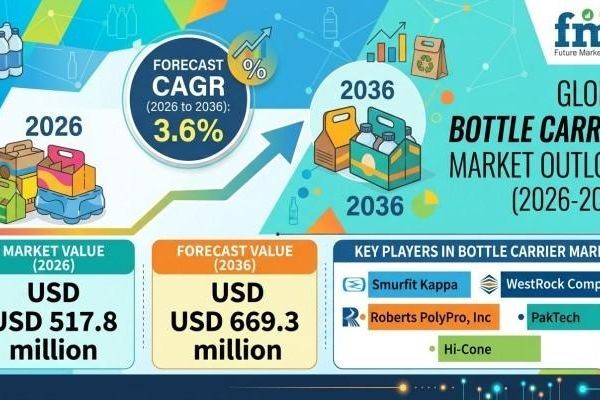
The global bottle carrier market is experiencing consistent growth as sustainability mandates, evolving packaging regulations, and the rapid expansion of e-commerce continue to transform packaging procurement strategies across beverage, food, pharmaceutical, and consumer goods sectors.
Valued at USD 504.7 million in 2025, the bottle carrier market is projected to reach USD 517.8 million in 2026 and further expand to USD 669.3 million by 2036, registering a CAGR of 2.6% during the forecast period. Growing emphasis on sustainable packaging, operational efficiency, product protection, and regulatory compliance is reinforcing the importance of bottle carriers within modern packaging and logistics ecosystems.
Get detailed market forecasts, competitive benchmarking, and pricing insights:
https://www.futuremarketinsights.com/reports/sample/rep-gb-13410
Market Snapshot: Bottle Carrier Market
- Market Value (2025): USD 504.7 Million
- Market Value (2026): USD 517.8 Million
- Forecast Value (2036): USD 669.3 Million
- CAGR (2026–2036): 2.6%
- Fastest-Growing Countries: India (4.7%), China (3.7%)
- Leading Material Type: Plastic (56.9% market share in 2026)
- Dominant Capacity Segment: Below 4 Bottles (38.4% market share in 2026)
- Largest End-Use Segment: Non-Alcoholic Beverages (57.2% market share in 2026)
Sustainability and Regulatory Compliance Reshaping Demand
As governments implement stricter environmental policies and consumers increasingly favor eco-conscious products, packaging manufacturers and brand owners are revising procurement priorities. Key areas of focus include:
- Recyclable and sustainable packaging solutions
- Compliance with labeling and packaging regulations
- Improved transportation and warehousing efficiency
- Enhanced product protection throughout distribution channels
- Integration with automated packaging and fulfillment systems
Bottle carriers are increasingly serving as critical packaging components that support retail readiness, supply chain efficiency, and sustainable product distribution.
Material Innovation and Manufacturing Economics
Plastic continues to dominate the bottle carrier market and is expected to account for 56.9% of total demand in 2026, supported by:
- Well-established manufacturing infrastructure
- Competitive production costs
- Lightweight yet durable performance characteristics
- Compatibility with high-speed production environments
At the same time, manufacturers are investing heavily in recyclable polymers, paper-based alternatives, and environmentally responsible materials to meet evolving sustainability targets and regulatory requirements.
Growing Installed Base and Replacement Opportunities
Demand for bottle carriers is expanding alongside modernization initiatives across packaging operations worldwide. Major growth drivers include:
- Expansion of food and beverage production facilities
- Rising direct-to-consumer and e-commerce shipments
- Increased demand for protective secondary packaging
- Replacement of conventional packaging formats with sustainable alternatives
Emerging markets are witnessing particularly strong adoption as industrialization, urbanization, and consumer goods production continue to accelerate.
Regional Manufacturing and Supply Chain Developments
Regional production dynamics remain a key determinant of market competitiveness:
- India is benefiting from expanding industrial output and rising packaging consumption.
- China continues to leverage its strong manufacturing ecosystem and regulatory-driven packaging upgrades.
- North America and Europe are emphasizing sustainability compliance, circular economy initiatives, and packaging innovation.
Notable supply chain trends include:
- Increased preference for locally sourced packaging materials
- Investments in sustainable material technologies
- Expansion of regional manufacturing footprints
- Industry consolidation aimed at improving operational efficiencies and economies of scale
Expanding Application Across Industries
Bottle carriers are witnessing broader adoption across diverse end-use sectors, including:
- Non-alcoholic beverages
- Alcoholic beverages
- Dairy products
- Juice and soft drink packaging
- Pharmaceuticals
- Consumer packaged goods
The non-alcoholic beverage segment is expected to maintain market leadership, accounting for 57.2% of total demand in 2026 due to large-scale production volumes and extensive retail distribution networks.
Evolving Procurement Priorities
Packaging buyers increasingly evaluate suppliers based on long-term value creation and operational reliability. Key decision factors include:
- Compliance with evolving packaging regulations
- Dependable supplier relationships
- Cost-effective lifecycle performance
- Manufacturing scalability
- Distribution network strength and service capabilities
Primary buyers include beverage producers, packaging distributors, food manufacturers, consumer goods companies, and retail supply chain operators.
Operational Efficiency and Value-Added Services
To strengthen customer retention and competitive positioning, packaging manufacturers are enhancing service offerings through:
- Reliable inventory management and supply assurance
- Regional warehousing and faster delivery capabilities
- Customized packaging solutions
- Technical integration support
- Transportation and storage cost optimization
Companies with vertically integrated production and distribution networks are increasingly gaining competitive advantages.
Regulatory Landscape Supporting Sustainable Growth
Packaging regulations worldwide continue to evolve, with policymakers emphasizing:
- Plastic reduction targets
- Recyclability and circular economy objectives
- Packaging waste reduction initiatives
- Environmental labeling and compliance standards
These developments are accelerating demand for sustainable, compliant, and high-performance bottle carrier solutions across global markets.
Competitive Landscape
Leading industry participants are competing through product innovation, sustainability initiatives, manufacturing expansion, and customer-focused packaging solutions. Strategic priorities include:
- Development of eco-friendly bottle carrier designs
- Geographic expansion and production capacity investments
- Product customization and branding capabilities
- Strengthening distribution and logistics networks
- Delivering compliance-ready packaging solutions
The market is also witnessing increased partnerships, acquisitions, and portfolio diversification strategies as manufacturers seek to strengthen market presence and address evolving customer requirements.






