
The global bundling machine market is experiencing sustained growth as manufacturers increasingly invest in automated packaging technologies to enhance productivity, improve packaging consistency, and meet evolving regulatory requirements. As industrial operations become more focused on efficiency, scalability, and quality assurance, bundling machines are emerging as critical components of modern packaging infrastructure.
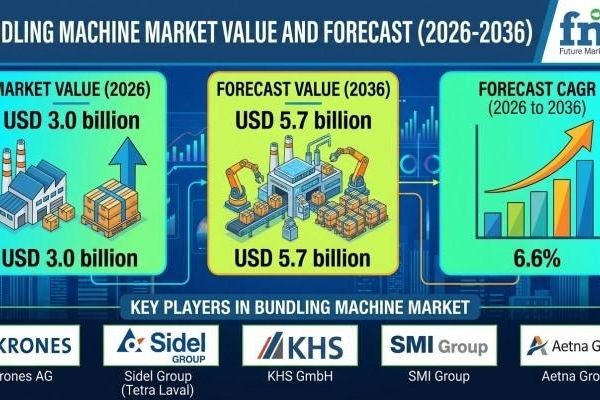
The Bundling Machine Market was valued at USD 2.8 billion in 2025 and is projected to reach USD 3.0 billion in 2026. Over the forecast period, the market is expected to expand to USD 5.7 billion by 2036, registering a CAGR of 6.6%. Rising demand for high-performance packaging systems that minimize labor dependency, streamline production workflows, and reduce operational costs continues to support market expansion.
Market Snapshot
- Market Value (2025): USD 2.8 Billion
- Market Value (2026): USD 3.0 Billion
- Forecast Value (2036): USD 5.7 Billion
- CAGR (2026–2036): 6.6%
- Fastest-Growing Markets: India (9.1%), China (7.8%), Brazil (7.2%)
Get detailed market forecasts, competitive benchmarking, and pricing trends:
https://www.futuremarketinsights.com/reports/sample/rep-gb-8876
Growing Demand Driven by Industrial Packaging Modernization
The adoption of bundling machines is increasing across food and beverage, pharmaceutical, consumer goods, logistics, and industrial manufacturing sectors. Companies are upgrading packaging facilities to achieve higher throughput, improve product protection, and comply with stricter packaging standards.
Key growth factors include:
- Rapid automation of packaging and end-of-line operations
- Rising production volumes in regulated industries
- Expansion of manufacturing facilities in emerging economies
- Greater emphasis on packaging quality, uniformity, and efficiency
Organizations are increasingly prioritizing packaging equipment that delivers long-term reliability, reduced downtime, and measurable productivity gains.
Procurement Strategies Shift Toward Lifecycle Value
Purchasing decisions for packaging machinery are evolving beyond initial capital expenditure considerations. Manufacturers are now assessing total ownership value and operational performance over the equipment lifecycle.
Key evaluation criteria include:
- Long-term production efficiency
- Equipment maintenance and servicing requirements
- Energy utilization and operating costs
- Integration with automated production environments
- Availability of technical support and spare parts
As a result, advanced bundling solutions offering scalability, automation capabilities, and dependable performance are gaining stronger market acceptance.
Automation Reshaping Packaging Operations
Automation continues to transform the bundling machine landscape as manufacturers seek higher productivity, labor optimization, and enhanced quality control.
Major automation trends include:
- Rising deployment of fully automatic bundling systems
- Integration with smart manufacturing and digital production lines
- Improved packaging precision and speed
- Reduced manual intervention and packaging defects
Fully automatic bundling machines are projected to account for 44.7% of the automation segment, highlighting growing investment in next-generation packaging infrastructure.
Technological Advancements Driving Product Innovation
Packaging equipment suppliers are introducing advanced bundling technologies designed to improve flexibility, efficiency, and operational performance.
Emerging innovation trends include:
- Growing use of shrink bundling solutions in high-volume applications
- Increased adoption of heat-seal bundling technologies
- Development of compact and energy-efficient machinery
- Enhanced durability and machine longevity
Shrink bundling machines are expected to maintain a leading market position, accounting for 46.2% of market share in 2026 due to their widespread use across industrial packaging applications.
Compliance and Quality Assurance Remain Key Investment Drivers
As packaging regulations become more stringent across industries, manufacturers are investing in advanced bundling systems to improve compliance and operational control.
Industry priorities include:
- Consistent package integrity and presentation
- Compliance with industrial and safety regulations
- Enhanced traceability and process monitoring
- Reduction of packaging waste and material losses
These requirements are particularly important within food processing, pharmaceutical manufacturing, and consumer packaged goods industries.
Competitive Landscape
The global bundling machine market remains moderately consolidated, with leading manufacturers competing through innovation, automation capabilities, and global service networks.
Key market participants include:
- Krones AG
- Sidel Group
- KHS GmbH
- SMI Group
- Aetna Group
- Schneider Packaging Equipment
- ARPAC LLC
- Robopac-Dimac
Competitive strategies focus on:
- Advanced automation and smart packaging technologies
- Expansion of manufacturing and distribution capabilities
- Strengthening aftermarket services and technical support
- Enhancing regional presence and regulatory expertise
Industry participants are also pursuing strategic partnerships, capacity expansions, and product portfolio diversification to strengthen market positioning and address evolving customer requirements across global packaging applications.
About Future Market Insights (FMI)
Future Market Insights, Inc. (FMI) is an ESOMAR-certified, ISO 9001:2015 market research and consulting organization, trusted by Fortune 500 clients and global enterprises. With operations in the U.S., UK, India, and Dubai, FMI provides data-backed insights and strategic intelligence across 30+ industries and 1200 markets worldwide.






