
A significant operational scale-up across chemical synthesis and polymer plant operations is prioritizing continuous emulsion polymerization, precise particle size distribution management, residual monomer stripping, and sustainable feedstock integration to lower total carbon footprint while maintaining stringent performance standards.
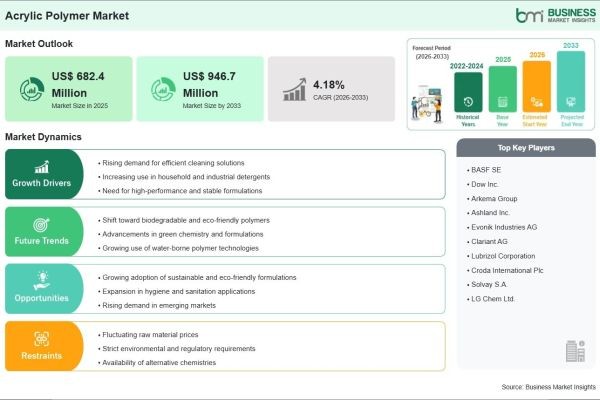
Based on market intelligence from Business Market Insights, the global Acrylic Polymer Market is anticipated to reach US$ 946.7 Million by 2033, mounting from its 2025 value of US$ 682.4 Million at a projected CAGR of 4.18% from 2026 to 2033.
Technological advancement is heavily shaping the industry landscape, with major chemical and resin manufacturers focusing on advanced emulsion polymerization, self-crosslinking acrylic systems, and renewable feedstocks. This evolution enables formulation chemists to produce adhesives, coatings, and sealants featuring exceptional UV resistance, optical clarity, weatherability, and superior adhesion across diverse substrates. Strong collaboration between chemical suppliers, coating formulators, and end-use manufacturers is accelerating the deployment of sustainable acrylic polymer solutions across global industrial markets.
Download Sample Report : https://www.businessmarketinsights.com/sample/BMIPUB00033739
What Are Acrylic Polymers?
Acrylic polymers are a group of synthetic polymers derived from acrylic acid, methacrylic acid, or their esters (such as butyl acrylate, methyl methacrylate, and ethyl acrylate). Available in water-borne emulsions, solvent-borne resins, and 100% solid powder forms, these polymers are widely recognized for their versatile chemical structure and outstanding physical properties.
The material offers essential functional advantages, including high transparency, color retention, resistance to oxidative breakdown, excellent film-forming ability, and strong tensile strength. Modern acrylic polymers serve as essential binders, thickeners, dispersants, and rheology modifiers in architectural paints, industrial coatings, pressure-sensitive adhesives, paper coatings, and personal care formulations.
Market Drivers
A primary driver of the Acrylic Polymer Market is the robust expansion of the global building and construction industry. Surging residential and commercial infrastructure developments demand high-durability architectural coatings, exterior insulation finish systems (EIFS), and eco-friendly sealants that rely heavily on acrylic polymer binders to withstand harsh weather conditions.
The rapid shift toward eco-friendly, low-VOC water-borne formulations acts as another major catalyst. Environmental regulations set by agencies such as the EPA and REACH restrict the use of solvent-based coatings and adhesives, compelling manufacturers to substitute traditional solvent systems with high-performing water-based acrylic emulsions.
Furthermore, booming demand from the packaging and pressure-sensitive adhesive (PSA) sectors is fueling market adoption. The rapid growth of e-commerce requires specialized acrylic-based packaging tapes, label adhesives, and protective films that deliver high initial tack, shear strength, and temperature stability during transit.
Market Segmentation
By Form / Type
- Water-Borne Emulsions: The dominant and fastest-growing segment, widely preferred across paints, coatings, and adhesives for its non-toxic, low-VOC profile and easy water cleanability.
- Solvent-Borne Resins: Utilized in specialized high-durability industrial coatings, marine finishes, and high-performance automotive clearcoats requiring rapid drying and extreme solvent resistance.
- 100% Solids / Powders: Applied in powder coatings, specialized construction mortars, and plastics additives where zero-solvent processing is required.
By Application
- Paints & Coatings: The largest application segment, encompassing architectural paints, automotive OEM finishes, industrial protective coatings, and wood finishes.
- Adhesives & Sealants: A major segment heavily relying on acrylic polymers for pressure-sensitive tapes, labels, construction sealants, and packaging adhesives.
- Water Treatment: Utilizing polyacrylic acid derivatives as dispersants and scale inhibitors in industrial cooling towers and desalination plants.
- Textiles & Leather: Applied as binders, back-coatings, and finishing agents to impart water repellency, durability, and soft texture.
- Personal Care & Cosmetics: Serving as thickeners, film formers, and stabilizing agents in hair gels, lotions, and skin creams.
By End-Use Industry
- Building & Construction: The largest end-user segment, utilizing acrylic resins in architectural coatings, concrete modifiers, sealants, and waterproofing membranes.
- Automotive & Transportation: Essential for durable exterior clearcoats, interior acoustic dampening materials, and lightweight plastic component finishes.
- Packaging & Paperboard: Experiencing steady growth driven by label adhesives, barrier coatings, and flexible packaging laminates.
- Consumer Goods & Textiles: Incorporating acrylic polymers for durable fabric coatings, carpets, and household products.
Regional Insights
- Asia-Pacific holds a dominant market position and is projected to expand at the fastest rate, propelled by rapid urbanization, massive infrastructure projects, and expanding automotive and textile manufacturing hubs in China, India, and Southeast Asian nations.
- North America represents a highly strategic market, supported by strong residential construction activity, high consumer demand for eco-friendly architectural coatings, and early adoption of bio-based polymer technologies.
- Europe maintains a significant share in the global market, driven by stringent environmental standards restricting volatile organic emissions and strong industrial innovation in sustainable chemistry across Germany, France, and the UK.
- Middle East & Africa is experiencing reliable growth, fueled by major urban infrastructure initiatives, commercial real estate development, and expanding water treatment facilities in the GCC region.
- South & Central America is witnessing steady market expansion as regional construction sectors modernize and domestic paint and packaging industries grow.
Top Players in the Acrylic Polymer Market
The competitive landscape features dominant global chemical corporations, specialty polymer manufacturers, and resin formulators focused on expanding manufacturing capacities, securing renewable raw materials, and developing multi-functional polymer grades.
- BASF SE
- The Dow Chemical Company
- Arkema S.A.
- Evonik Industries AG
- Covestro AG
- Solvay S.A.
- Nippon Shokubai Co., Ltd.
- DIC Corporation
- Toagosei Co., Ltd.
- Ashland Global Holdings Inc.
Technological Innovations
The integration of bio-based acrylic monomers synthesized from renewable plant sources (such as sugarcane, glycerol, and lactic acid) is transforming the acrylic polymer market. Chemical developers are successfully replacing petroleum-based acrylic acid with bio-derived drop-in equivalents, significantly reducing the carbon footprint of downstream coatings and adhesives without sacrificing performance.
Additionally, advancements in core-shell emulsion polymerization technology are enabling multi-stage acrylic particles with tailored morphological properties. These self-crosslinking acrylic emulsions provide superior scratch resistance, stain blocking, and dirt pick-up resistance, eliminating the need for hazardous external crosslinkers in architectural and wood coatings.
Future Market Outlook
The future outlook for the Acrylic Polymer Market is exceptionally strong through 2033, reinforced by the continuous global emphasis on sustainable building materials, low-emission coatings, and high-efficiency packaging. As regulatory policies worldwide mandate stricter environmental compliance, bio-based and zero-VOC water-borne acrylic systems will capture an increasing market share.
Market leaders over the coming decade will be distinguished by their ability to supply high-performance, cost-effective, and fully recyclable acrylic polymers that integrate seamlessly with next-generation smart coatings, bio-adhesives, and green construction materials.
Frequently Asked Questions (FAQs)
What is the projected size of the Acrylic Polymer Market by 2033?
The global market is projected to reach US$ 12.45 Billion by 2033, expanding from US$ 7.82 Billion in 2025.
What is the CAGR for the Acrylic Polymer Market?
The market is estimated to record a CAGR of 6.00% from 2026 to 2033.
Which form segment holds a dominant position in the market?
Water-Borne Emulsions hold the largest market share due to their eco-friendly, low-VOC profile and widespread application across paints, coatings, and adhesives.
Which region is leading market growth?
Asia-Pacific is both the largest and fastest-growing regional market, driven by rapid urbanization, major construction projects, and large-scale manufacturing activity.
What is the primary factor driving demand for acrylic polymers?
Key drivers include expanding global construction activities, strict environmental regulations favoring low-VOC water-borne coatings, and rising demand for packaging adhesives in e-commerce.
Browse More Reports:
https://www.businessmarketinsights.com/reports/e-mobility-market
https://www.businessmarketinsights.com/reports/blood-collection-market
https://www.businessmarketinsights.com/reports/critical-care-ventilators-market
About Us
Business Market Insights is a market research platform that provides subscription service for industry and company reports. Our research team has extensive professional expertise in domains such as Electronics & Semiconductor; Aerospace & Defense; Automotive & Transportation; Energy & Power; Healthcare; Manufacturing & Construction; Food & Beverage; Chemicals & Materials; and others.
Contact Us
If you have any questions about this report or would like further information, please contact us:
Contact person: Ankit Mathur
Email: sales@businessmarketinsights.com
Phone: +16467917070






