
A significant operational scale-up across ceramic powder synthesis, tape casting, high-temperature sintering, and precision laser machining is prioritizing dielectric breakdown strength, grain boundary control, low dielectric loss tangents, and stringent quality tolerance standards for microelectronics assembly.
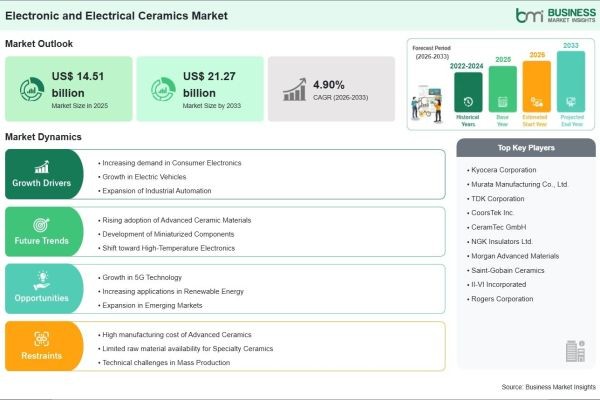
Based on market intelligence from Business Market Insights, the global Electronic and Electrical Ceramics Market is anticipated to reach US$ 21.27 Billion by 2033, mounting from its 2025 value of US$ 14.51 Billion at a projected CAGR of 4.90% from 2026 to 2033.
Technological advancement is reshaping the industry through improved material formulations, high-temperature stability, enhanced dielectric properties, and greater compatibility with miniaturized components. Manufacturers are also focusing on sustainable production methods and advanced processing techniques to meet the needs of next-generation electronics and electrical systems.
Download Sample Report : https://www.businessmarketinsights.com/sample/BMIPUB00033914
What Are Electronic and Electrical Ceramics?
Electronic and electrical ceramics are specialized ceramic materials designed to perform specific electrical, thermal, and mechanical functions in electronic devices and electrical systems. These materials are valued for their insulation properties, dielectric strength, thermal stability, and resistance to wear and corrosion.
They are widely used in capacitors, resistors, insulators, substrates, piezoelectric devices, sensors, and other critical components. Their ability to operate reliably under demanding conditions makes them essential in consumer electronics, automotive systems, power infrastructure, and industrial equipment.
Industry Drivers
A primary driver of the Electronic and Electrical Ceramics Industry is the growing demand for advanced electronic components across multiple sectors. As electronics become more sophisticated, the need for high-performance ceramic materials that support miniaturization and efficiency continues to rise.
The expansion of electric vehicles, renewable energy systems, and power electronics is another major growth factor. These applications require reliable insulation, thermal management, and high-voltage performance, all of which are supported by advanced ceramic materials.
In addition, increasing adoption of 5G, IoT, and smart devices is strengthening demand for ceramic substrates, capacitors, and sensors. These technologies depend on precise electrical performance and durability, further supporting industry growth.
Industry Segmentation
By Material Type
- Alumina Ceramics: The dominant segment, widely used for electrical insulation, substrates, and structural components.
- Zirconia Ceramics: Valued for high strength, toughness, and thermal stability.
- Titanate Ceramics: Used in capacitors and piezoelectric applications.
- Silicon Carbide Ceramics: Preferred for high-temperature and high-power applications.
- Others: Includes specialty ceramics used in niche electronic and electrical applications.
By Product Type
- Capacitors: The largest product segment, used extensively in electronic circuits and power systems.
- Resistors: Provide current control and stability in electrical devices.
- Insulators: Essential for high-voltage and power transmission applications.
- Substrates: Support semiconductor and circuit integration.
- Piezoelectric Devices: Used in sensors, actuators, and precision control systems.
- Others: Includes ceramic packages, coatings, and specialized components.
The Capacitors segment held the dominant industry share in 2025 due to widespread use in consumer electronics and industrial systems, while Substrates are expected to register strong growth with semiconductor demand.
By Application
- Consumer Electronics: The largest application segment, driven by smartphones, appliances, and digital devices.
- Automotive: Uses ceramics in sensors, ignition systems, EV components, and power electronics.
- Telecommunications: Supports 5G infrastructure, RF components, and communication devices.
- Power & Energy: Includes insulators, grid components, and renewable energy systems.
- Medical Devices: Uses ceramics in imaging, diagnostic, and therapeutic equipment.
- Others: Covers industrial, aerospace, and specialty applications.
Regional Insights
- Asia-Pacific remains the dominant and fastest-growing region, supported by strong electronics manufacturing, semiconductor production, and rising consumer demand in China, Japan, South Korea, and India.
- North America maintains a significant position, driven by advanced electronics, aerospace, and defense applications.
- Europe is a mature market with strong demand from automotive, industrial, and power infrastructure sectors.
- Middle East & Africa is witnessing gradual growth, supported by infrastructure development and industrial expansion.
- South & Central America is experiencing steady adoption as electronics and electrical manufacturing continue to expand.
Top Players in the Electronic and Electrical Ceramics Industry
The competitive landscape includes global material suppliers and component manufacturers focused on performance, reliability, and innovation.
- Murata Manufacturing Co., Ltd.
- Kyocera Corporation
- TDK Corporation
- CeramTec GmbH
- CoorsTek, Inc.
- NGK Insulators, Ltd.
- FERRO Corporation
- Steatite
- Morgan Advanced Materials
- Corning Incorporated
Leading companies are investing in advanced formulations, miniaturization technologies, and sustainable manufacturing to strengthen their position in the evolving industry.
Technological Innovations
Material innovation is transforming the industry through improved dielectric performance, higher thermal resistance, and better compatibility with miniaturized components. These advances are helping manufacturers support the next generation of electronics and power systems.
Advanced processing techniques such as tape casting, sintering optimization, and multilayer ceramic technologies are also improving product performance and manufacturing efficiency. These innovations are especially important for high-frequency, high-power, and high-reliability applications.
Future Industry Outlook
The future outlook for the Electronic and Electrical Ceramics Industry remains positive, supported by continued growth in electronics, automotive electrification, and power infrastructure. Demand is expected to strengthen as advanced ceramics become more integral to high-performance systems.
Industry leadership over the next decade will likely depend on material performance, manufacturing scalability, and the ability to support emerging technologies. Companies that can deliver reliable, high-quality, and cost-effective ceramic solutions will be best positioned to capture future growth.
Frequently Asked Questions (FAQs)
What is the main purpose of electronic and electrical ceramics?
They provide insulation, thermal stability, dielectric performance, and structural support in electronic and electrical systems.
Which material segment is dominant?
Alumina Ceramics held the dominant industry share due to widespread use in insulation and substrates.
Which product segment is dominant?
Capacitors held the dominant industry share in 2025 due to broad usage in electronics and power systems.
Which region is expected to grow the fastest?
Asia-Pacific is projected to exhibit the fastest growth and highest industry share, supported by electronics manufacturing and rising demand.
What is the primary factor driving demand?
The primary drivers are growing electronics demand, automotive electrification, and the need for high-performance ceramic materials.
Browse More Reports:
interventional radiology market
law enforcement and public safety drone market
About Us
Business Market Insights is a market research platform that provides subscription service for industry and company reports. Our research team has extensive professional expertise in domains such as Electronics & Semiconductor; Chemicals & Materials; Automotive & Transportation; Energy & Power; Manufacturing; and Technology, Media, & Telecommunications.
Contact Us
If you have any questions about this report or would like further information, please contact us:
Contact person: Ankit Mathur
Email: sales@businessmarketinsights.com
Phone: +16467917070






