
A significant operational scale-up across neurovascular device manufacturing and precision catheter extrusion is prioritizing kink-resistant shaft design, biocompatible hydrophilic coatings, radiopaque marker visibility, and micro-scale assembly integrity to ensure safe delivery through delicate cerebral microvasculature.
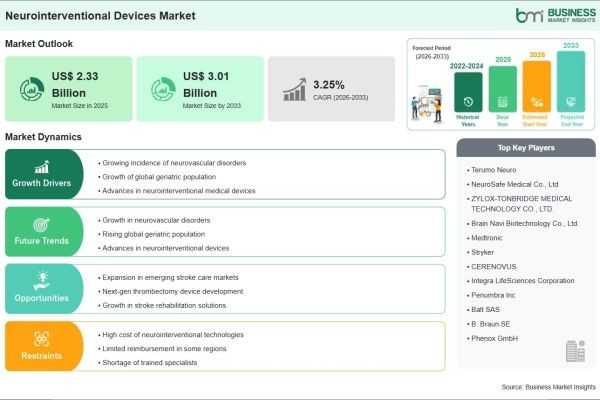
Based on market intelligence from Business Market Insights, the global Neurointerventional Devices Market is anticipated to reach US$ 3.01 Billion by 2033, mounting from its 2025 value of US$ 2.33 Billion at a projected CAGR of 3.25% from 2026 to 2033.
Technological advancement is heavily shaping the industry landscape, with major medical device manufacturers focusing on next-generation flow diverters, advanced stent retrievers, and highly trackable microcatheters. This evolution enables interventional neurologists to navigate complex, tortuous brain anatomies with unprecedented precision, minimizing procedure times and improving patient recovery rates. Strong collaboration between med-tech developers, stroke centers, and academic institutions is streamlining clinical trials and accelerating the deployment of life-saving neurovascular solutions globally.
Download Sample Report : https://www.businessmarketinsights.com/sample/BMIPUB00033651
What Are Neurointerventional Devices?
Neurointerventional devices are highly specialized, minimally invasive medical tools designed for the diagnosis and treatment of conditions affecting the central nervous system and neurovasculature. Instead of open brain surgery, these devices are navigated through the body's vascular network—typically entering through the femoral or radial artery—using real-time fluoroscopic imaging to reach the brain.
The technology offers essential functional advantages, including significantly reduced patient trauma, shorter hospital stays, and lower risks of post-operative complications. Modern neurointerventional solutions—ranging from embolic coils and flow diverters to aspiration catheters—are critical for treating acute ischemic strokes, ruptured and unruptured cerebral aneurysms, and arteriovenous malformations (AVMs), empowering healthcare systems to dramatically improve neurovascular patient outcomes.
Market Drivers
A primary driver of the Neurointerventional Devices Market is the globally rising prevalence of cerebrovascular diseases, particularly acute ischemic strokes. The aging global population, coupled with increasing rates of hypertension, diabetes, and obesity, is expanding the patient pool requiring immediate neurovascular intervention, thereby driving consistent demand for thrombectomy devices.
The widespread clinical shift toward minimally invasive endovascular procedures acts as another major catalyst. Compared to traditional surgical clipping, endovascular coiling and flow diversion offer faster recovery times and less intraoperative risk, prompting widespread preference among both patients and neurosurgeons.
Furthermore, increasing awareness and the establishment of dedicated comprehensive stroke centers worldwide are accelerating market adoption. Government and healthcare initiatives aimed at reducing the "door-to-needle" and "door-to-puncture" times are prioritizing the equipping of hospitals with advanced neurointerventional cath labs and the latest generation of clot-retrieval technologies.
Market Segmentation
By Product Type
- Thrombectomy Devices: The fastest-growing product segment, comprising stent retrievers and aspiration catheters used to physically remove blood clots in acute ischemic stroke patients.
- Embolic Coils: A dominant segment used extensively in endovascular coiling procedures to pack and isolate cerebral aneurysms, preventing rupture.
- Neurovascular Stents & Flow Diverters: Crucial devices designed to redirect blood flow away from large or wide-necked aneurysms, promoting natural vessel healing.
- Microcatheters and Guidewires: Essential access devices that provide the necessary navigation and support to deliver implants deep into the cerebral vasculature.
- Intracranial Balloons: Utilized for balloon-assisted coiling and treating intracranial stenosis.
By Pathology
- Ischemic Stroke: The largest application segment, driven by the high global incidence of stroke and the proven efficacy of mechanical thrombectomy.
- Cerebral Aneurysm: A major segment heavily reliant on embolic coils and flow diverters for both prophylactic and emergency interventions.
- Arteriovenous Malformations (AVM) and Fistulas: Requiring specialized liquid embolics and micro-coils to safely block abnormal blood vessel connections in the brain.
By End User
- Hospitals: The dominant end-user segment, equipped with specialized neuro-cath labs and multidisciplinary stroke teams required for complex interventions.
- Ambulatory Surgical Centers (ASCs): An emerging segment seeing increased adoption for routine neurovascular diagnostic procedures and minor interventions.
- Research and Academic Institutes: Focused on advancing neurovascular science and testing the next generation of neurointerventional materials.
Regional Insights
- North America maintains a dominant position in the global neurointerventional devices market, supported by a highly developed healthcare infrastructure, favorable reimbursement policies for stroke care, and rapid adoption of advanced technologies like robotics.
- Asia-Pacific is projected to be the fastest-expanding region, driven by a rapidly aging population, increasing healthcare expenditure, and concerted efforts to establish stroke networks in major countries like China, Japan, and India.
- Europe represents a highly strategic market, where established CE mark regulatory pathways and strong government-funded healthcare systems spur consistent adoption of new neurovascular treatments.
- Middle East & Africa is experiencing reliable growth, propelled by the modernization of tertiary care hospitals and increasing regional awareness of stroke management protocols.
- South & Central America is witnessing steady market adoption as regional healthcare systems slowly improve access to specialized neurosurgical care.
Top Players in the Neurointerventional Devices Market
The competitive landscape features dominant global medical device conglomerates focused on aggressive R&D, clinical trial generation, and strategic acquisitions to build comprehensive neurovascular portfolios.
- Medtronic plc
- Stryker Corporation
- Penumbra, Inc.
- MicroVention, Inc. (Terumo Corporation)
- Cerenovus (Johnson & Johnson Services, Inc.)
- Balt Group
- Phenox GmbH (Wallaby Medical)
- Asahi Intecc Co., Ltd.
Technological Innovations
The neurointerventional devices market is being transformed by the development of surface-modified implants and flow diverters. Manufacturers are coating stents and coils with anti-thrombogenic materials to reduce the risk of clot formation post-implantation, which drastically lowers the patient's reliance on long-term dual antiplatelet therapy (DAPT).
Additionally, the integration of artificial intelligence (AI) and robotic-assisted navigation is revolutionizing the field. AI-powered imaging software now helps clinicians rapidly diagnose large vessel occlusions (LVOs) and quantify salvageable brain tissue, while early-stage robotic endovascular systems promise to deliver microcatheters with sub-millimeter precision, reducing radiation exposure for the operating physician and improving overall procedural safety.
Future Market Outlook
The future outlook for the Neurointerventional Devices Market is highly optimistic, backed by continuous advancements in biomaterials and the expanding adoption of mechanical thrombectomy as a front-line treatment globally. As device profiles become smaller and more navigable, interventionalists will be able to access increasingly distal vessels in the brain, opening up new frontiers in stroke treatment through 2033.
Market leadership in the upcoming decade will depend on clinical data superiority, portfolio breadth, and physician training initiatives. Med-tech companies capable of delivering highly integrated stroke solutions—from AI diagnosis to advanced clot extraction—will secure a substantial competitive edge in the rapidly evolving neurovascular ecosystem.
Frequently Asked Questions (FAQs)
What is the projected size of the Neurointerventional Devices Market by 2033?
The global market is projected to reach US$ 5.85 Billion by 2033, rising from US$ 3.14 Billion in 2025.
What is the CAGR for the Neurointerventional Devices Market?
The market is estimated to record a CAGR of 8.10% from 2026 to 2033.
Which product segment is currently dominant?
The Thrombectomy Devices segment is currently experiencing the most rapid growth due to its status as the standard of care for acute ischemic stroke interventions.
Which region is leading the global market?
North America maintains the dominant share of the global market, heavily supported by specialized stroke centers and favorable reimbursement landscapes.
What is the primary factor driving market growth?
The primary catalysts are the globally rising incidence of ischemic stroke, the aging population, and a distinct clinical shift from open brain surgery to minimally invasive endovascular procedures.
Browse More Reports:
https://www.businessmarketinsights.com/reports/traction-transformer-market
https://www.businessmarketinsights.com/reports/wireless-fire-detection-systems-market
https://www.businessmarketinsights.com/reports/3d-food-printing-market
About Us
Business Market Insights is a market research platform that provides subscription service for industry and company reports. Our research team has extensive professional expertise in domains such as Electronics & Semiconductor; Aerospace & Defense; Automotive & Transportation; Energy & Power; Healthcare; Manufacturing & Construction; Food & Beverage; Chemicals & Materials; and others.
Contact Us
If you have any questions about this report or would like further information, please contact us:
Contact person: Ankit Mathur
Email: sales@businessmarketinsights.com
Phone: +16467917070






