
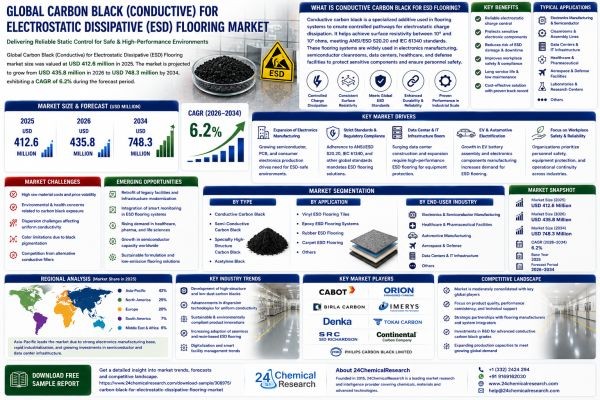
Global Carbon Black (Conductive) for Electrostatic Dissipative (ESD) Flooring market size was valued at USD 412.6 million in 2025. The market is projected to grow from USD 435.8 million in 2026 to USD 748.3 million by 2034, exhibiting a CAGR of 6.2% during the forecast period.
Conductive carbon black is a specialized additive incorporated into flooring systems to create pathways for controlled electrostatic charge dissipation. Engineered to deliver surface resistivity values typically ranging between 106 and 109 ohms, these materials meet the performance thresholds defined under ANSI/ESD S20.20 and IEC 61340 standards. ESD flooring systems utilizing conductive carbon black find extensive application across electronics manufacturing facilities, semiconductor cleanrooms, data centers, healthcare environments, and defense installations — wherever uncontrolled static discharge poses significant risks to sensitive components and personnel safety. What makes conductive carbon black particularly compelling is its long-established technical track record: formulators across polymer and resin flooring systems have relied on its consistent electrical behavior for decades, and that confidence is not easily displaced by newer alternatives that have yet to prove themselves at industrial scale.
Get Full Report Here: https://www.24chemicalresearch.com/reports/308975/carbon-black-for-electrostatic-dissipative-flooring-market
Market Dynamics:
The market's trajectory is shaped by a complex interplay of powerful growth drivers, significant restraints that are being actively addressed, and vast, untapped opportunities.
Powerful Market Drivers Propelling Expansion
- Expanding Electronics Manufacturing Infrastructure Fueling Demand for ESD-Safe Flooring Solutions: The global proliferation of electronics manufacturing facilities has created sustained and growing demand for electrostatic dissipative flooring systems, with carbon black remaining the conductive additive of choice for a significant portion of the market. As semiconductor fabrication plants, printed circuit board assembly lines, and consumer electronics production facilities expand across Asia-Pacific, North America, and Europe, the operational requirement for controlled static environments has become non-negotiable. ESD flooring incorporating conductive carbon black provides a reliable, cost-effective pathway to achieving surface resistivity values within the 106 to 109 ohms range mandated by standards such as ANSI/ESD S20.20 and IEC 61340-5-1, making it a foundational specification in cleanroom and static-sensitive manufacturing environments. The traceability and reproducibility of carbon black's conductivity profile within flooring matrices gives formulators a proven technical foundation that newer alternative additives have yet to displace at scale.
- Stringent Regulatory and Industry Standards Mandating Static Control in Critical Environments: Regulatory frameworks and industry-specific standards governing electrostatic discharge protection have evolved considerably over the past decade, compelling facility managers and flooring specifiers to invest in certified ESD flooring systems. In sectors such as aerospace, defense electronics, medical device manufacturing, and data center operations, compliance with ESD Association guidelines, MIL-STD-1686, and ISO 61340 series standards is not discretionary — it is embedded into procurement and facility design requirements. Carbon black-loaded conductive compounds in vinyl, rubber, epoxy, and polyurethane flooring formulations consistently deliver the charge-dissipation performance necessary to meet these thresholds. The data center construction boom, driven by cloud computing infrastructure investment and AI workload expansion, is directly translating into growing procurement of ESD flooring systems, with conductive carbon black-based products accounting for a substantial portion of installed raised-access and poured flooring solutions in these facilities. Beyond the electronics sector, the pharmaceutical and biotechnology industries are increasingly recognizing the risks that electrostatic discharge poses to sensitive instrumentation, flammable solvents, and precision laboratory environments — a recognition that is broadening the addressable market for ESD flooring well beyond traditional manufacturing settings.
- Growth in Automotive Electronics and EV Battery Manufacturing Creating New High-Volume Applications: The accelerating electrification of the automotive industry is generating a new wave of static-sensitive manufacturing environments. Electric vehicle battery pack assembly, power electronics integration, and advanced driver-assistance system (ADAS) component production all require robust ESD controls throughout the production floor. As automakers and Tier 1 suppliers retrofit legacy facilities and commission new gigafactory-scale plants, ESD flooring specifications are being integrated from the ground up. Carbon black-based conductive flooring compounds are well-suited to these high-traffic, heavy-load industrial environments due to their durability and resistance to mechanical abrasion — properties that more fragile intrinsically conductive polymer alternatives often cannot match under comparable operational stress. This dynamic is opening an entirely new tier of high-volume demand for conductive carbon black in flooring applications that simply did not exist a decade ago.
Download FREE Sample Report: https://www.24chemicalresearch.com/download-sample/308975/carbon-black-for-electrostatic-dissipative-flooring-market
Significant Market Restraints Challenging Adoption
Despite its promise, the market faces hurdles that must be overcome to achieve universal adoption.
- High Raw Material and Formulation Costs Constraining Adoption in Price-Sensitive Markets: While carbon black itself is a relatively accessible commodity material, the grades of conductive and semi-conductive carbon black required to achieve reliable ESD performance in flooring applications — such as furnace blacks with controlled structure and surface area characteristics — command meaningful price premiums over standard reinforcing grades used in rubber and plastics. Specialty conductive carbon black grades must deliver consistent electrical performance lot-to-lot, necessitating tighter manufacturing controls and quality specifications that are reflected in their cost. For flooring manufacturers supplying cost-driven commercial construction markets or regions with limited ESD awareness and compliance infrastructure, these material costs can compress margins and inhibit the broader specification of performance-certified ESD flooring systems in favor of lower-cost but less reliable static-dissipative alternatives.
- Environmental and Health Considerations Associated with Carbon Black Handling and Processing: Carbon black is classified by the International Agency for Research on Cancer (IARC) as a Group 2B possible human carcinogen based on evidence from inhalation studies, primarily relevant to occupational exposure during manufacturing and processing operations. This classification, while not prohibiting its use, imposes occupational health and safety obligations on flooring compound manufacturers, including engineering controls for dust containment, respiratory protection programs, and regulatory reporting requirements in jurisdictions with stringent chemical management frameworks such as REACH in the European Union. The administrative and compliance burden associated with carbon black handling, combined with growing corporate sustainability commitments, is prompting some flooring formulators to evaluate alternative conductive filler strategies — even where the technical performance case for carbon black substitution is not yet fully established. This regulatory sensitivity represents a structural restraint on market expansion, particularly in environmentally progressive markets in Northern Europe and parts of Asia-Pacific.
Critical Market Challenges Requiring Innovation
One of the most persistent technical challenges confronting carbon black-based ESD flooring manufacturers is achieving homogeneous dispersion of conductive carbon black particles within polymer matrices at production scale. Carbon black aggregates are notoriously prone to agglomeration, and inconsistent dispersion directly translates into localized variations in surface resistivity — a critical quality failure in environments where uniform charge dissipation across the entire floor plane is a safety and compliance requirement. Formulators working with vinyl composition tile, homogeneous vinyl sheet, and epoxy pour systems must invest significantly in compounding process controls, high-shear mixing equipment, and in-line quality monitoring to ensure that finished flooring products consistently achieve certified ESD performance across every square meter of production output.
Furthermore, the inherently black pigmentation of conductive carbon black imposes significant limitations on the color palette available to ESD flooring designers and specifiers. In environments where both ESD protection and workplace aesthetics are valued — such as corporate data centers, medical facilities, and technology campuses — the inability to achieve light colors, pastels, or multi-tone designs using carbon black-loaded compounds restricts market penetration. Manufacturers have partially addressed this through surface-layer lamination strategies and hybrid flooring constructions, but these approaches introduce additional manufacturing complexity and can compromise the continuity of the conductive network through the flooring cross-section. Additionally, carbon black faces increasing competitive pressure from alternative conductive fillers, including carbon nanotubes and graphene nanoplatelets, which can achieve comparable conductivity levels at lower loading concentrations — a credible medium-term competitive threat that the market cannot afford to underestimate.
Vast Market Opportunities on the Horizon
- Retrofit and Renovation of Legacy Industrial and Commercial Facilities Presents Substantial Near-Term Demand: A substantial proportion of existing electronics manufacturing, pharmaceutical production, and data center infrastructure worldwide was constructed prior to the widespread codification of current ESD flooring standards, representing a significant retrofitting opportunity for conductive carbon black-based flooring systems. As these facilities undergo scheduled refurbishment cycles, expand production capacity, or seek third-party ESD compliance certification to meet customer audit requirements, flooring replacement with certified ESD systems becomes a prioritized capital investment. Carbon black-based flooring products offer a compelling value proposition in retrofit scenarios due to their established supply chains, proven installation methodologies, and the availability of multiple format options — including tiles, sheets, and pour-in-place systems — that accommodate the constraints of live-facility renovation without extended production shutdowns.
- Integration of Smart Monitoring Technologies into ESD Flooring Systems Opening New Value-Added Market Segments: Emerging opportunities exist at the intersection of ESD flooring and facility monitoring technology, where embedded sensor networks can provide continuous, real-time verification of flooring conductivity performance rather than relying on periodic manual testing protocols. Carbon black-based conductive flooring, with its consistent and predictable electrical properties, forms an ideal substrate for integration with such monitoring architectures. Flooring manufacturers and technology integrators are exploring systems where conductive grid networks embedded within or beneath carbon black-loaded flooring layers enable automated resistance mapping, grounding continuity verification, and predictive maintenance alerts — transforming ESD flooring from a passive compliance element into an active component of facility quality management systems.
- Rising ESD Awareness in the Healthcare and Life Sciences Sector Unlocking Previously Underpenetrated Market Segments: The healthcare and life sciences sectors represent a growing frontier for ESD flooring adoption, driven by the increasing density of sensitive electronic medical equipment, automated pharmacy dispensing systems, robotic surgical platforms, and high-value diagnostic instrumentation in clinical and laboratory environments. Unlike the electronics manufacturing sector, where ESD flooring adoption is mature, the healthcare sector is at an earlier stage of systematic ESD risk awareness and mitigation — creating meaningful market development opportunities for suppliers capable of positioning carbon black-based ESD flooring within the specific compliance, hygiene, and durability frameworks relevant to healthcare facility management. Products combining ESD performance with antimicrobial surface treatments, chemical resistance to hospital-grade disinfectants, and compliance with healthcare flooring standards represent a strategically important product development direction that could substantially expand the served market for conductive carbon black in ESD flooring applications.
In-Depth Segment Analysis: Where is the Growth Concentrated?
By Type:
The market is segmented into Conductive Carbon Black, Semi-Conductive Carbon Black, Specialty High-Structure Carbon Black, and Acetylene Black. Conductive Carbon Black remains the dominant type in the ESD flooring market owing to its superior ability to create continuous electron-transfer pathways within polymer matrices. Its high structure and surface area enable consistent charge dissipation across flooring surfaces, making it the preferred additive for manufacturers seeking reliable electrostatic protection. Semi-conductive variants are gaining traction in applications requiring a more controlled and graduated dissipation profile, particularly where sensitive electronic components demand precise resistance thresholds. Acetylene Black, known for its exceptional purity and well-developed aggregate structure, is increasingly preferred in premium ESD flooring solutions where performance consistency and long-term conductivity retention are paramount considerations.
By Application:
Application segments include Vinyl ESD Flooring Tiles, Epoxy ESD Flooring Systems, Rubber ESD Flooring, Carpet ESD Flooring, and others. Epoxy ESD Flooring Systems represent the leading application segment, driven by their seamless installation characteristics and the ease with which carbon black can be uniformly dispersed throughout the resin matrix to achieve consistent surface resistivity. These systems are particularly favored in cleanroom and heavy industrial environments where joint-free, chemically resistant surfaces are essential. Vinyl ESD Flooring Tiles also command significant adoption due to their modular nature, ease of replacement, and strong compatibility with carbon black compounding processes. Rubber ESD flooring is gaining momentum especially in areas demanding anti-fatigue properties alongside electrostatic protection.
By End-User Industry:
The end-user landscape includes Electronics & Semiconductor Manufacturing, Healthcare & Pharmaceutical Facilities, Aerospace & Defense, Automotive Manufacturing, and Data Centers & IT Infrastructure. Electronics & Semiconductor Manufacturing stands as the foremost end-user segment for carbon black-based ESD flooring, as the fabrication and assembly of microelectronic components demand rigorously controlled electrostatic environments to prevent latent or catastrophic device damage. The expanding global semiconductor supply chain has intensified investment in ESD-compliant facility infrastructure, directly elevating demand for high-performance conductive carbon black formulations. Healthcare and pharmaceutical facilities represent a rapidly growing end-user category, while data centers are emerging as a high-growth segment driven by the exponential rise in global digital infrastructure investment.
Download FREE Sample Report: https://www.24chemicalresearch.com/download-sample/308975/carbon-black-for-electrostatic-dissipative-flooring-market
Competitive Landscape:
The global Carbon Black (Conductive) for ESD Flooring market is characterized by the presence of several large, vertically integrated specialty chemical and carbon black manufacturers that dominate production capacity and supply chain relationships. Cabot Corporation, Orion Engineered Carbons, and Birla Carbon stand out as leading global manufacturers, each maintaining dedicated product lines of high-structure conductive carbon blacks engineered to meet the stringent resistivity requirements of ESD flooring applications. These companies invest heavily in R&D to develop grades with optimized particle size, structure, and surface chemistry — properties that directly govern conductivity performance in polymer and resin flooring systems. Their global manufacturing footprints, technical service capabilities, and long-standing relationships with flooring compounders and formulators provide them with a significant competitive advantage. The competitive strategy is overwhelmingly focused on R&D to enhance product quality and reduce costs, alongside forming strategic vertical partnerships with end-user companies to co-develop and validate new applications, thereby securing future demand.
List of Key Carbon Black (Conductive) for ESD Flooring Companies Profiled:
- Cabot Corporation (United States)
- Orion Engineered Carbons (Germany)
- Birla Carbon (India / Global)
- Imerys (France)
- Denka Company Limited (Japan)
- Tokai Carbon Co., Ltd. (Japan)
- Sid Richardson Carbon & Energy Co. (United States)
- Continental Carbon Company (United States)
- Philips Carbon Black Limited (PCBL) (India)
Regional Analysis: A Global Footprint with Distinct Leaders
- Asia-Pacific: Stands as the leading region in the Carbon Black (Conductive) for ESD Flooring Market, driven by its commanding presence in global electronics and semiconductor manufacturing. Countries such as China, Japan, South Korea, and Taiwan host some of the world's largest and most advanced fabrication facilities, cleanrooms, and electronics assembly plants, all of which demand high-performance ESD flooring solutions to protect sensitive components from electrostatic discharge damage. The region's rapid industrialization, continuous expansion of its electronics supply chain, and proliferation of data centers across Southeast Asia are further accelerating the adoption of ESD flooring incorporating conductive carbon black. Governments across Asia-Pacific are also actively supporting domestic manufacturing through favorable industrial policies, encouraging the installation of industry-compliant ESD flooring infrastructure — a policy dynamic that is expected to sustain strong demand momentum well into the forecast period.
- North America: Represents a significant and mature market for Carbon Black (Conductive) in ESD Flooring applications. The United States, in particular, is home to a well-established semiconductor industry, advanced defense electronics manufacturing, and a rapidly growing data center sector. Strict workplace safety regulations and industry standards governing electrostatic control in sensitive manufacturing environments drive consistent demand for high-performance ESD flooring. Growing investments in domestic semiconductor manufacturing, supported by government initiatives to strengthen supply chain resilience, are expected to further expand the market for conductive carbon black ESD flooring across the region. Canada also contributes to regional demand through its technology and advanced manufacturing sectors, while increasing cleanroom construction in pharmaceutical and medical device manufacturing adds additional application opportunities.
- Europe: Maintains a strong demand profile for Carbon Black (Conductive) for ESD Flooring, underpinned by its advanced industrial base in automotive electronics, precision engineering, and medical device manufacturing. Germany, the Netherlands, and France are key markets where stringent quality and safety standards govern manufacturing environments, necessitating reliable electrostatic dissipation in production facilities. The region's well-developed automotive sector, including major electric vehicle production plants, is an important driver for ESD flooring adoption. Sustainability considerations are also influencing product development, with European manufacturers seeking conductive carbon black formulations compatible with low-emission and environmentally responsible flooring systems.
- South America and Middle East & Africa: These regions represent the emerging frontier of the Carbon Black ESD Flooring market. While currently smaller in scale, they present significant long-term growth opportunities driven by increasing industrialization, infrastructure investment in technology and data centers — particularly across Gulf Cooperation Council countries — and a growing adoption of international manufacturing compliance standards. As foreign direct investment in electronics and automotive manufacturing continues to grow across Brazil, Mexico, and parts of the Middle East, demand for conductive carbon black ESD flooring solutions is expected to develop progressively over the coming years, making these regions an important longer-term consideration for market participants.
Get Full Report Here: https://www.24chemicalresearch.com/reports/308975/carbon-black-for-electrostatic-dissipative-flooring-market
Download FREE Sample Report: https://www.24chemicalresearch.com/download-sample/308975/carbon-black-for-electrostatic-dissipative-flooring-market
About 24chemicalresearch
Founded in 2015, 24chemicalresearch has rapidly established itself as a leader in chemical market intelligence, serving clients including over 30 Fortune 500 companies. We provide data-driven insights through rigorous research methodologies, addressing key industry factors such as government policy, emerging technologies, and competitive landscapes.
- Plant-level capacity tracking
- Real-time price monitoring
- Techno-economic feasibility studies
International: +1(332) 2424 294 | Asia: +91 9169162030
Website: https://www.24chemicalresearch.com/






