
Cisco certifications remain among the most respected credentials in the IT industry. For professionals looking to move beyond associate-level certifications and develop advanced expertise, the CCNP certification program offers specialized paths designed to support different career goals.
Two of the most popular options are CCNP Enterprise and CCNP Security. While both certifications validate professional-level skills, they focus on different technologies, responsibilities, and career outcomes. Understanding the differences between these certification tracks can help candidates choose the path that best aligns with their interests and long-term objectives.
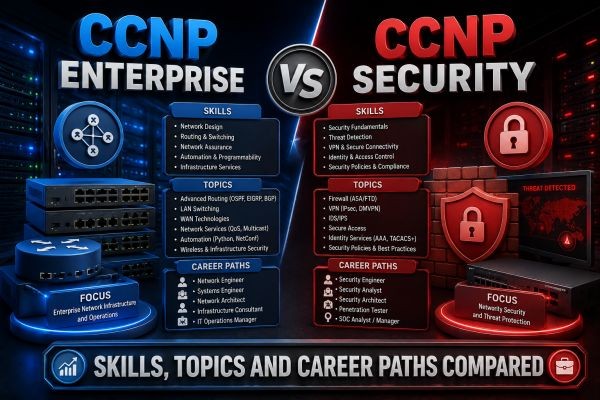
This guide compares CCNP Enterprise and CCNP Security by examining the skills developed, exam topics covered, and career opportunities associated with each certification.
The Purpose Behind Each Certification
Cisco created separate professional certification tracks because modern organizations need specialists in both networking and cybersecurity.
CCNP Enterprise focuses on designing, implementing, managing, and troubleshooting enterprise networks. The certification supports professionals responsible for keeping business infrastructure connected and performing efficiently.
CCNP Security focuses on protecting networks, applications, and users from cyber threats. It prepares professionals to secure infrastructure, enforce access controls, and respond to evolving security risks. Although both certifications share networking foundations, their objectives differ significantly.
Comparing the Core Skill Sets
The skills gained through each certification determine the type of work professionals perform after earning the credential.
Skills Developed in CCNP Enterprise
CCNP Enterprise strengthens expertise in:
-
Advanced routing and switching
-
Enterprise network architecture
-
Wireless networking
-
Network troubleshooting
-
SD-WAN technologies
-
Network automation
-
Infrastructure optimization
Professionals often develop a strong understanding of how enterprise networks operate and how to maintain performance at scale.
Skills Developed in CCNP Security
CCNP Security focuses on:
-
Network defense strategies
-
Firewall management
-
Secure remote access
-
Threat detection
-
Security monitoring
-
Identity and access management
-
Security policy implementation
These skills help professionals protect systems and reduce organizational risk. The difference can be summarized simply: Enterprise professionals build and optimize networks, while Security professionals protect them.
Major Topics Covered in Each Certification
Both certification paths require candidates to pass a core exam and a concentration exam. However, the subject matter varies considerably.
| Category | CCNP Enterprise | CCNP Security |
|---|---|---|
| Routing & Switching | Extensive Coverage | Foundational Coverage |
| Wireless Networking | Major Focus Area | Limited Coverage |
| SD-WAN | Significant Focus | Minimal Coverage |
| Network Automation | Included | Included |
| Firewalls | Basic Security Concepts | Major Focus Area |
| VPN Technologies | Limited Coverage | Extensive Coverage |
| Threat Prevention | Basic Concepts | Core Subject |
| Identity Services | Limited Coverage | Extensive Coverage |
This distinction helps explain why professionals often choose one certification over the other based on their interests and career plans.
For a better understanding, check out Cert Empire’s YouTube tutorial [https://youtu.be/N5rFGUX2q0M?si=wmrT8g4RyYFr_JF3].
Learning Experience: What to Expect
The preparation process differs between the two tracks.
Candidates pursuing CCNP Enterprise typically spend significant time working with:
-
Routing protocols
-
Enterprise architecture
-
Wireless solutions
-
Infrastructure services
-
Automation tools
Lab exercises often focus on connectivity, scalability, and network performance.
CCNP Security candidates generally spend more time studying:
-
Security policies
-
Access control technologies
-
Firewalls
-
Secure connectivity
-
Threat defense systems
Their practical work often involves securing environments and responding to potential vulnerabilities. Both paths require technical problem-solving skills, but the nature of those problems is different.
Who Should Choose CCNP Enterprise?
CCNP Enterprise is often the right choice for professionals who enjoy networking technologies and infrastructure management.
This certification may fit your goals if you:
-
Enjoy routing and switching
-
Like troubleshooting network issues
-
Want to design enterprise infrastructure
-
Are interested in SD-WAN and automation
-
Aspire to become a network architect
Many experienced network engineers view CCNP Enterprise as a natural progression from foundational Cisco [https://www.cisco.com/] certifications. The certification provides broad networking expertise that remains valuable across multiple industries.
Who Should Choose CCNP Security?
CCNP Security is ideal for professionals who want to specialize in cybersecurity and infrastructure protection.
This path may be a better fit if you:
-
Enjoy cybersecurity concepts
-
Want to work with security technologies
-
Like analyzing risks and vulnerabilities
-
Prefer security-focused responsibilities
-
Plan to build a cybersecurity career
As organizations face increasingly sophisticated cyber threats, security expertise continues to become more valuable. Professionals preparing for Cisco certification exams often use learning resources from Cert Empire [https://certempire.com] to reinforce their understanding of technical concepts and certification objectives.
Career Paths After Certification
One of the biggest differences between these certifications is the type of career opportunities they support.
Common CCNP Enterprise Career Paths
Professionals frequently pursue roles such as:
-
Network Engineer
-
Infrastructure Engineer
-
Network Administrator
-
Enterprise Architect
-
Wireless Network Engineer
These positions focus on ensuring reliable and efficient network operations.
Common CCNP Security Career Paths
Professionals often move into roles such as:
-
Security Engineer
-
Network Security Specialist
-
Cybersecurity Analyst
-
Security Consultant
-
Security Operations Engineer
These positions focus on defending systems, managing security controls, and reducing organizational risk. While some responsibilities overlap, employers typically seek different expertise depending on the position.
Demand and Future Growth
Both certifications remain highly relevant in 2026.
Enterprise networking continues evolving through:
-
Hybrid cloud infrastructure
-
AI-assisted network management
-
Network automation
-
Software-defined networking
Cybersecurity continues advancing through:
-
Zero Trust security models
-
AI-powered threat detection
-
Secure Access Service Edge (SASE)
-
Extended Detection and Response (XDR)
Industry demand remains strong in both areas, making either certification a valuable investment. The best choice often depends less on market trends and more on personal interests and professional goals.
How to Make the Right Choice
Before selecting a certification path, ask yourself several important questions:
-
Do I enjoy building and optimizing networks?
-
Am I more interested in cybersecurity than infrastructure?
-
Which daily responsibilities sound more appealing?
-
What type of technical challenges motivate me?
-
Where do I want my career to be in five years?
Your answers can help identify which certification aligns more closely with your aspirations.
Bottom Line
CCNP Enterprise and CCNP Security are both respected Cisco certifications that support rewarding and long-term career opportunities. However, they serve different purposes within modern IT environments.
CCNP Enterprise focuses on networking technologies, infrastructure management, and enterprise connectivity. CCNP Security emphasizes cybersecurity, threat prevention, and protecting organizational assets.
By comparing the skills, topics, and career paths associated with each certification, professionals can make a more informed decision and choose the Cisco certification track that best supports their future goals.
More insights: CCNP Enterprise vs CCNP Security: Understanding the Core Differences [https://www.treelandscapingdirectory.com/blog/ccnp-enterprise-vs-ccnp-security-understanding-the-core-differences]






