
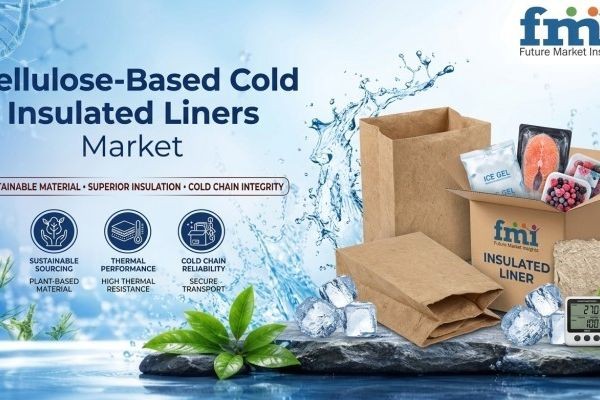
The global cellulose-based cold chain insulated liners market is entering a period of rapid expansion as pharmaceutical distributors, food delivery networks, and logistics providers transition from rigid polymer insulation toward repulpable fiber-based thermal barriers. According to the latest market analysis by Future Market Insights, the market is projected to grow from USD 0.9 billion in 2026 to USD 3.4 billion by 2036, registering a CAGR of 14.2% during the forecast period.
The market was valued at USD 0.8 billion in 2025. Growth is being driven by the phase-out of multi-material EPS coolers, increasing extended producer responsibility requirements, demand for recyclable cold chain packaging, and the need to maintain strict temperature profiles across pharmaceutical and perishable-goods distribution networks.
Cellulose-based liners encompass engineered, repulpable paper and fiber-based thermal barriers designed to maintain temperature-sensitive payloads during transit while remaining compatible with municipal and commercial paper recycling streams. Flat-packed corrugated fiber matrices, macerated paper pads, multilayer kraft paper baffles, and compressed recycled newsprint panels form key components of the market.
Get detailed market forecasts, competitive benchmarking, and pricing trends:
https://www.futuremarketinsights.com/reports/sample/rep-gb-32254
Market Overview and Strategic Growth Outlook
The transition toward cellulose-based insulation is gaining momentum as logistics operators seek alternatives capable of supporting demanding cold chain requirements without creating complex end-of-life waste streams. Pharmaceutical distribution networks are increasingly focused on thermal packaging that can support 2°C to 8°C profiles across 96-hour transit lanes, while also simplifying disposal at hospitals and clinical facilities.
Flat-packed fiber insulation also addresses a major operational challenge: warehouse footprint. Unlike rigid foam coolers, modular cellulose panels can be stored at higher densities before final assembly, enabling fulfillment centers to reclaim valuable warehouse space.
Key Market Projections and Strategic Insights
- Global Market Value (2026): USD 0.9 Billion
- Forecast Market Value (2036): USD 3.4 Billion
- Forecast CAGR (2026–2036): 14.2%
- Leading Material Segment: Kraft Paper
- Material Segment Share: 45.2%
- Leading Thickness Segment: 1 to 2 inches
- Thickness Segment Share: 51.3%
- Leading End-Use Segment: Pharmaceuticals
- End-Use Share: 42.8%
- Fastest-Growing Market: United States
- USA CAGR: 16.5%
- Key Growth Regions: North America, Europe, Asia Pacific
Competitive Landscape and Market Share Analysis
The competitive environment remains moderately consolidated, with certification, material engineering, integrated manufacturing, and production scale emerging as important competitive factors.
Key companies operating in the market include:
- Ranpak
- Mondi Group
- DS Smith
- International Paper
- TemperPack
- Sealed Air
- Smurfit Westrock
Leading manufacturers are focusing on integrated fiber insulation, high-performance repulpable barriers, specialized fiber configurations, and automated production systems. Integrated box manufacturing can embed insulating matrices directly into corrugated structures, reducing secondary assembly requirements.
Segment Analysis
Kraft paper is expected to account for 45.2% share in 2026, supported by its structural integrity and ability to withstand condensation during high-humidity transit conditions. Its longer fiber structure supports tensile performance while maintaining repulpability.
The 1-to-2-inch thickness segment is projected to hold 51.3% share in 2026. This profile balances thermal performance with parcel dimensions, storage density, and shipping economics. Flat-packed panels within this range can also improve pallet density before final assembly.
By end use, pharmaceuticals lead with 42.8% share in 2026. Medical distributors are increasingly seeking thermal packaging that can simplify downstream waste management while supporting temperature-sensitive biological and pharmaceutical shipments.
Regional Opportunity Assessment
The United States is projected to expand at a 16.5% CAGR from 2026 to 2036, supported by DSCSA modernization and the growing need for standardized temperature-tracked distribution nodes.
Germany follows with a 15.4% CAGR, driven by packaging compliance requirements and extended producer responsibility pressures. The United Kingdom is expected to grow at 13.5%, while France advances at 10.5%.
In Asia Pacific, China is projected to register a 14.8% CAGR, supported by pharmaceutical export requirements and alignment with international disposal standards. Japan is expected to grow at 12.2%, while India is projected to expand at 11.6% through 2036.
Market Drivers and Opportunities
Key growth drivers include:
- Increasing EPR requirements
- Phase-out of multi-material EPS coolers
- Pharmaceutical cold chain modernization
- Demand for repulpable packaging
- Warehouse space optimization
- Growth in temperature-sensitive distribution
- Consumer demand for simpler recyclable packaging
Emerging opportunities include integrated box plant production, automated dispensing systems, and repulpable hydrophobic barriers. These technologies can improve production efficiency while addressing moisture resistance and thermal performance requirements.
Challenges Impacting Market Adoption
The market continues to face technical and commercial challenges. Achieving moisture resistance without compromising repulpability remains a major engineering constraint. Standard recycled paper can degrade under condensation from thawing refrigerants, while specialized barrier treatments can increase unit costs.
Balancing thermal performance, dimensional weight, structural integrity, and recyclability will therefore remain critical to broader adoption, particularly in price-sensitive food delivery applications.
Related Reports:
https://www.openpr.com/news/4601659/brick-carton-packaging-market-size-to-reach-usd-16-0-billion
https://www.openpr.com/news/4601664/bopp-bag-market-size-to-reach-usd-1-4-billion-by-2036-as
FMI Custom Research: Strategic Intelligence for Confident Decision-Making
In today's rapidly evolving business environment, leadership teams need more than market data—they need clear, actionable intelligence tailored to their strategic objectives. FMI's Custom Research solutions are designed around the specific business questions organizations need answered, enabling executives to evaluate growth opportunities, validate investments, assess competitive dynamics, and reduce uncertainty before making critical decisions. By combining deep industry expertise, primary research, and proprietary market intelligence, FMI delivers insights that help organizations move from assumptions to evidence-based strategies with greater speed and confidence.
Business Impact
FMI helps organizations transform market complexity into strategic clarity, enabling leadership teams to identify growth opportunities faster, optimize resource allocation, strengthen competitive positioning, and make high-stakes business decisions with confidence.
To explore how FMI Custom Research can support your strategic priorities, please connect with our team at - sales@futuremarketinsights.com
About Future Market Insights (FMI)
Future Market Insights, Inc. (FMI) is an ESOMAR-certified, ISO 9001:2015 market research and consulting organization, trusted by Fortune 500 clients and global enterprises. With operations in the U.S., UK, India, and Dubai, FMI provides data-backed insights and strategic intelligence across 30+ industries and 1200 markets worldwide.






