
A consistent operational scale-up is expanding global fireproofing manufacturing and distribution networks, fueled by the commercial necessity to supply high-performance intumescent and cementitious coatings capable of meeting strict safety codes across modern industrial and commercial builds.
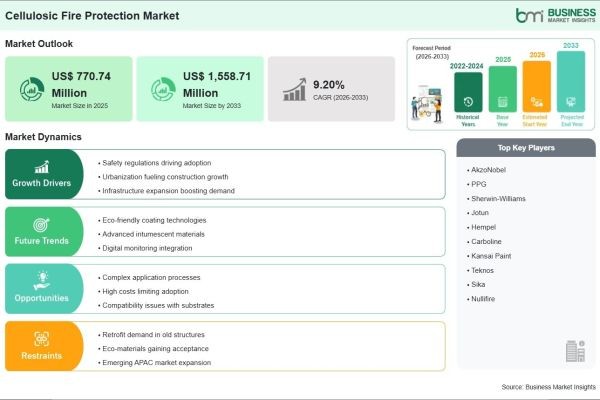
Based on market intelligence from Business Market Insights, the global Cellulosic Fire Protection Market is anticipated to reach US$ 1,558.71 Million by 2033, mounting from its 2025 value of US$ 770.74 Million at a projected CAGR of 9.20% from 2026 to 2033.
Technological advancements in intumescent coatings, including the shift toward eco-friendly, water-borne formulations and high-durability epoxy materials, are reshaping the cellulosic fire protection industry. Manufacturers are increasingly focusing on delivering protective solutions with faster drying times, lower volatile organic compound (VOC) emissions, and extended fire-resistance ratings. This strategic shift allows contractors and builders to achieve highly optimized fire safety compliance, significantly lowering application times while comfortably meeting stringent environmental and building safety standards.
Download Sample Report : https://www.businessmarketinsights.com/sample/BMIPUB00035349
What Is Cellulosic Fire Protection?
Cellulosic fire protection refers to specialized passive fireproofing materials designed to protect structures, primarily steel, wood, and concrete, from cellulosic fires. A cellulosic fire is typically fueled by combustible materials such as timber, paper, textiles, and furniture, reaching temperatures of around 500°C within minutes and peaking near 945°C. The primary purpose of these protection systems is to insulate structural components, delaying structural collapse and providing occupants with crucial time to evacuate safely while allowing emergency responders to control the blaze.
Common cellulosic fire protection solutions include intumescent coatings, cementitious sprays, and fireproof boards. Modern intumescent coatings are highly engineered paints that, when exposed to extreme heat, swell to many times their original thickness, forming a dense, insulating char layer that protects the underlying steel from losing its load-bearing capacity. The inclusion of these advanced materials ensures that buildings safely operate within the bounds of modern building codes, where specific fire-resistance ratings (e.g., 60, 90, or 120 minutes) are legally and structurally enforced parameters.
Industry Drivers
A major driver of the Cellulosic Fire Protection Industry is the massive expansion of global commercial and residential construction. As cities become more densely populated and architectural designs incorporate more exposed structural steel for aesthetic purposes, the need for fire protection materials that do not compromise the building's visual appeal has skyrocketed. This architectural trend directly translates into robust, recurring procurement orders for thin-film intumescent coatings across regional construction networks.
The rapid implementation of stringent building safety codes and occupational hazard regulations is another crucial growth factor. Following several high-profile urban fire disasters globally, regulatory bodies such as the NFPA (National Fire Protection Association) and regional building authorities have mandated rigorous fireproofing standards for new constructions and retrofitting projects. This shift in regulatory enforcement compels developers to integrate high-grade passive fire protection materials into their structural designs, greatly expanding the addressable market.
Furthermore, a heightened focus on environmental sustainability is boosting demand for water-borne fire protection coatings. Traditional solvent-based coatings release volatile organic compounds (VOCs) that are harmful to both human health and the environment. The widespread adoption of low-VOC, eco-friendly intumescent coatings is strongly supported by green building certifications, such as LEED, ensuring sustained market penetration in developed regions.
Industry Segmentation
By Product Type
- Intumescent Coatings: The dominant segment globally, favored for their aesthetic finish and ability to provide highly effective fire resistance without adding significant weight or bulk to steel structures.
- Cementitious Materials: A cost-effective spray-on solution widely used in hidden or non-aesthetic structural areas where thick application is acceptable.
- Fireproofing Boards & Slabs: Rigid, pre-formed insulation boards utilized to encase structural columns and beams, providing immediate fire protection upon installation.
By Technology (For Coatings)
- Water-borne: A rapidly growing segment driven by strict environmental regulations and the rising demand for low-VOC green building materials.
- Solvent-borne: Highly durable coatings preferred for exterior structures or environments exposed to harsh weather conditions during the construction phase.
By End User
- Construction (Commercial & Residential): The largest end-user segment, handling massive volumes of fireproofing for high-rises, shopping malls, hospitals, and residential complexes.
- Oil & Gas: While primarily reliant on hydrocarbon fire protection, offshore rigs and onshore administrative facilities utilize cellulosic protection for specific structural zones.
- Industrial & Manufacturing: Encompassing factories and warehouses requiring robust protection to safeguard personnel and highly valuable inventory.
The intumescent coatings segment dominates the industry due to its fundamental role in providing seamless, aesthetically pleasing fire resistance for exposed structural steel. The construction sector remains the leading end-use segment because of the universal regulatory need for passive fire protection in modern buildings. Water-borne technologies are capturing significant market share, supported by continuous environmental mandates across global construction markets.
Regional Insights
- North America dominated the industry due to a highly regulated construction sector, stringent fire safety codes set by the NFPA, and a strong push toward green building certifications. The U.S. is the primary consumer of advanced, low-VOC intumescent coatings.
- Asia-Pacific is expanding rapidly, supported by a booming construction industry, massive urbanization, and escalating infrastructure investments across China, India, and Southeast Asia. The growing awareness of fire safety standards drives immense material procurement.
- Europe continues to grow steadily, driven by a strong focus on sustainable construction, rigorous European Union safety directives, and the widespread retrofitting of older buildings across the UK, Germany, and France.
- Middle East & Africa is seeing rising demand from ongoing investments in massive commercial real estate projects and smart city developments, particularly in Saudi Arabia and the UAE.
- South & Central America remains an active market, focusing on improving urban safety infrastructure and expanding commercial real estate investments in Brazil and Mexico.
Top Players in the Cellulosic Fire Protection Industry
The industry is highly competitive, with leading global chemical and coating companies focusing on technological integration, sustainable formulations, and strategic acquisitions to strengthen their global market share.
- The Sherwin-Williams Company
- PPG Industries, Inc.
- Akzo Nobel N.V.
- Jotun A/S
- Hempel A/S
- Sika AG
- Etex Group (Promat)
- Carboline Company
- Teknos Group
- Nullifire (RPM International)
These companies continue to invest heavily in specialized R&D, aiming to develop ultra-thin film coatings, faster-drying formulations, and highly weather-resistant fire protection systems.
Technological Innovations
Technological innovation is transforming the Cellulosic Fire Protection Industry. The development of ultra-fast drying intumescent coatings allows steel fabricators to apply fire protection off-site, drastically reducing construction bottlenecks and minimizing on-site application variables. This off-site modular approach ensures higher quality control and accelerates overall project timelines.
Manufacturers are also rapidly advancing the design of high-durability, epoxy-based cellulosic coatings. Unlike traditional water-borne paints, these advanced formulations can withstand prolonged exposure to rain, high humidity, and mechanical damage during the construction phase without degrading. These innovations not only protect the structural integrity of the building but also safeguard the contractor from costly re-application procedures.
Additionally, the push toward highly sustainable, ultra-low VOC formulations is another major trend. By combining high-performance fire resistance with green chemistry, manufacturers are providing solutions that allow architects and developers to confidently meet premium environmental certifications, such as LEED v4 and BREEAM, without sacrificing life-safety performance.
Future Industry Outlook
The future outlook for the Cellulosic Fire Protection Industry remains highly positive. Rising global construction activities, the expanding enforcement of building safety codes, continuous technological innovation in coating formulations, and a growing emphasis on green building practices are expected to support steady demand through 2034. The ongoing shift toward modular, off-site construction will further cement fast-drying intumescent coatings as a vital component of modern structural engineering.
As smart building designs and stringent safety regulations continue to advance, cellulosic fire protection materials will become even more resilient, environmentally friendly, and seamlessly integrated into global construction supply chains. Companies that focus on developing robust water-borne portfolios, durable exterior coatings, and comprehensive technical support networks are likely to capture the strongest growth opportunities in the coming years.
Frequently Asked Questions (FAQs)
What is the projected size of the Cellulosic Fire Protection Market by 2034?
The market is projected to reach US$ 1.48 Billion by 2034, rising from US$ 0.92 Billion in 2025.
What factors are driving industry growth?
Key drivers include the rapid expansion of global commercial construction, stringent governmental fire safety regulations, and the rising demand for aesthetically pleasing, low-VOC intumescent coatings.
Which product segment dominates the industry?
Intumescent coatings currently hold the largest market share due to their essential role in providing high-performance fire resistance while maintaining the aesthetic appeal of exposed structural steel.
Which region leads the industry?
North America dominates the market due to robust infrastructure investments, highly regulated building codes, and early adoption of advanced, eco-friendly fire protection materials.
Browse More Reports:
https://www.businessmarketinsights.com/reports/middle-east-non-invasive-radiosurgery-robots-market
https://www.businessmarketinsights.com/reports/latin-america-veterinary-imaging-market
About Us
Business Market Insights is a market research platform that provides subscription service for industry and company reports. Our research team has extensive professional expertise in domains such as Electronics & Semiconductor; Aerospace & Defense; Automotive & Transportation; Energy & Power; Healthcare; Manufacturing & Construction; Food & Beverages; Chemicals & Materials; and Technology, Media, & Telecommunications.
Contact Us
If you have any questions about this report or would like further information, please contact us:
Contact person: Ankit Mathur
Email: sales@businessmarketinsights.com
Phone: +16467917070






