
India is one of the most visited destinations in the world — and also one of the most price-sensitive when it comes to airfares. The difference between flying to India at the right time versus the wrong time can run into tens of thousands of rupees, or hundreds of dollars, on the exact same route. Understanding when fares dip and why they do so is one of the most practical things any traveller can do before planning a trip.
This guide covers the cheapest months to fly to India from all the major origin countries — the United States, the United Kingdom, Canada, Australia, the UAE, Singapore, and others — along with what drives prices up, what brings them down, and how to make sure you are booking at the right moment.
How Airline Pricing to India Actually Works
Before diving into specific months, it helps to understand the mechanics behind why fares to India fluctuate so dramatically.
Airfare is driven by demand, and demand to India follows predictable seasonal patterns. When demand is high — during Indian festivals, school holidays in Western countries, or peak winter tourism season — airlines have little incentive to reduce fares. When demand drops, fares follow.
There are three broad pricing seasons for flights to India:
Peak season (October to January) — This is when India's weather is at its most appealing, particularly in the north and centre of the country. Winter festivals, the wedding season, and the influx of tourists from colder countries all drive demand and prices to their highest point. December is consistently the most expensive month to fly to India from almost every major country.
Shoulder season (February to March, and September) — These months sit between the extremes. The weather in India is still reasonable, demand has eased, and fares are noticeably lower than peak season without being as uncomfortable as travelling in the hottest months.
Low season (April to August) — The Indian summer and monsoon season coincide with a significant drop in tourist arrivals. This is when the cheapest flights are available. Fares can be dramatically lower than peak season, though travellers should be prepared for heat, humidity, and rain depending on their destination within India.
Cheapest Months to Fly to India From the United States
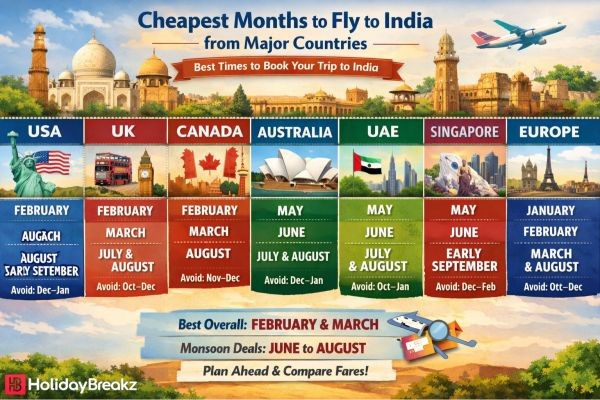
Cheapest months: February, March, August, and early September
Flights from the US to India are among the longest in the world, typically routing through hubs in the Middle East (Dubai, Doha, Abu Dhabi), Europe (London, Frankfurt, Amsterdam), or Southeast Asia. Journey times range from 16 to 22 hours depending on the connection.
This long routing means fares are inherently higher than shorter international routes, which makes finding the right window even more important.
February and March offer the best combination of reasonable fares and comfortable weather in India. The peak Christmas and New Year rush has ended, and the Indian summer has not yet begun. Flights from cities like New York (JFK), Los Angeles (LAX), Chicago (ORD), and San Francisco (SFO) tend to see fares drop meaningfully from the January high.
August is technically within the monsoon season in India, but it is also when US summer travel demand — which was focused on European and domestic routes — begins to ease. Fares to India in August can be 30% to 40% lower than fares in December, though travellers visiting destinations like Kerala, Goa, or Mumbai should account for heavy rainfall.
What to avoid: Mid-November through January, particularly the Thanksgiving to New Year period, when demand spikes from the Indian diaspora in the US travelling home for the holidays.
Cheapest Months to Fly to India From the United Kingdom
Cheapest months: February, March, July, and August
The UK has one of the highest volumes of traffic to India of any country, driven by a large South Asian diaspora, strong business ties, and significant leisure tourism. This high volume of flights means there is good competition between carriers, which generally keeps fares more competitive than from some other origins — but seasonal patterns still matter enormously.
February and March are the sweet spot for UK travellers. Indian winter tourism season has wound down, UK school holidays have not yet begun, and carriers like British Airways, Virgin Atlantic, Air India, and Gulf-based airlines all compete for the reduced demand with lower fares. Departures from London (Heathrow and Gatwick), Manchester, and Birmingham all tend to show lower prices in this window.
July and August are counterintuitive — these are peak UK summer holiday months, which pushes up fares to beach destinations in Europe and the Mediterranean. But because India is not a typical UK summer holiday destination (given the monsoon), fares to Indian cities can actually dip during this period.
What to avoid: October through December, particularly around Diwali (which falls in October or November), Christmas, and New Year. The combination of diaspora travel and leisure tourism creates a perfect storm of high demand and high fares.
Cheapest Months to Fly to India From Canada
Cheapest months: February, March, and August
Canadian routes to India share many characteristics with US routes — long haul, typically routed via Middle Eastern or European hubs, and heavily influenced by the diaspora travel calendar. Canada has a large South Asian community, particularly concentrated in Toronto (YYZ), Vancouver (YVR), and Calgary (YYC).
The cheapest window from Canada broadly mirrors the US pattern: February and March see the best fares as the holiday travel surge ends, and August provides another dip as Indian summer/monsoon keeps leisure demand low.
One nuance for Canadian travellers is that Air India and Air Canada both operate direct or near-direct services on major routes, particularly Toronto–Delhi. When both carriers are competing on the same route, fares can be particularly competitive — worth checking both when searching.
What to avoid: November and December, when diaspora travel demand peaks sharply ahead of the Indian winter festival and wedding season.
Cheapest Months to Fly to India From Australia
Cheapest months: February, March, June, and July
Australia's flights to India are a fascinating case because the Australian and Indian seasons operate differently from Northern Hemisphere origins. Most Australian routes to India — particularly from Sydney (SYD), Melbourne (MEL), and Perth (PER) — route through Singapore, Kuala Lumpur, Bangkok, or the Middle East.
Perth has a geographic advantage here: it is the closest Australian city to India, and direct flights from Perth to Mumbai and Delhi exist, making it the cheapest departure point for many travellers.
February and March work well for the same reasons as other countries — Indian peak season has ended and fares ease. But June and July are particularly interesting for Australian travellers: these are the Australian winter school holiday months, when many families travel domestically or to Southeast Asia, easing pressure on India routes. Combined with India's monsoon season reducing inbound tourism, fares can drop noticeably.
What to avoid: December and January, when Australian summer holidays coincide with Indian peak season — a double peak that pushes fares to their highest levels of the year.
Cheapest Months to Fly to India From the UAE
Cheapest months: May, June, July, and August
The UAE is one of India's closest international neighbours, with extremely high flight frequency between Dubai (DXB), Abu Dhabi (AUH), Sharjah (SHJ), and every major Indian city. The sheer volume of flights — operated by Emirates, Air Arabia, IndiGo, Air India, SpiceJet, and others — means competition keeps fares relatively low year-round compared to long-haul origins.
That said, there is still a meaningful seasonal pattern. The cheapest months from the UAE to India are the summer months — May through August — when UAE residents and expats tend to travel back home or to cooler destinations. This is also when India's monsoon peaks, reducing inbound demand further.
Fares from the UAE to India during these months can be extraordinarily low, particularly on budget carriers like Air Arabia and IndiGo. The short flight time (3 to 4 hours) also means the absolute fare is lower than from longer-haul origins.
What to avoid: October through January, particularly around Diwali, Eid al-Fitr (date varies), and Christmas. These periods see very high demand from the large South Asian expatriate community in the UAE.
Cheapest Months to Fly to India From Singapore
Cheapest months: May, June, and the first half of September
Singapore is exceptionally well-connected to India, with non-stop flights from Singapore Changi (SIN) to Delhi, Mumbai, Chennai, Bengaluru, Hyderabad, Kolkata, and several other cities. Singapore Airlines, IndiGo, Air India, Scoot, and Vistara all operate on these routes, creating robust competition.
The cheapest period from Singapore broadly follows India's low demand season. May and June, before Indian school holidays drive domestic travel demand, and before Singaporean school holiday travel peaks, tend to offer the best fares.
Early September, after Singapore's National Day holiday period and before the Indian festival season kicks in from October, also provides a small but useful fare dip.
What to avoid: The December holiday period is consistently the most expensive. Chinese New Year (January or February) can also push fares up on some routes due to broader regional travel demand.
Cheapest Months to Fly to India From Germany and Continental Europe
Cheapest months: January (post-New Year), February, March, and August
Germany, France, the Netherlands, and other Western European countries have strong flight connections to India — primarily through Lufthansa from Frankfurt and Munich, Air France from Paris, KLM from Amsterdam, and various Middle Eastern carriers connecting through their hubs.
January, immediately after the New Year period, sees a sharp drop in fares as the holiday rush ends. February and March continue the trend as European winter holidays conclude and demand for warm destinations in Asia eases.
August is again a somewhat counterintuitive cheap month: while it is peak European summer holiday season, the focus of European leisure travel in August is typically the Mediterranean and Southern Europe, not India. Combined with the monsoon reducing India's appeal for first-time visitors, fares can dip noticeably.
What to avoid: October through December, when leisure demand builds ahead of the Indian winter season, and flights around Christmas become particularly expensive.
What Months Are Universally Cheap for Flights to India?
Looking across all the major origin countries, a few patterns emerge consistently:
February and March are the closest thing to a universal cheap window. Indian peak tourist season is winding down, festival travel has ended, and demand from most origin countries is at a seasonal low. Weather in India during February and March — particularly in the north and centre — is also still very pleasant. This makes it arguably the best overall time to fly to India if your dates are flexible.
The monsoon months (June to August) offer the deepest discounts but require the most flexibility in terms of what you plan to do once you arrive. Southern and coastal destinations like Kerala, Goa, and the Andaman Islands experience heavy rainfall. Northern destinations like Delhi, Rajasthan, and Himachal Pradesh are hot and humid. However, destinations like Ladakh and the hills of Himachal Pradesh are actually at their most accessible and visually stunning during the Indian summer, making this period ideal for adventure travellers.
September sits in a useful transition zone — monsoon is retreating, temperatures are beginning to ease, and fares have not yet climbed to the Diwali and Christmas peak. It is a particularly good month for travellers who want reasonable prices with improving conditions.
Practical Tips to Get the Cheapest Flights to India
Book 6 to 10 weeks in advance for low season, and 3 to 5 months in advance for peak season. Flights to India for Christmas and New Year can sell out or spike dramatically in price if you leave booking until October or November.
Be flexible with your arrival city. Delhi and Mumbai are the most common entry points, but fares to Chennai, Hyderabad, Bengaluru, or Kolkata are sometimes significantly lower. If you are planning a tour of India, consider flying into one city and out of another to both save money and add variety to your itinerary.
Consider indirect flights over direct routes. Non-stop flights to India — where they exist — command a premium. Connections through Dubai, Doha, Abu Dhabi, Singapore, or Kuala Lumpur are often cheaper and add only a few hours to the total journey time.
Search mid-week departures. Tuesdays and Wednesdays are statistically the cheapest days to fly on most international routes. Weekend departures — particularly Friday and Sunday evenings — attract a premium.
Set fare alerts well in advance. Flight prices to India fluctuate constantly, and the same seat can vary by a significant amount within days. Monitoring fares over several weeks before booking gives you a clearer picture of whether you are seeing a genuine low or a temporary dip.
When you are ready to search, using a platform that lets you compare flights across multiple airlines and view total costs upfront— including baggage and fare conditions — takes a lot of the guesswork out of finding the right fare at the right time. HolidayBreakz India is built specifically for this kind of comparison, making it easier to spot when a price is genuinely good versus when it will come down further.
Best Time to Visit India by Region — Matched to Cheap Fare Windows
Getting cheap flights is only half the equation. Here is how the cheapest fare windows align with the best time to visit different parts of India:
North India (Delhi, Agra, Rajasthan, Varanasi): Best weather is October to March. The February–March cheap fare window aligns perfectly with the tail end of ideal conditions. January fares are high but weather is excellent.
South India (Tamil Nadu, Kerala, Karnataka): Best weather is October to February. The post-peak fare dip in February and March still gives good conditions in the south, though the northeast monsoon affects the Tamil Nadu coast from October to December.
Goa and West Coast: Best weather is November to February (peak, expensive). The shoulder months of October and March offer decent conditions with lower fares.
Himalayan regions (Ladakh, Himachal Pradesh, Uttarakhand): Best for travel from June to September — coinciding almost exactly with the cheapest fare window. This is genuinely the best alignment of cheap flights and ideal conditions anywhere in India.
Mumbai and Maharashtra: Relatively good year-round except July and August (monsoon). The February–March window offers both reasonable fares and pleasant conditions.
Frequently Asked Questions
What is the cheapest month to fly to India overall?
February and March are consistently the cheapest months to fly to India from most major countries. The Indian peak tourist season has ended, and demand from diaspora travellers has dropped after the winter festivals. Monsoon months (June to August) can be even cheaper in terms of fares, but conditions at most popular destinations are less favourable.
Which country has the cheapest flights to India?
The UAE, particularly Dubai and Sharjah, consistently offers the cheapest flights to India due to the short distance and high competition between carriers. Flights from the UAE to Indian cities can be remarkably inexpensive, especially during summer months.
How far in advance should I book flights to India?
For travel during peak season (October to January), book 3 to 5 months in advance. For low season travel, 6 to 10 weeks before departure often provides a good fare without booking too early and missing potential price drops.
Are direct flights to India worth the extra cost?
It depends on the origin. From the UAE or Singapore, non-stop flights are often not much more expensive and are worth it given the short journey. From the US, UK, or Australia, the premium for non-stop service can be substantial, and a connection through a Middle Eastern hub often offers both a lower fare and a manageable total travel time.
Is it cheaper to fly into Delhi or Mumbai?
It varies by origin and season. Delhi (Indira Gandhi International) and Mumbai (Chhatrapati Shivaji Maharaj International) are both major international hubs with high flight frequency. Secondary cities like Hyderabad, Bengaluru, and Chennai can sometimes be cheaper depending on the route.
Does the Indian wedding season affect flight prices?
Yes, significantly. The Indian wedding season peaks between November and February, and it creates a surge in diaspora travel from the UK, US, Canada, UAE, and Australia. Fares during this window — particularly around major festival dates — can be substantially higher than at other times of year.
Can I find cheap last-minute flights to India?
Occasionally, but India routes are not as reliably discounted at the last minute as some short-haul routes. On high-demand routes like London–Delhi or New York–Mumbai, last-minute fares are often higher than advance purchase fares. The exception is during the deep low season (July–August), where some unsold inventory may be available at reduced prices.
Final Thoughts
The cheapest months to fly to India are not a secret — they follow a logical pattern driven by Indian tourism seasons, diaspora travel calendars, and the school holiday schedules of origin countries. Once you understand this rhythm, you can plan your trip to take advantage of lower fares without necessarily compromising on the experience at your destination.
February and March remain the best all-round window: fares are lower than peak season, the weather across most of India is still very good, and you avoid the holiday crowds that come with the Christmas–New Year peak. If your destination is in the mountains or you are an adventure traveller, the June to August window offers even deeper discounts with genuinely spectacular conditions in the Himalayan regions.
Wherever you are flying from, the principle is the same: plan ahead, stay flexible where you can, and compare the total cost of your journey — not just the headline fare — before you commit.
India rewards the traveller who plans thoughtfully. Start with the right flight.






