
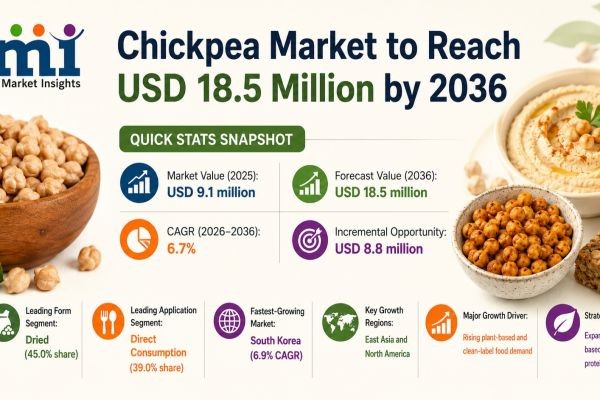
The global chickpea market is expanding from a traditional staple into a mainstream consumer category, according to latest insights by future market insights. Driven by a global shift toward health-conscious lifestyles, clean-label transparency, and sustainable food systems, both retail and foodservice channels are rapidly diversifying their plant-based portfolios. The global industry is projected to reach a valuation of USD 9.7 billion in 2026. Progressing at a steady Compound Annual Growth Rate (CAGR) of 6.7% over the ten-year forecast period, the market is anticipated to achieve a total valuation of USD 18.5 billion by 2036, opening up significant commercial opportunities for processors and ingredient formulators worldwide.
Request a Sample Report: https://www.futuremarketinsights.com/reports/sample/rep-gb-15696
Market Performance Overview (2026–2036)
To understand the core structural dynamics and procurement channels shaping this market expansion, an analysis of segment-specific shares highlights where global volume is concentrated:
- Dried Form (45.0% share): Remains the commanding industrial and retail format due to its long shelf-life, exceptional versatility across culinary applications, and deeply established presence in global distribution networks.
- Direct Consumption (39.0% share): Leads the application framework, demonstrating a strong consumer preference for easily accessible, whole-food configurations that encourage repeat household purchases.
- Target Origin Segments: The sector encompasses key commercial varieties including Kabuli chickpea, Indian chickpea, garbanzo beans, and Desi chickpeas, catering to distinct regional manufacturing and processing specifications.
Technical Drivers and Sourcing Advantages
The continuous integration of chickpeas into value-added food portfolios is propelled by three primary commercial catalysts:
Clean-Label and Plant-Based Formulation Fit
As modern consumer purchasing criteria tilt toward health, sustainability, and ingredient transparency, chickpeas have emerged as an ideal clean-label tool. Their native functional properties allow food manufacturers to develop high-protein flours, meat alternatives, and dairy substitutes without relying on synthetic texturizers or raising regulatory red flags on ingredient decks.
Modernization of Retail and E-Commerce
The growth velocity of this market is heavily augmented by the expansion of organized retail chains, digital commerce platforms, and specialty health stores. Modern trade penetration in developing regions and online subscription services in developed markets have significantly broadened the addressable consumer base, simplifying direct-to-consumer product delivery.
Versatility in Next-Generation Products
Advancements in formulation technology are expanding the chickpea market far beyond baseline whole-pulse channels. Manufacturers are successfully engineering sophisticated snack lines, ready-to-eat delicacies, functional dips, and spreadable spreads, effectively lowering trial barriers for mainstream consumer groups.
Industrial Infrastructure Challenges
Global processing facilities and supply chain managers must navigate distinct operational and economic hurdles:
- The Premium Pricing Resistance: While premium and organic chickpea products command high margins in upscale urban demographics, the price gap between specialty formulations and conventional agricultural commodities limits rapid adoption among price-sensitive consumer segments.
- Supply Chain and Distribution Efficiency: Maintaining batch consistency in terms of taste, size, color, and moisture retention requires strict quality control near cultivation zones. Fragmented supply arrangements or localized crop volatility can introduce uneven ingredient quality, complicating large-scale factory production runs.
Regional Growth Outlook
The geographic analysis reflects rapid development velocity across East Asian convenience networks and mature North American plant-based corridors:
- South Korea (6.9% CAGR): The global growth frontrunner, driven by high consumer spending, rapid retail infrastructure development, and early adoption of innovative convenience food formats.
- USA (6.8% CAGR): Sustaining robust volume demand due to evolving health preferences, intense snack portfolio reformulations, and expanding supermarket shelf allocations.
- European Union (6.7% CAGR): Supported by strict natural-additive guidelines, high corporate compliance standards, and a deeply embedded culture of sustainable dietary positioning.
- United Kingdom (6.6% CAGR): Underpinned by strong brand investments in next-generation food formats and expanding institutional procurement pipelines.
- Japan (6.5% CAGR): Moving at a steady pace as mature consumer demographics look for clean, functional plant proteins that align with preventative health routines.
Competitive Landscape
The global chickpea ecosystem features a mixture of large agricultural processors and specialized regional distribution actors. Global market equity, multi-regional supply logistics, and advanced product innovation capabilities are led by industry giants including Archer Daniels Midland, The Hain Celestial Group, AGT Food and Ingredients, and Arbel S.A.
To defend market share and secure premium channel access, leading processors are heavily investing in continuous process optimization, expanding their portfolios of chickpea-based proteins, starches, and texturizing flours. Concurrently, emerging regional startups are establishing strong market footholds by targeting high-value, highly localized niche applications where strict crop traceability and sustainable farming metrics create a distinct performance advantage.
Exclusive Discounts on Full Report: https://www.futuremarketinsights.com/reports/chickpea-market
Frequently Asked Questions
What is the projected valuation of the global market by 2036?
The global chickpea market is projected to reach USD 18.5 billion by 2036, scaling upward from an estimated baseline of USD 9.7 billion in 2026 at a CAGR of 6.7%.
Why does the dried form segment maintain a dominant 45.0% share?
The dried format provides maximum flexibility for multi-season storage, lower cross-border shipping costs, and a familiar technical foundation for both industrial food processors and domestic kitchens.
What commercial sectors drive the leading applications?
Direct consumption and savory snacks represent the primary market sinks, while functional spreads, premium dips, and texturizing flours serve as rapidly growing, high-margin product channels.
FMI Custom Research: Strategic Intelligence for Confident Decision-Making
In today's rapidly evolving business environment, leadership teams need more than market data they need clear, actionable intelligence tailored to their strategic objectives. FMI's Custom Research solutions are designed around the specific business questions organizations need answered, enabling executives to evaluate growth opportunities, validate investments, assess competitive dynamics, and reduce uncertainty before making critical decisions.
Key Executive Benefits
- Decision-Ready Insights tailored to business priorities
• Reduced Strategic Risk through validated market intelligence
• Market Entry Confidence with detailed competitive analysis
• Competitive Advantage supported by proprietary research
• Faster Growth Decisions through customized strategic insights
• Primary Market Validation from industry stakeholders
• Global Industry Expertise across diverse sectors
• Proven Track Record with thousands of consulting engagements
Business Impact
FMI helps organizations transform market complexity into strategic clarity, enabling leadership teams to identify growth opportunities faster, optimize resource allocation, strengthen competitive positioning, and make high-stakes business decisions with confidence.
To explore how FMI Custom Research can support your strategic priorities, please connect with our team at - sales@futuremarketinsights.com






