

Data Science has become one of the most sought-after career paths for students, fresh graduates, working professionals, and career switchers. With businesses increasingly relying on data, professionals who can analyze information, build predictive models, and use Artificial Intelligence to solve business problems are in growing demand.
Bangalore, being one of India’s major technology hubs, offers numerous options for learning Data Science. However, choosing the right Data Science institute in Bangalore can be challenging. Institutes may differ considerably in curriculum, teaching methodology, practical exposure, project work, learning formats, and placement assistance.
So, what should you actually look for before enrolling?
If you are considering NUCOT, this guide explains the key aspects of its Data Science training program and what learners can expect from the learning and career-support process.
Why Choosing the Right Data Science Institute Matters
Learning Data Science is not simply about completing a syllabus or receiving a certificate. The field involves programming, statistics, data analysis, visualization, Machine Learning, Artificial Intelligence, and increasingly, Generative AI.
A good training program should therefore help you move from understanding concepts to applying them.
When comparing Data Science training institutes in Bangalore, consider questions such as:
- Does the curriculum cover the skills currently used in industry?
- Will you work on practical projects and datasets?
- Are concepts explained through real-world examples?
- Does the program include tools such as Python, SQL, Power BI, and Machine Learning libraries?
- Is there career and interview preparation?
- Are both classroom and online learning options available?
- What exactly does the institute mean by placement assistance?
These questions can help you evaluate an institute based on substance rather than simply choosing one because of advertisements or placement claims.
What Makes NUCOT’s Data Science Program Different?
NUCOT’s Data Science and Generative AI program is designed around technical learning, practical exposure, and career preparation. The curriculum includes Python, statistics, Machine Learning, data visualization, SQL, and Generative AI, along with practical projects and assignments.
The objective is to help learners develop skills that can be applied to real-world data problems rather than limiting their learning to theoretical concepts.
For someone comparing a Data Science course in Bangalore, this practical orientation can be particularly important. Data Science professionals are expected to work with datasets, identify patterns, communicate insights, and build solutions—not simply remember definitions.
1. Industry-Relevant Data Science Curriculum
A Data Science curriculum needs to cover more than just Python.
NUCOT program brings together several areas required for modern data-oriented roles, including:
The combination allows learners to gradually move from programming fundamentals to analytics, Machine Learning, and AI applications.
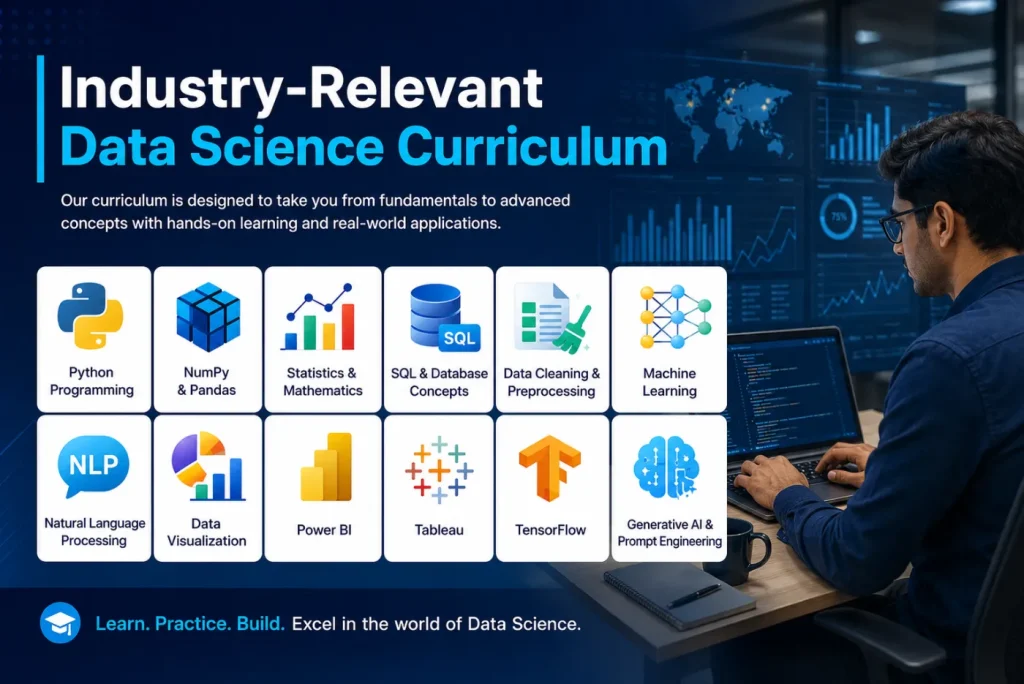
This is particularly useful for beginners because Data Science can initially appear overwhelming due to the number of technologies involved.
A structured curriculum can help learners understand how these technologies connect with one another.
2. Practical Learning Instead of Only Theory
One of the most important factors when selecting a Data Science training institute in Bangalore is the amount of practical exposure provided during the program.
Knowing how a Machine Learning algorithm works is useful, but knowing how to apply it to a business problem is much more valuable.
NUCOT’s training includes practical assignments, real-time projects, and business case-based learning. The program is designed to give learners opportunities to work with datasets, perform data preparation, build analytical solutions, and apply Machine Learning concepts.
Practical work can also help learners build a portfolio that demonstrates what they can actually do.
For example, instead of simply mentioning “Python” or “Machine Learning” on a resume, a learner can discuss projects involving data cleaning, visualization, predictive modeling, or dashboard development.
3. Generative AI Included in the Learning Path
The Data Science landscape is changing rapidly, and Generative AI has become an important part of modern technology roles.
NUCOT includes Generative AI as part of its Data Science learning path, with areas such as Large Language Models, prompt engineering, APIs, and AI applications.
This provides learners with exposure beyond traditional analytics and Machine Learning.
Understanding how AI tools work and how they can be integrated into applications can be useful for professionals looking to build skills relevant to the evolving technology market.
For learners comparing AI and Data Science courses in Bangalore, having both conventional Data Science foundations and Generative AI exposure in one program can be an advantage.
4. Training for Different Types of Learners
Not everyone joining a Data Science program comes from the same background.
Some learners may be fresh graduates looking for their first IT opportunity. Others may already be working in IT and want to move into Data Science. Some may come from non-IT backgrounds and be planning a career transition.
NUCOT positions its Data Science program for fresh graduates, career switchers, working professionals, and entrepreneurs. Prior programming experience can be helpful, but the program starts with Python fundamentals, making it accessible to beginners as well.
This makes the learning approach relevant to people at different stages of their careers.
However, learners should remember that Data Science requires consistent practice. An institute can provide the curriculum and guidance, but developing job-ready skills also depends on how seriously the learner works on assignments, projects, and interview preparation.
5. Classroom and Online Learning Options
Learning preferences vary from person to person.
Some students prefer classroom training because they value face-to-face interaction, immediate doubt clarification, and learning alongside other students. Others prefer online classes because of work commitments, travel, or location.
NUCOT provides both offline classroom training in Bangalore and live online training options. Its classroom program emphasizes face-to-face learning, trainer interaction, and peer collaboration, while online sessions provide live instruction and mentorship.
Having both formats gives learners flexibility when deciding how they want to pursue their Data Science education.
6. Career Preparation Beyond Technical Training
Completing technical training is only one part of starting a Data Science career.
Candidates also need to prepare for:
- Resume screening
- Technical interviews
- Project discussions
- Communication rounds
- Mock interviews
- Portfolio presentation
- Job applications
NUCOT’s placement assistance process includes career assessment, resume and portfolio development, mock interviews, interview preparation, and job referrals.
This approach recognizes that candidates need both technical skills and career-readiness skills when entering the job market.
The institute also states that placement assistance is based on candidate skills, performance, interview readiness, and employer requirements. Final hiring decisions remain with employers.
That distinction is important for anyone evaluating placement claims made by training institutes.
7. Placement Assistance With a Structured Process
Placement support is often one of the first things students look for when searching for a Data Science course in Bangalore with placement.
However, placement assistance should be evaluated carefully.
Rather than looking only for a percentage, prospective students should ask:
- How are resumes prepared?
- Are mock interviews conducted?
- Are projects reviewed?
- How are candidates matched with openings?
- Is interview feedback provided?
- Does placement support continue after training?
- Are there additional charges during the placement process?
NUCOT describes a five-step placement approach covering course completion, career assessment, portfolio and resume preparation, mock interviews, and hiring.
The institute also states that it does not charge candidates during the placement process.
For prospective students, understanding the actual process is more useful than relying on a single placement percentage.
8. Real-World Career Outcomes
Another factor to consider is whether an institute can demonstrate actual learner experiences.
NUCOT’s placement page features learner testimonials describing experiences with Data Science training, technical mentoring, assignments, interview preparation, and placement support. For example, one learner reported securing a job after completing the Data Science course following a career gap, while another described practical sessions that helped improve technical knowledge and confidence.
These experiences should be considered as individual outcomes rather than guarantees for every learner. Career results can vary depending on educational background, technical ability, communication skills, project quality, interview performance, and the hiring market.
That is why prospective students should evaluate both the training methodology and their own commitment to learning.
9. Small-Batch and Interactive Learning
The learning environment can make a significant difference, especially for beginners.
In a large classroom, students may hesitate to ask questions or may not receive enough individual attention. Smaller groups can make it easier to interact with trainers and clarify doubts.
NUCOT’s published learner feedback includes positive comments about smaller batches and interactive learning. One testimonial specifically highlighted the benefit of limited class size for understanding concepts and asking questions.
For students who prefer guided learning and regular interaction, this can be an important consideration when comparing institutes.
10. Who Should Consider a Data Science Course at NUCOT?
NUCOT’s Data Science program may be relevant to several learner groups.
Fresh Graduates
Graduates from BE, BTech, BCA, MCA, BSc, and related backgrounds can use structured training to build practical skills and prepare for entry-level technology roles.
Career Switchers
Professionals from non-IT backgrounds who want to transition into analytics, AI, or Data Science can use a structured curriculum to develop programming and analytical foundations.
Working Professionals
IT professionals can use Data Science and Generative AI training to expand their existing technical skills and explore AI-oriented career opportunities.
Learners Interested in AI
Those interested in Machine Learning, Generative AI, NLP, or AI engineering can benefit from a curriculum that combines traditional Data Science concepts with newer AI technologies.
What Should You Check Before Enrolling?
Even if an institute appears suitable, it is worth doing your own evaluation before paying the course fee.
Ask for a detailed curriculum and understand what will actually be taught.
Check whether practical projects are included and ask whether you will be able to discuss those projects during interviews.
Understand the class format, batch size, duration, trainer experience, and availability of doubt-clearing support.
Most importantly, ask for a clear explanation of placement assistance. A training institute should be transparent about the difference between placement assistance and guaranteed employment.
NUCOT itself states that its program is a paid training program and that placement assistance depends on factors such as candidate performance, technical skills, interview readiness, and employer requirements.
Final Thoughts: Is NUCOT Worth Considering?
Choosing a Data Science institute in Bangalore should not be based on a single factor such as course fees, advertisements, certificates, or placement numbers.
A better approach is to look at the complete learning journey.
NUCOT combines Python, SQL, statistics, Machine Learning, data visualization, Power BI, and Generative AI with practical projects and career preparation. It offers both classroom and online learning options and provides structured placement assistance involving resume development, mock interviews, portfolio preparation, and career guidance.
For learners who want a practical, job-oriented path into Data Science, these are important factors to consider.
Ultimately, an institute can provide the training, mentors, projects, and career support—but the learner’s consistency makes the biggest difference. Regular practice, project development, interview preparation, and continuous learning are essential for building a sustainable Data Science career.
If you are comparing Data Science training institutes in Bangalore, NUCOT can therefore be one of the institutes worth researching, visiting, and evaluating based on your own career goals before making a decision.
Frequently Asked Questions
1. Is NUCOT suitable for beginners in Data Science?
Yes. NUCOT’s program starts with Python fundamentals and progresses toward Machine Learning, AI, visualization, and Generative AI, making it suitable for learners who are new to the field.
2. Does NUCOT offer offline Data Science training in Bangalore?
Yes. NUCOT offers classroom-based Data Science training in Bangalore as well as live online training.
3. Does the course include Generative AI?
Yes. Generative AI is included in the curriculum, with topics including LLMs, prompt engineering, APIs, and AI applications.
4. Does NUCOT provide placement assistance?
Yes. NUCOT provides placement assistance that includes career assessment, resume and portfolio preparation, mock interviews, and job referrals.
5. What skills can learners develop?
The program covers Python, SQL, statistics, data analysis, visualization, Machine Learning, Power BI, TensorFlow, and Generative AI, along with practical project experience.






