
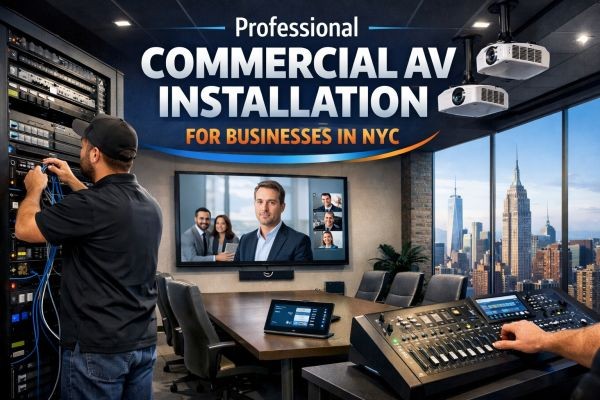
A professional Commercial AV Installation goes far beyond hanging a display and dropping in speakers; it is an engineered integration of acoustics, signal management, power infrastructure and user experience design that supports dozens or thousands of hours of mission-critical use. Businesses, education institutions, and public venues depend on commercial AV systems for clear communication, compelling presentations, and reliable events. This article explores the planning, engineering, installation and lifecycle practices that make commercial AV deployments successful and sustainable over time.
Engineering Begins With Use Cases And Requirements
An effective AV installation starts by documenting precise use cases. Is the room for boardroom meetings, live streaming classes, or multi-camera production for town halls? The stated use case drives almost every downstream decision: speaker choice, camera count, processor capacity, rack depth and network topology. Engineers perform a technical discovery that maps content sources, expected simultaneous inputs, room occupancy patterns, accessibility needs and future use scenarios. This upfront specificity prevents overbuilding or under-provisioning and ensures the system is purpose built rather than generic.
Acoustic Design And Treatment As Foundational Elements
Acoustics are often the difference between a functional system and a great one. Before selecting speakers, a commercial AV installation addresses room modes, reverberation times and first-reflection points. Acoustic panels, bass traps, diffusers and cloud treatments are specified to tame reflections and produce intelligible speech. For larger spaces, room shape and seating geometry are factored into speaker coverage models, while feedback control and isolation prevent bleed into microphones during live events. Intelligent acoustic design reduces electronic processing needs and results in cleaner, more natural audio that audiences accept without fatigue.
Audio System Design: Coverage, Clarity, And Redundancy
Commercial installations consider coverage patterns and array design for even SPL distribution, microphone topology for floor noise rejection and DSP configurations for clarity. For mission-critical spaces redundancy matters: parallel audio paths, multiple microphone pickup points and spare amplifier channels protect against single-point failures. The signal chain is engineered for headroom so transient peaks do not clip and dynamic content retains its impact. Where live mixing or production is required, consoles and routing matrices are sized to handle multiple sources with low-latency processing.
Video And Display Planning For Visual Impact
Visual decisions are dictated by viewing distance, content type and ambient light. For presentation-heavy rooms, a high-brightness laser projector paired with a low-gain screen can deliver large, high-contrast images in dimmable spaces, while LED or OLED panels are better for rooms with mixed lighting. For multi-display environments, video processing and scaling must be designed for seamless source distribution. In auditorium and stadium installations, redundancy and failover for projection paths and content servers ensure events proceed uninterrupted even when a component fails.
Control Systems And Simplified UX
Commercial users expect AV to “just work.” Control systems abstract complexity into simple touch-panel presets or integrated automation that sets lighting, shades, projectors and audio levels with a single action. Good AV installation firms design user flows with the least number of steps for common tasks, provide clearly labeled touchscreen pages and ensure fallback manual controls are present for emergency use. Training and clearly documented quick-start sheets are part of the handover, reducing calls and increasing user confidence.
Infrastructure: Cabling, Power, And Rack Design
Professional installations treat infrastructure as first-class. Structured cabling, proper conduit, and rack design with thermal management and cable labeling make systems serviceable. Power design includes dedicated circuits for amplifiers, UPS protection for processors and media servers, and proper grounding and bonding to eliminate hum and noise. Racks are engineered for airflow and accessibility; cable management prevents future errors and simplifies troubleshooting. A tidy rack is also a risk mitigation practice—serviceability reduces downtime and field service cost.
Networked AV And IP-Based Systems
IP-based AV offers flexibility, but it requires robust network design. Commercial AV installation integrates AV over IP with VLANs, multicast planning, QoS and bandwidth reservations to ensure media streams do not interfere with enterprise traffic. Management systems monitor stream health and allow coordinated firmware updates. Security—access controls and authentication—prevents unauthorized stream injection or control. Properly engineered networked AV combines the agility of IP with the reliability enterprises require.
Testing, Commissioning, And Acceptance
Before handover, comprehensive testing validates the installation under load. Commissioning includes audio sweep tests, video signal routing verification, redundancy failover tests and full run-throughs of typical event workflows. Acceptance criteria should be objective and measurable—SPL uniformity tolerances, latency limits, and successful failover behavior. A signed commissioning report confirms the system meets the technical brief and provides a baseline for future maintenance.
Training, Documentation, And Knowledge Transfer
Commercial AV installations include formal training for operators and facility staff. Training covers daily operations, emergency procedures, simple troubleshooting and escalation paths. Documentation delivered at handover includes as-built diagrams, equipment lists with serial numbers, firmware baselines and scheduled maintenance tasks. This knowledge transfer reduces dependence on external contractors for routine tasks and increases uptime.
Maintenance, Service Contracts, And Lifecycle Management
Commercial AV systems require ongoing care—lamp replacements, firmware patches, connector inspections and DSP recalibration. Service contracts provide scheduled maintenance windows, priority field service and replacement part availability. Lifecycle planning anticipates component obsolescence and budgets for mid-life refreshes of displays, amplifiers and networked endpoints. A proactive maintenance posture reduces surprise failures and spreads capital replacement over time.
Accessibility, Compliance, And User Safety
Installations must meet accessibility standards for control heights, assistive listening loops and readable captions for the hearing impaired. Emergency audio evacuation messages and synchronized visual cues are integrated where required to comply with building codes. Safety in rigging, cable routing and electrical work is enforced through certified installers, ensuring the installation meets legal and ethical standards.
Project Management And Stakeholder Coordination
Commercial installations involve multiple stakeholders: AV engineers, IT, facilities, architects and executive sponsors. Successful projects have a single integrator who coordinates trades, aligns schedules, and manages scope changes. Clear milestones, weekly progress reports and a defined punchlist process keep projects on time and reduce surprise costs during the finishing phase.
Conclusion
Commercial AV installation is an engineered discipline that balances acoustics, visual systems, signal management, network integration and user experience. Organizations that invest in professional engineering, thorough commissioning and proactive maintenance realize communication environments that are reliable, engaging and scalable. Done well, commercial AV becomes a silent partner in enterprise operations—powering meetings, events and productions with consistent quality and predictable performance.






