
Industrial electronic equipment is becoming faster, smaller, and more connected. Factory automation, motor drives, data equipment, charging systems, power converters, and communication networks all contain electronics that can generate or experience electromagnetic interference (EMI).
That makes noise control an important part of electrical design.
One component frequently used for this purpose is the common mode choke.
Although a common mode choke is related to other magnetic components such as inductors and transformers, it has a different job. Its primary purpose is to increase impedance to unwanted common-mode noise while allowing the intended differential-mode current or signal to pass with relatively little interference.
For engineers researching all transformers devices manufacturing USA, common mode chokes are worth considering separately because they belong to the broader family of magnetic components used in electrical and electronic systems. They may be manufactured alongside transformers, inductors, and other custom magnetic components, but their function is specifically associated with EMI and EMC control.
Why EMI Has Become a Bigger Design Concern
Electronics rarely operate alone anymore.
A modern industrial machine may contain a motor drive, programmable controller, sensors, communication interfaces, switching power supplies, processors, and networking equipment. These circuits can operate at different frequencies and may be connected through cables that provide paths for unwanted electrical noise.
Switching power supplies are a particularly important example.
Rapid changes in voltage and current can create high-frequency noise. That noise can travel through power lines or signal connections and potentially interfere with other circuits.
EMI can also move in the opposite direction. External noise can enter sensitive electronic equipment through cables and connections.
The result is that engineers often need to consider both emissions and immunity during system design.
TDK explains that common-mode filters and chokes are used for noise suppression on power and signal lines and can help with electromagnetic compatibility.
What Is a Common Mode Choke?
A common mode choke is a magnetic component designed to suppress common-mode electrical noise.
It typically uses two or more windings on a shared magnetic core. The desired currents flowing in opposite directions can produce magnetic fields that largely cancel each other, while common-mode noise currents flowing in the same direction produce magnetic flux that results in higher impedance.
This difference is what allows the component to suppress common-mode noise without simply blocking the normal signal or power current.
TDK describes the basic structure as similar to two choke coils combined on one core. The winding arrangement allows differential-mode signals to pass while presenting greater impedance to common-mode noise.
In simple terms, a common mode choke can be thought of as a noise filter for unwanted current that appears in the same direction on multiple conductors.
How Common Mode Chokes Work
To understand the component, it helps to distinguish between two types of current behavior.
Differential-Mode Current
Differential-mode current travels through one conductor and returns through another in the normal circuit path.
The magnetic fields created by the two windings can largely cancel when the component is designed correctly for this operating mode.
This means the desired power or signal can pass through the choke without experiencing the same impedance that common-mode noise sees.
Common-Mode Current
Common-mode current travels in the same direction on the conductors.
Instead of canceling, the magnetic effects reinforce one another in the core.
The resulting impedance makes it more difficult for high-frequency common-mode noise to travel through the circuit.
This principle is why common mode chokes are useful in EMI filtering.
Analog Devices explains that common-mode chokes can be placed between a noise source and a power-line input or output to attenuate conducted common-mode noise.
Common Mode Choke vs Transformer
A common question is whether a common mode choke is simply a type of transformer.
The two components share some physical characteristics, particularly the use of magnetic cores and multiple windings in many designs. However, their intended functions are different.
A transformer is generally designed to transfer electrical energy between circuits and can be used for voltage conversion, isolation, impedance transformation, or other purposes.
A common mode choke is primarily designed to suppress unwanted common-mode noise.
Analog Devices describes power transformers as components used to step voltage up or down between primary and secondary circuits, while common-mode chokes are designed specifically for filtering common-mode noise.
This distinction matters when selecting magnetic components for industrial equipment.
A transformer should not automatically be substituted for a common mode choke simply because both use magnetic coupling.
Where Common Mode Chokes Are Used
Common mode chokes appear in a wide variety of electrical and electronic systems.
Their applications can include power supplies, industrial control equipment, communication interfaces, automotive electronics, data equipment, and other systems where electromagnetic noise needs to be controlled.
Industrial Automation
Factories increasingly depend on electronic control systems.
Programmable logic controllers, motor drives, sensors, industrial computers, robotics, and communication equipment may all operate within the same environment.
Motor drives and switching electronics can create electrical noise that travels through power and signal cables.
A common mode choke can be incorporated into the appropriate circuit to help control this noise.
This is particularly relevant when several electronic systems operate close together and reliable communication is important.
Power Supplies and Converters
Switching power supplies are another major application.
Modern power converters can operate at relatively high switching frequencies. Rapid switching creates electrical waveforms that can contain unwanted high-frequency components.
Common mode filtering can be part of the overall EMI-control strategy.
TDK notes that common-mode filters are useful in power-line applications for suppressing conducted common-mode interference.
The choke is normally only one part of the filtering system. PCB layout, grounding, shielding, capacitors, inductors, cable routing, and enclosure design can all affect final EMI performance.
Data and Communication Equipment
Common mode chokes are also used on communication lines.
High-speed interfaces are especially sensitive to the balance between noise suppression and signal integrity.
A filter that removes too much of the desired high-frequency signal can create a new problem.
This is why the electrical characteristics of the choke need to match the communication interface.
TDK notes that common-mode filters are used on high-speed interfaces such as USB, HDMI, DisplayPort, and other differential communication systems.
Würth Elektronik has also documented the use of common mode chokes for EMI suppression on USB interfaces used in industrial applications.
Automotive and Electrified Systems
Automotive electronics have also increased the importance of EMI control.
Modern vehicles contain numerous electronic control units, communication networks, power converters, sensors, and electrified systems.
Common mode chokes can be used on appropriate power or communication lines to reduce unwanted noise.
For example, TDK describes common-mode filters for automotive power supply lines as a countermeasure for common-mode noise associated with higher-frequency DC-DC converter operation.
The same general engineering principle applies to other electrified equipment where switching power electronics create high-frequency interference.
Common Mode Chokes and U.S. Transformer Manufacturing
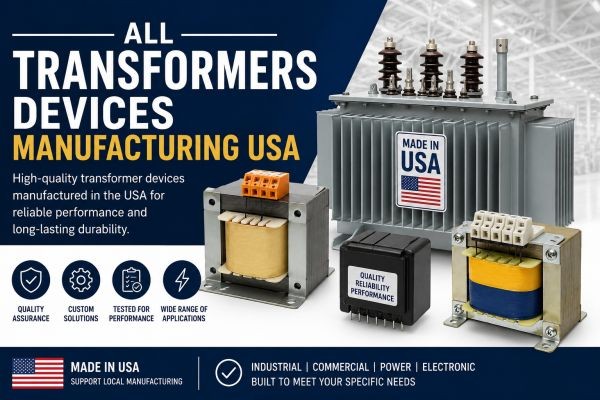
The phrase “all transformers devices manufacturing USA” can refer broadly to companies and facilities involved in producing different magnetic components for electrical equipment.
However, transformers and common mode chokes should not be treated as identical products.
A magnetic-component manufacturer may produce several related categories, including:
-
Power transformers
-
High-frequency transformers
-
Isolation transformers
-
Current transformers
-
Toroidal transformers
-
Inductors
-
Common mode chokes
-
Specialty magnetic components
-
Custom transformer assemblies
CET Technology, for example, identifies transformers, inductors, chokes, and other magnetic components among its product categories. Its published information also states that it provides U.S.-based engineering, sales, and customer service while manufacturing takes place at facilities in Asia.
That distinction is useful for procurement teams.
A company can have U.S.-based engineering or customer support without every component being physically manufactured in the United States. If domestic manufacturing is a requirement for a particular project, buyers should verify the manufacturing location of the specific component rather than assuming it from a company's location or marketing description.
Important Specifications When Selecting a Common Mode Choke
Selecting a common mode choke involves more than choosing the highest inductance available.
The component has to match the electrical and mechanical requirements of the circuit.
Common-Mode Impedance
Common-mode impedance is one of the most important characteristics.
The choke needs to provide sufficient impedance in the frequency range where unwanted noise occurs.
TDK recommends considering the relationship between the desired transmission frequency, filter cutoff characteristics, and the frequency range of the noise being suppressed.
Rated Current
The choke must also handle the expected current.
Current affects temperature rise and power losses.
TDK notes that rated current for common-mode filters is defined in relation to temperature rise when current is applied to the lines.
Therefore, a component should not be selected based only on its impedance specification.
Rated Voltage
Voltage requirements also need to be considered.
The applicable voltage rating depends on the circuit and the construction of the particular component. TDK specifies the rated voltage of a common-mode filter in relation to the voltage between the relevant lines.
Differential-Mode Performance
A common mode choke should suppress unwanted common-mode noise without unnecessarily degrading the intended differential signal.
This becomes particularly important in high-speed communication applications.
The communication data rate, signal bandwidth, impedance, insertion loss, and choke characteristics all need to be considered together.
Custom Common Mode Chokes for Specialized Equipment
Not every industrial application can use the same catalog component.
Equipment designers may have limitations involving:
-
Available PCB space
-
Current
-
Voltage
-
Frequency
-
Connector configuration
-
Mounting method
-
Temperature
-
Insulation
-
Required impedance
-
Mechanical dimensions
-
Production volume
A custom common mode choke can be developed when the standard options do not provide the required combination of characteristics.
Customization can involve the core, winding arrangement, dimensions, terminals, electrical ratings, or other construction details.
This is similar to custom transformer development, where the magnetic component is designed around the requirements of the equipment rather than forcing the equipment design around a standard component.
Common Design Mistakes to Avoid
One common mistake is choosing a choke based only on inductance.
Inductance is important, but it does not tell the entire story.
Engineers should also consider the frequency range of the noise, common-mode impedance, differential-mode behavior, current rating, voltage rating, temperature rise, physical size, and the characteristics of the complete circuit.
Another mistake is adding an EMI component too late in the design process.
TDK notes that PCB provisions for common-mode filtering are preferably considered during the design stage because adding a filter later can require changes to the circuit layout.
The physical location of the choke can also matter.
A component placed far away from the noise source may not provide the same system-level benefit as a correctly positioned filter.
EMI control is therefore a system-design problem, not simply a component-selection problem.
FAQs About Common Mode Chokes
What is the main purpose of a common mode choke?
Its primary purpose is to suppress unwanted common-mode electromagnetic interference on power or signal lines while allowing the intended differential-mode current or signal to pass.
Is a common mode choke a transformer?
Not in terms of its primary function. Both can use magnetic cores and windings, but a transformer is generally designed for energy transfer or voltage transformation, while a common mode choke is designed primarily for noise suppression.
Where are common mode chokes used?
They can be used in industrial automation, switching power supplies, communication equipment, automotive electronics, data equipment, and other systems where common-mode EMI needs to be controlled.
Does a common mode choke reduce all electrical noise?
No. Its effectiveness depends on the type and frequency of the noise, the component characteristics, the circuit layout, and the rest of the filtering system. Differential-mode noise may require additional filtering methods.
How do I choose a common mode choke?
Start with the application's current, voltage, signal or switching frequency, required common-mode impedance, differential-mode performance, temperature conditions, physical dimensions, and mounting requirements.
Can common mode chokes be customized?
Yes. Depending on the manufacturer and application, magnetic components can be customized for electrical ratings, dimensions, winding arrangements, terminals, and other requirements.
Why are common mode chokes important in industrial electronics?
Industrial equipment often contains switching power supplies, motors, drives, processors, and communication systems that can generate or experience electromagnetic interference. Common mode chokes can form part of the EMI-control strategy.
Are common mode chokes used with transformers?
Yes. They can appear in the same power-electronic system but perform different functions. For example, an isolated power converter may use a transformer for isolation or energy transfer and a common mode choke for EMI suppression.
Conclusion
Common mode chokes are relatively small components, but they can have an important role in modern electronic systems.
As industrial equipment becomes more automated, connected, and dependent on switching power electronics, controlling electromagnetic interference becomes an increasingly important part of electrical design.
A common mode choke provides one method of addressing unwanted common-mode noise. Its effectiveness depends on selecting the appropriate electrical characteristics and integrating the component correctly into the overall system.
For companies researching transformer devices manufacturing in the USA, it is useful to look beyond transformers alone. Common mode chokes, inductors, and other magnetic components can perform very different functions while being part of the same broader power-electronics ecosystem.
The most appropriate component ultimately depends on the application, electrical requirements, operating environment, and EMI problem being addressed.






