
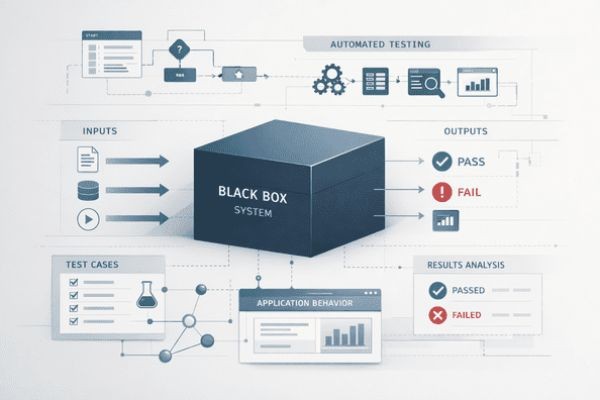
Ensuring that software behaves correctly from a user’s perspective is a central objective of quality assurance. Testers often need to validate system functionality without examining internal code structures. This is where black box testing becomes particularly valuable. By focusing on inputs, outputs, and system behavior, this approach allows testers to evaluate whether an application meets its functional requirements.
To make testing more structured and efficient, QA teams rely on several well-defined techniques. These techniques help testers design effective test cases, identify edge cases, and uncover potential defects in software systems.
Equivalence Partitioning
Equivalence partitioning is one of the most widely used techniques in black box testing. The idea behind this approach is to divide input data into groups, or partitions, that are expected to behave in similar ways.
Instead of testing every possible input value, testers select one representative value from each partition. If the selected value works correctly, it is assumed that other values in the same group will also behave as expected.
For example, if a form accepts ages between 18 and 60, testers may create separate partitions for valid and invalid inputs and test representative values from each group. This method reduces the number of test cases while still maintaining good coverage.
Boundary Value Analysis
Many software defects occur at the boundaries of input ranges rather than within normal operating conditions. Boundary value analysis focuses on testing values at the edges of valid input ranges.
Testers typically evaluate the minimum value, maximum value, and values just outside these limits. For instance, if a system accepts numbers between 1 and 100, testers may validate inputs such as 0, 1, 100, and 101.
This technique is highly effective at identifying off-by-one errors and validation problems that often occur in real applications.
Decision Table Testing
Some applications rely on complex business rules that involve multiple conditions and outcomes. Decision table testing helps testers organize these rules in a structured format.
In this technique, testers create a table that lists different combinations of conditions along with the expected results. Each row in the table represents a unique test scenario.
Decision tables ensure that all possible combinations of conditions are considered, making this technique particularly useful for systems that process transactions, approvals, or eligibility rules.
State Transition Testing
Certain applications behave differently depending on their current state or previous actions. State transition testing focuses on verifying how a system moves from one state to another when specific events occur.
For example, an account login system may transition between states such as active, locked, or suspended depending on login attempts or administrative actions.
By testing these transitions, QA teams can verify that the system handles different states correctly and prevents unexpected behavior.
Error Guessing
Error guessing is a technique that relies on the tester’s experience and intuition to identify potential problem areas. Experienced testers often anticipate where defects are likely to occur based on previous projects or common development mistakes.
For example, testers might check scenarios involving empty inputs, incorrect formats, or unexpected user actions. Although this approach is less structured than other techniques, it can reveal issues that formal methods might miss.
Error guessing works best when combined with systematic testing methods.
Pairwise Testing
When systems accept multiple input parameters, the number of possible test combinations can become extremely large. Pairwise testing helps reduce this complexity by testing combinations of two parameters at a time.
Research has shown that many defects occur due to interactions between pairs of inputs rather than larger combinations. By focusing on these interactions, testers can significantly reduce the number of required test cases while still detecting many potential issues.
This technique is particularly useful in complex applications with multiple configuration options.
Role of Black Box Testing in a Broader Testing Strategy
Modern quality assurance practices often combine different testing approaches to achieve better coverage. While black box testing focuses on validating system behavior from an external perspective, other methods examine internal code logic and structure.
In many projects, teams apply both black box testing and white box testing to analyze software from different angles. The external validation performed through black box methods ensures that the system behaves correctly for users, while internal testing methods help verify code reliability.
Using multiple approaches together creates a more balanced and comprehensive testing strategy.
Conclusion
Structured testing techniques play an important role in making functional validation more effective. Techniques such as equivalence partitioning, boundary value analysis, decision table testing, and state transition testing help QA teams design meaningful test cases and uncover potential defects.
By applying these methods within black box testing, testers can systematically evaluate software behavior without relying on internal implementation details. When integrated into a broader quality assurance strategy, these techniques help organizations deliver reliable and user-focused software systems.






