
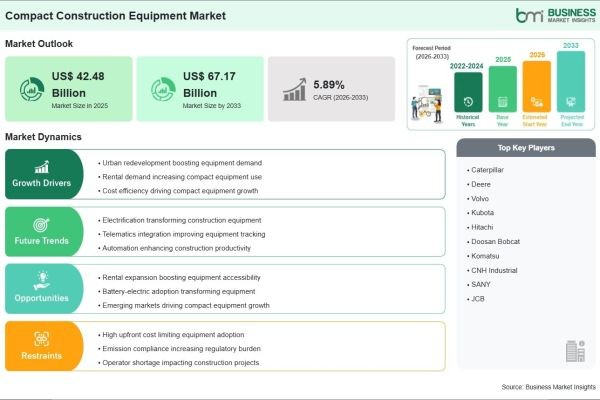
A consistent operational scale-up is expanding global equipment rental and manufacturing pipelines, fueled by the commercial necessity to supply adaptable, precision-focused machinery capable of supporting rigorous infrastructure and residential projects within confined urban environments.
Based on market intelligence from Business Market Insights, the global Compact Construction Equipment Market is anticipated to reach US$ 67.17 Billion by 2033, mounting from its 2025 value of US$ 42.48 Billion at a projected CAGR of 5.89% from 2026 to 2033.
Technological advancements in telematics, multi-functional design capabilities, and zero-emission electric powertrains are reshaping the compact construction equipment industry. Manufacturers are increasingly focusing on delivering smart machines equipped with advanced GPS tracking, automated load sensing, and improved operator ergonomics. This strategic shift allows contractors to achieve highly optimized operational efficiency and precise material handling, significantly lowering project timelines and fuel consumption while comfortably meeting strict environmental sustainability standards.
Download Sample Report : https://www.businessmarketinsights.com/sample/BMIPUB00035342
What Is Compact Construction Equipment?
Compact construction equipment refers to a class of heavy-duty, yet physically smaller machinery designed specifically to operate in confined spaces where traditional heavy construction equipment cannot fit or maneuver effectively. These versatile machines are engineered for agility, lower ground pressure, and multi-attachment compatibility, making them indispensable for urban redevelopment, residential landscaping, and tight-quarter utility repairs. They feature robust hydraulic systems, operator-centric cabins, and highly efficient engines designed to maximize digging, lifting, and grading capabilities within a minimal footprint.
Common compact construction equipment includes mini excavators, compact track loaders, skid steer loaders, telehandlers, and compact wheel loaders. Modern compact machines increasingly feature quick-coupler systems that allow operators to seamlessly switch between buckets, augers, trenchers, and hydraulic breakers, essentially turning one machine into a multi-purpose workhorse. The integration of advanced diagnostics and electric variants ensures that these machines can safely operate within fast-paced, emission-sensitive urban zones where noise and exhaust pollution are strictly regulated.
Industry Drivers
A major driver of the Compact Construction Equipment Industry is the massive expansion of urban redevelopment and residential construction projects globally. As older urban infrastructure undergoes renewal and cities become more densely populated, the need for machinery that can perform heavy-duty tasks within confined alleys, residential backyards, and tight street corners is skyrocketing. This spatial constraint directly translates into robust, recurring procurement and rental orders for compact excavators and skid steers among municipal bodies and independent contractors.
The rapid growth of the equipment rental service sector is another crucial growth factor. Heavy machinery often requires significant upfront capital and ongoing maintenance costs. The thriving equipment rental market allows small to mid-sized contractors to access premium, well-maintained compact equipment for short-term projects or seasonal applications without the financial burden of ownership. This shift in procurement models greatly expands the user base and overall utilization rates of compact machinery worldwide.
Furthermore, a heightened focus on environmental compliance and sustainability is boosting demand for electric and hybrid compact equipment. Strict emissions regulations in North America and Europe have pushed manufacturers to develop battery-electric variants of mini excavators and loaders. These electric models provide zero-emission, low-noise operation, making them highly desirable for indoor construction, underground utility work, and late-night urban operations where traditional diesel engines would be prohibited.
Industry Segmentation
By Equipment Type
- Excavators (Mini/Compact): The dominant segment globally, essential for precision trenching, foundation digging, and utility line installation in tight spaces.
- Skid Steer Loaders: Highly versatile and maneuverable machines favored for landscaping, material handling, and site clearing.
- Track Loaders: Similar to skid steers but equipped with tracks for superior traction and lower ground pressure on muddy or uneven terrain.
- Loaders (Compact Wheel Loaders): Utilized for efficient loading and transporting of materials across medium-sized construction sites.
- Telehandlers: High-value machines that provide superior reach and lifting capabilities, bridging the gap between a forklift and a crane.
- Compactors: Essential for soil and asphalt compaction in narrow trenches and tight residential driveways.
By Propulsion
- Internal Combustion Engine (ICE): The leading segment owing to its established reliability, immediate refueling capability, and continuous runtime in remote, demanding environments.
- Electric: A rapidly growing segment driven by stringent urban emission laws and the need for low-noise, indoor-compatible machinery.
By Power Output
- <60 HP: Represents a significant market share, providing an ideal balance of compact size and adequate power for residential and light utility work.
- 61–100 HP: Heavy-duty compact machines designed for more demanding commercial site preparation and heavy material lifting.
By Engine Capacity
- <2L: Ideal for ultra-compact micro-excavators and small skid steers.
- 2–3.5L: The most popular segment, providing an optimal combination of fuel efficiency and reliable power output for a vast majority of compact equipment.
- >3.5L: Used in the largest tier of compact machinery requiring high hydraulic flow rates for heavy attachments.
The excavator segment dominates the industry due to its fundamental role in almost every preliminary construction and utility laying procedure. Internal Combustion Engines (ICE) remain the leading propulsion segment because of global fuel accessibility and continuous runtime. Engines between 2-3.5L account for the largest capacity share, supported by their perfect balance of torque and operational efficiency.
Regional Insights
- North America dominated the industry due to a highly developed residential construction sector, massive investments in utility infrastructure upgrades, and a dominant equipment rental ecosystem. The U.S. is a primary hub for advanced skid steer and track loader utilization.
- Asia-Pacific is expanding rapidly, supported by massive urban migration, government-backed smart city initiatives, and booming infrastructure developments across China, India, and Southeast Asia. The continuous push for affordable housing drives immense machinery procurement.
- Europe continues to grow steadily, driven by a strong focus on green construction mandates, stringent emission regulations, and the rapid adoption of electric compact equipment across the UK, Germany, and the Nordic countries.
- Middle East & Africa is seeing rising demand from ongoing investments in commercial mega-projects, landscaping for tourism infrastructure, and urban modernization in the GCC region.
- South & Central America remains an active market, focusing on agricultural infrastructure, mining support, and improving urban utility networks in Brazil and Mexico.
Top Players in the Compact Construction Equipment Industry
The industry is highly competitive, with leading machinery manufacturers focusing on technological integration, electrification, and expanding their global dealer and rental networks.
- Caterpillar Inc.
- Deere & Company (John Deere)
- Volvo Construction Equipment
- Kubota Corporation
- Hitachi Construction Machinery Co., Ltd.
- Doosan Bobcat
- Komatsu Ltd.
- CNH Industrial N.V.
- SANY Group
- JCB
These companies continue to invest heavily in specialized R&D, aiming to develop fully electric fleets, sophisticated telematics fleet management software, and highly efficient hydraulic systems.
Technological Innovations
Technological innovation is transforming the Compact Construction Equipment Industry. The deployment of advanced Telematics and Fleet Management Systems allows contractors to remotely monitor the health, location, and fuel consumption of their entire machinery fleet in real-time. This digital integration helps predict maintenance needs before mechanical failures occur, drastically reducing costly machine downtime and improving overall project efficiency.
Manufacturers are also rapidly advancing the design of Battery-Electric and Hybrid powertrains. The development of high-capacity lithium-ion battery packs allows modern electric mini excavators and loaders to operate for a full working shift on a single charge. These innovations not only protect the environment by eliminating diesel emissions but also safeguard operators from prolonged exposure to exhaust fumes and engine vibration.
Additionally, the integration of intelligent machine control and grade-assist technologies is another major trend. By combining smart sensors with the machine's hydraulics, even novice operators can achieve perfectly graded surfaces and precise trench depths automatically, significantly improving worksite productivity and reducing the need for manual site surveying.
Future Industry Outlook
The future outlook for the Compact Construction Equipment Industry remains highly positive. Rising global urbanization, the expanding need for efficient infrastructure redevelopment, continuous technological innovation in battery technologies, and a growing equipment rental market are expected to support steady demand through 2033. The ongoing shift toward zero-emission urban construction zones will further cement electric compact machinery as a vital component of modern contractor fleets.
As smart city grids, autonomous operating capabilities, and remote-control machinery continue to advance, compact construction equipment will become even more precise, automated, and seamlessly integrated into digital job-site planning. Companies that focus on developing robust electric portfolios, intelligent attachment ecosystems, and global rental partnerships are likely to capture the strongest growth opportunities in the coming years.
Frequently Asked Questions (FAQs)
What is the projected size of the Compact Construction Equipment Market by 2033?
The market is projected to reach US$ 67.17 Billion by 2033, rising from US$ 42.48 Billion in 2025.
What factors are driving industry growth?
Key drivers include rapid urban redevelopment, the booming equipment rental sector, and the increasing demand for highly maneuverable machinery in confined residential and commercial construction sites.
Which equipment segment dominates the industry?
Mini/Compact Excavators currently hold the largest market share due to their essential, high-volume role in trenching, foundation work, and utility laying across all construction sectors.
Which region leads the industry?
North America dominates the market due to robust residential construction activities, a mature machinery rental ecosystem, and continuous infrastructure modernization projects.
Browse More Reports:
https://www.businessmarketinsights.com/reports/brics-veterinary-x-ray-market
About Us
Business Market Insights is a market research platform that provides subscription service for industry and company reports. Our research team has extensive professional expertise in domains such as Electronics & Semiconductor; Aerospace & Defense; Automotive & Transportation; Energy & Power; Healthcare; Manufacturing & Construction; Food & Beverages; Chemicals & Materials; and Technology, Media, & Telecommunications.
Contact Us
If you have any questions about this report or would like further information, please contact us:
Contact person: Ankit Mathur
Email: sales@businessmarketinsights.com
Phone: +16467917070






