
Market Overview and Growth Outlook
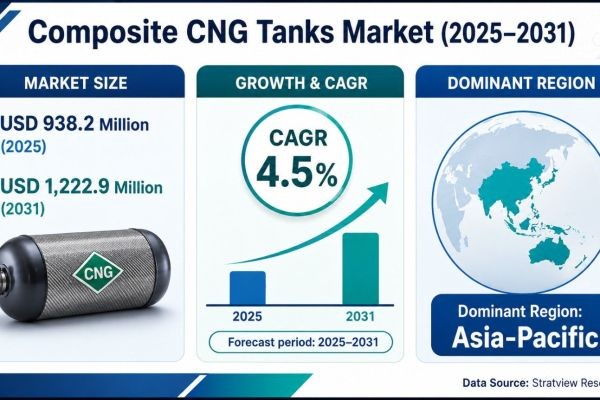
The Composite CNG Tanks Market was valued at USD 885.7 million in 2024, rising from USD 814.2 million in 2023 after 8.8% year-on-year growth. The market is projected to reach USD 938.2 million in 2025 and USD 1,222.9 million by 2031, creating a measurable long-term growth trajectory across transportation and gas-storage applications.
The Composite CNG Tanks Market is expected to grow at a CAGR of 4.5% during 2025–2031. Cumulative sales opportunities are estimated at USD 7,586.00 million over the forecast period. These figures indicate sustained demand for high-pressure storage solutions that combine lightweight construction, durability, safety, and corrosion resistance.
Composite CNG tanks combine carbon fiber, fiberglass, and resin around a metal or polymer liner. This construction reduces vehicle weight while maintaining the durability required for high-pressure natural gas storage. Lower vehicle weight supports fuel efficiency, while resistance to impacts and a lower rupture risk strengthen their suitability for cars, buses, trucks, and industrial purposes.
The latest Composite CNG Tanks Market trends reflect a transition toward lighter pressure vessels and greater adoption of CNG-powered transportation. Government support for cleaner fuel initiatives, stricter emission regulations, natural gas infrastructure expansion, and increasing vehicle adoption are reinforcing demand across the wider storage and transportation ecosystem.
Request a free sample report:
https://www.stratviewresearch.com/Request-Sample/composite-CNG-tanks-market#form
Market Segmentation Analysis
The market is segmented by Application Type into Transportation and Gas Carrier & Storage. Transportation is expected to remain the key demand generator as buses, trucks, and passenger cars shift toward CNG-powered solutions. Gas Carrier & Storage is projected to grow faster in the coming years, broadening the market’s role beyond vehicle fuel systems.
By Pressure Vessel Type, the segmentation comprises Type-II Vessels, Type-III Vessels, and Type-IV Vessels. Type-IV Vessels are expected to contribute the largest share throughout the forecast period and witness the fastest growth. Their lightweight design, durability, corrosion resistance, and ability to withstand high pressure support their leadership position.
By Region, the market is segmented into North America, Europe, Asia-Pacific, and Rest of the World. This regional structure captures differences in CNG vehicle adoption, clean-fuel policy support, natural gas infrastructure, industrial investment, and renewable-energy development while retaining the precise geographic categories established in the market analysis.
Regional Market Insights
Asia-Pacific is projected to remain the dominant Composite CNG Tanks Market throughout 2025–2031. Rapid industrialization, rising energy-industry investments, strong government support for clean-fuel initiatives, increasing adoption of CNG-powered vehicles, and expanding natural gas infrastructure collectively support the region’s leading position.
Europe is expected to record the fastest growth rate during the forecast period. The regional outlook is supported by stricter environmental regulations, rising use of hydrogen as a clean fuel, and significant investments in renewable-energy infrastructure, creating favorable conditions for advanced composite pressure vessels.
Emerging Trends Shaping the Composite CNG Tanks Market
One defining industry trend is the increasing preference for Type-IV Vessels. Their lightweight, durable, and corrosion-resistant construction addresses performance requirements for high-pressure storage. Their suitability for storing CNG and hydrogen also extends their relevance across automotive, aerospace, and industrial applications, strengthening their role within the competitive landscape.
A second trend is the widening use of composite tanks across transportation fleets. CNG adoption in buses, trucks, and passenger cars is being supported by lower emissions, fuel-cost savings, government incentives, and stricter emission regulations. This direction reinforces Transportation while creating parallel opportunities for Gas Carrier & Storage.
Key Growth Drivers of the Market
- Cleaner transportation policies: Government initiatives supporting cleaner fuel alternatives encourage vehicle operators to adopt CNG-powered solutions, increasing demand for lightweight and durable high-pressure tanks.
- Stricter emission regulations: Tighter environmental requirements accelerate the shift toward lower-emission vehicles, expanding composite tank demand across buses, trucks, and passenger cars.
- Vehicle-weight reduction: Lightweight composite construction lowers vehicle weight, supporting better fuel efficiency and strengthening the commercial case for advanced CNG storage systems.
- Natural gas infrastructure expansion: Continued development of natural gas infrastructure improves the operating environment for CNG vehicles and creates additional demand for gas-storage equipment.
- Type-IV performance advantages: Durability, corrosion resistance, high-pressure capability, and lower weight support wider investment in Type-IV Vessels across transportation and industrial applications.
Competitive Landscape
Top Companies in the Market
- Hexagon Composites ASA
- Luxfer Holdings PLC
- Worthington Industries, Inc.
- ILJIN Composites Co., Ltd.
- Sinoma Science & Technology Co., Ltd.
- Forvia SE
- CIMC Enric Holdings Limited
- Quantum Fuel Systems LLC
- Beijing Tianhai Industry Co., Ltd.
- Shenyang Gas Cylinder Safety Technology Co., Ltd.
Conclusion and Strategic Outlook
The Composite CNG Tanks Market forecast indicates an increase from USD 885.7 million in 2024 to USD 1,222.9 million by 2031, representing a 4.5% CAGR during 2025–2031. Transportation demand, Type-IV adoption, clean-fuel initiatives, natural gas infrastructure expansion, and stricter environmental regulations will remain central to the industry outlook.
Asia-Pacific’s dominance and Europe’s faster growth underline the market’s varied regional development. As lightweight pressure-vessel performance becomes increasingly important, composite CNG tanks are positioned to retain a strategic role in vehicle fuel storage, gas carrier systems, and broader clean-fuel infrastructure.
FAQs – Composite CNG Tanks Market
1. What is the Composite CNG Tanks Market size and forecast?
The Composite CNG Tanks Market was valued at USD 885.7 million in 2024 and is expected to reach USD 938.2 million in 2025. It is forecast to reach USD 1,222.9 million by 2031.
2. What CAGR is expected for the Composite CNG Tanks Market?
The Composite CNG Tanks Market is expected to grow at a CAGR of 4.5% during 2025–2031. The industry is projected to generate cumulative sales opportunities of USD 7,586.00 million during this period.
3. What factors are driving market growth?
Growth is supported by cleaner-fuel initiatives, stricter emission regulations, increasing CNG vehicle adoption, natural gas infrastructure expansion, and lightweight composite construction. These factors strengthen demand across transportation and storage applications.
4. Which regions lead market demand?
Asia-Pacific is expected to remain the dominant region throughout the forecast period. Europe is projected to grow fastest, supported by environmental regulations, hydrogen use, and renewable-energy infrastructure investment.
5. What are the key risks and investment considerations?
The source identifies competition based on price, service offerings, and regional presence. Investment opportunities are linked to Type-IV Vessels, Transportation, faster-growing Gas Carrier & Storage demand, and regions advancing clean-fuel infrastructure.






