
The Container Weighing Systems Industry is experiencing a significant structural shift globally, primarily driven by the tightening of international maritime safety regulations, the rapid automation of smart ports, and the relentless expansion of global intermodal trade. As logistics hubs and shipping terminals prioritize operational safety and supply chain transparency, precise weight measurement has evolved from a basic compliance check into a highly integrated, data-driven operational necessity.
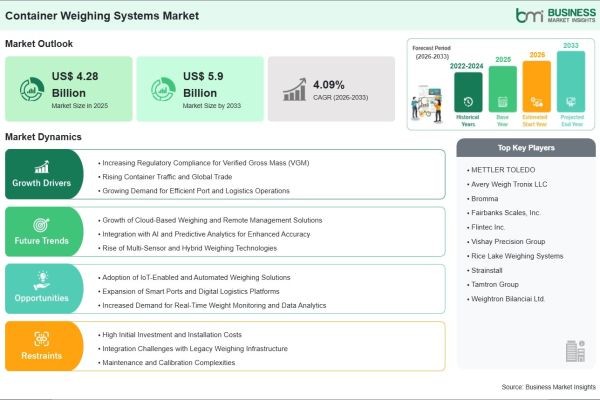
According to Business Market Insights, the global Container Weighing Systems Market size is expected to reach US$ 5.9 Billion by 2033 from US$ 4.28 Billion in 2025. The market is estimated to record a CAGR of 4.09% from 2026 to 2033.
Advancements in IoT-enabled weighbridges, dynamic on-board weighing architectures, and real-time data integration platforms are fundamentally reshaping how cargo weight is authenticated. Major port operators and logistics conglomerates are aggressively investing in automated hardware and AI-driven software suites to drastically reduce processing times, eliminate human error, and guarantee seamless compliance with international shipping mandates.
Download Sample Report : https://www.businessmarketinsights.com/sample/BMIPUB00033270
What Is a Container Weighing System?
A Container Weighing System is a highly specialized configuration of physical hardware, integrated load cells, and analytical software designed to accurately capture the gross mass of shipping containers. These systems operate across various mediums—including terminal weighbridges, reach stackers, container handling cranes, and transport chassis—to measure the total weight of a container, including its internal payload, dunnage, and securing materials.
Unlike traditional, manual weighing processes that are slow and prone to discrepancy, modern container weighing systems are fully digitized. They seamlessly interface with a port's Terminal Operating System (TOS) to instantly record, verify, and transmit the Verified Gross Mass (VGM) of a container. This exact measurement is an absolute prerequisite to prevent the catastrophic structural failure of cargo ships, crane collapses, and road transport accidents caused by dangerously overweight or improperly balanced containers.
Market Drivers
The most dominant driver propelling the Container Weighing Systems Industry is the stringent enforcement of regulatory safety frameworks, specifically the Verified Gross Mass (VGM) mandate introduced by the International Maritime Organization (IMO) under the Safety of Life at Sea (SOLAS) convention. This global regulation absolutely prohibits a packed container from being loaded onto a vessel unless its accurate, verified weight is provided to the ship's master and terminal operator. This compliance requirement forces every link in the logistics chain to invest in certified weighing infrastructure.
The rapid digital transformation of marine ports and inland logistics hubs represents another massive growth factor. The global shift toward "Smart Ports" relies heavily on automation to handle the surging volumes of international trade. IoT-connected weighing hardware is being integrated directly into container handling equipment—such as straddle carriers and RTG cranes—allowing containers to be weighed seamlessly "on the fly" without interrupting terminal workflow or causing traffic bottlenecks.
Furthermore, the transport and logistics sector is heavily deploying advanced on-board weighing systems for road and rail networks. Fines for overloaded trucks are severe, and dynamic weighing systems allow fleet operators to maximize vehicle payload capacity safely, minimizing fuel consumption and dramatically reducing wear and tear on civil infrastructure.
Market Segmentation
By Component
- Hardware
- Software and Services
By Medium
- Rail
- Road
- Ship
By Vertical
- Construction
- Food and Beverage
- Manufacturing
- Transport and Logistics
- Ports
- Other Verticals
The hardware segment currently commands the dominant share of market revenue, driven by the intensive physical deployment of heavy-duty weighbridges and specialized crane load pins globally. Meanwhile, the software and services segment is logging an exceptionally fast growth rate as stakeholders demand advanced cloud-based platforms to securely process, share, and audit VGM data across complex international supply chains. Among mediums, the road segment dominated historical market shares due to the massive volume of last-mile truck transport requiring compliance checks.
Regional Insights
- Asia-Pacific represents the absolute largest container weighing systems market globally. The region houses the vast majority of the world's busiest mega-ports across China, Singapore, and South Korea, driving unparalleled demand for high-throughput, automated terminal weighing solutions to support massive manufacturing exports.
- North America commands a highly mature market position, anchored by strict federal highway weight enforcement, aggressive port modernization programs across the US Eastern and Western seaboards, and robust investments in smart intermodal rail logistics.
- Europe maintains a robust market trajectory, heavily defined by rigorous adherence to SOLAS mandates, the rapid expansion of sustainable green logistics networks, and heavy integration of advanced port management software across vital hubs like Rotterdam and Hamburg.
- Middle East & Africa and South & Central America are demonstrating steady structural progress, supported by rising government investments in developing world-class transshipment terminals and modernizing regional freight transport corridors.
Top Players in the Container Weighing Systems Industry
The global marketplace features concentrated competition among specialized industrial metrology firms and heavy-lifting equipment manufacturers. Key industry participants are heavily focused on developing highly durable load sensors capable of functioning in severe maritime environments, alongside proprietary software that integrates directly with global customs and freight forwarding networks.
- METTLER TOLEDO
- Avery Weigh-Tronix, LLC
- Bromma
- Fairbanks Scales, Inc.
- Flintec Inc.
- Vishay Precision Group
- Rice Lake Weighing Systems
- Strainstall
- Tamtron Group
- Weightron Bilanciai Ltd
These market leaders frequently forge strategic partnerships with port authorities and terminal operating software (TOS) developers to provide end-to-end, fully automated compliance solutions.
Technological Innovations
Technological innovations in dynamic, "weigh-in-motion" (WIM) architectures are fundamentally upgrading terminal efficiency. Unlike static weighbridges that require trucks to stop entirely, advanced optical sensors and high-speed load cells can accurately determine the weight and center of gravity of a container while the vehicle or railcar is moving. This dramatically cuts down gate processing times at busy ports and prevents massive congestion backlogs.
Furthermore, the integration of blockchain technology and secure cloud architectures is gaining immense traction. As verified gross mass data must be transmitted across multiple independent entities—from the shipper to the hauler, to the terminal, to the vessel master—blockchain ensures an immutable, tamper-proof record of the container's weight. This entirely eliminates the risk of fraudulent weight declarations and massively streamlines customs auditing.
Additionally, advancements in twistlock weighing technology have allowed manufacturers to embed ultra-precise strain gauges directly into the lifting spreaders of ship-to-shore cranes. This ensures that the weight of the container is calculated perfectly as it is lifted into the air, requiring absolutely zero deviation from the standard loading sequence.
Future Market Outlook
The long-term trajectory for the Container Weighing Systems Industry remains highly stable and positive. As global trade volumes continue to rebound and shipping conglomerates deploy increasingly larger ultra-large container vessels (ULCVs), the structural risks associated with improperly distributed container weights become exponentially higher. Accurate, automated weighing infrastructure will remain the primary physical tool for maintaining global maritime safety.
The upcoming maturation of fully autonomous smart ports and AI-driven predictive logistics will push weighing systems from passive measurement tools into active load-optimization ecosystems. Companies that continuously provide hyper-accurate sensor technology, resilient hardware for extreme marine conditions, and seamless IoT software integration will maintain a commanding lead in the global transport landscape.
Frequently Asked Questions (FAQs)
What is Verified Gross Mass (VGM) and why is it legally required?
Verified Gross Mass (VGM) is the total weight of a shipping container, including the cargo, packing materials, and the tare weight of the container itself. It is legally mandated by the IMO’s SOLAS convention because historically, false or estimated container weights led to catastrophic ship stability issues, collapsed container stacks, and severe injuries to port workers.
What is the difference between static weighbridges and twistlock weighing systems?
Static weighbridges require a truck carrying the container to drive onto a large floor scale, stop, and be weighed. The weight of the truck chassis and fuel must then be subtracted to find the container's weight. Twistlock weighing systems are integrated directly into the lifting mechanisms of container cranes. They measure the exact weight of the container instantly as it is being lifted, which is generally faster and eliminates the need to calculate the truck's tare weight.
Can a container be rejected at the port if the weight is wrong?
Yes. Under the SOLAS mandate, it is illegal for a terminal operator to load a container onto a vessel without a VGM certificate. If a container arrives without a VGM, or if the terminal's scales determine the declared weight is significantly inaccurate, the container will be gated out, delayed, or subject to severe repacking fines.
How does container weighing improve road transport?
Beyond maritime safety, accurate container weighing ensures that transport trucks do not exceed local highway weight limits. Overloaded trucks are subject to massive law enforcement fines, cause severe damage to road infrastructure, and suffer from increased braking distances, posing a massive safety risk to public traffic.
Browse More Reports:
https://www.businessmarketinsights.com/reports/brics-hospital-and-pharmacy-robots-market
https://www.businessmarketinsights.com/reports/north-america-hospital-and-pharmacy-robots-market
https://www.businessmarketinsights.com/reports/benelux-non-invasive-radiosurgery-robots-market
About Us
Business Market Insights is a market research platform that provides a subscription service for industry and company reports. Our research team has extensive professional expertise in domains such as Electronics & Semiconductor; Aerospace & Defense; Automotive & Transportation; Energy & Power; Healthcare; Manufacturing & Construction; Food & Beverages; Chemicals & Materials; and Technology, Media, & Telecommunications.
Contact Us
If you have any questions about this report or would like further information, please contact us:
Contact person: Ankit Mathur
Email: sales@businessmarketinsights.com
Phone: +16467917070






