
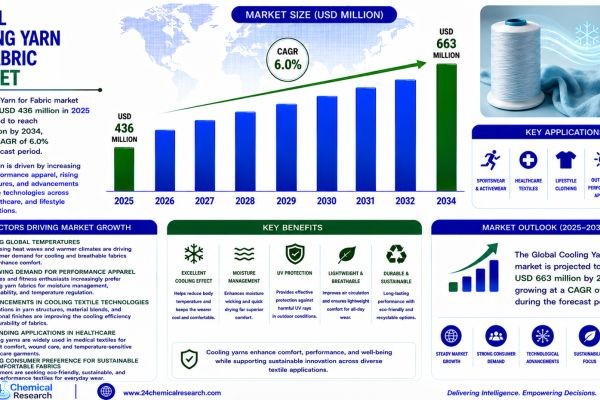
Global Cooling Yarn for Fabric market was valued at USD 436 million in 2025 and is projected to reach USD 663 million by 2034, exhibiting a steady CAGR of 6.0% during the forecast period.
Cooling yarn for fabric represents a revolutionary advancement in textile technology, engineered specifically to enhance wearer comfort through superior thermal regulation and moisture management. These specialized yarns incorporate advanced features such as moisture-wicking channels, phase-change materials (PCMs), and engineered cross-sections that facilitate rapid heat dissipation and evaporation. The technology has evolved from niche applications to become a critical component in performance apparel, driven by consumer demand for clothing that maintains comfort during physical activity and in warm environments. Unlike conventional fabrics, cooling yarns actively work to lower skin temperature, making them indispensable for sportswear, outdoor gear, and everyday clothing in increasingly warmer global climates.
Get Full Report Here: https://www.24chemicalresearch.com/reports/304155/cooling-yarn-for-fabric-market
Market Dynamics:
The market's growth trajectory is shaped by a complex interplay of powerful growth drivers, significant restraints that manufacturers are actively addressing, and vast, untapped opportunities across various application sectors.
Powerful Market Drivers Propelling Expansion
- Rising Demand for Performance and Athleisure Apparel: The massive global athleisure market, valued at over $200 billion, represents the primary growth vector for cooling yarns. Consumers increasingly seek clothing that offers both style and functionality, particularly moisture-wicking and cooling properties that enhance comfort during exercise and daily activities. This trend has blurred the lines between traditional sportswear and casual clothing, creating a substantial addressable market. Major athletic brands have responded by incorporating cooling technologies across their product lines, from high-performance training gear to lifestyle collections, driving consistent demand for advanced yarn solutions.
- Climate Change and Increasing Global Temperatures: The escalating impact of climate change has transformed cooling fabrics from a luxury to a necessity in many regions. Urban heat island effects in densely populated cities and rising average temperatures worldwide have expanded the application of cooling yarns beyond sportswear into work uniforms, healthcare garments, and everyday clothing. In regions with hot and humid climates, which encompass significant portions of Asia, Africa, and the Middle East, the functional benefits of cooling fabrics translate directly into improved comfort, productivity, and health outcomes for consumers and workers alike.
- Technological Innovations in Fiber Science: Continuous advancements in material science are driving the development of more effective and accessible cooling technologies. The integration of phase-change materials that absorb and release thermal energy represents a significant leap forward, allowing fabrics to actively regulate temperature rather than simply managing moisture. Similarly, innovations in fiber cross-sections—such as hollow-core designs that trap air for insulation and channels that enhance wicking—are creating more efficient cooling effects. Mineral-based technologies that impart cooling sensations through natural materials are also gaining traction, offering sustainable alternatives to synthetic solutions.
Download FREE Sample Report: https://www.24chemicalresearch.com/download-sample/304155/cooling-yarn-for-fabric-market
Significant Market Restraints Challenging Adoption
Despite the clear benefits and growing demand, the market faces several hurdles that must be overcome to achieve broader adoption across price-sensitive segments.
- High Production Costs and Technical Complexity: The manufacturing of advanced cooling yarns involves specialized processes, proprietary technologies, and often expensive raw materials that elevate production costs significantly compared to conventional textiles. The incorporation of phase-change materials, specialized polymer blends, and technical finishes requires sophisticated equipment and controlled environments, creating barriers to entry for smaller manufacturers. These cost premiums are ultimately passed to consumers, limiting market penetration to premium apparel segments and delaying adoption in more price-sensitive markets.
- Performance Validation and Consumer Education Challenges: Establishing and communicating the verified cooling performance of textiles remains challenging due to the lack of standardized testing protocols and clear industry labeling standards. This void has led to market confusion, with some products making unsubstantiated cooling claims that undermine consumer trust in legitimate technologies. Furthermore, educating consumers about the scientific principles behind cooling fabrics and their tangible benefits requires substantial marketing investment, which many brands are hesitant to make without guaranteed returns.
Critical Market Challenges Requiring Innovation
The transition from laboratory innovation to commercial-scale production presents unique challenges that require ongoing research and development investment.
Maintaining consistent performance quality at industrial production volumes remains difficult, particularly for technologies that rely on precise material formulations or surface treatments. The durability of cooling effects after repeated washing and wearing represents another significant technical hurdle, as some treatments degrade over time, reducing the functional lifespan of garments. Ensuring that cooling properties are intrinsic to the fiber structure rather than merely applied as surface treatments is crucial for long-term performance but requires more complex manufacturing processes.
Additionally, the market contends with supply chain complexities related to specialized raw materials. Many cooling technologies depend on specific polymers or additives that have limited sourcing options or volatile pricing. The logistical challenges of handling and storing these materials compared to conventional textiles add another layer of complexity and cost for manufacturers seeking to scale production.
Vast Market Opportunities on the Horizon
- Expansion into Healthcare and Medical Applications: The healthcare sector presents significant untapped potential for cooling yarn technologies. Patients suffering from conditions such as multiple sclerosis, menopausal hot flashes, or those undergoing chemotherapy often experience temperature regulation challenges that could be alleviated through specialized cooling garments. Additionally, healthcare worker uniforms incorporating cooling technologies could improve comfort during long shifts in warm hospital environments. The global medical textiles market, valued at over $20 billion, represents a substantial growth opportunity for manufacturers who can meet the stringent regulatory and performance requirements of this sector.
- Automotive and Interior Textile Applications: The automotive industry offers promising avenues for cooling yarn integration, particularly in seat covers, headrests, and interior surfaces that come into direct contact with occupants. As vehicles incorporate more glass surfaces and consumers spend more time in their cars, temperature regulation inside vehicle cabins becomes increasingly important. Cooling fabrics could significantly enhance passenger comfort while reducing reliance on air conditioning systems, thereby improving fuel efficiency in conventional vehicles and extending battery range in electric vehicles.
- Sustainable and Smart Textile Integration: The convergence of cooling technology with sustainability trends represents a major opportunity for market differentiation. Developing cooling yarns from recycled materials such as post-consumer polyester or bio-based sources aligns with growing consumer environmental concerns and corporate sustainability initiatives. Furthermore, integrating cooling properties with other smart textile functions—such as biometric monitoring, UV protection, or antimicrobial properties—can create multifunctional, high-value products that command premium pricing and appeal to tech-savvy consumers.
In-Depth Segment Analysis: Where is the Growth Concentrated?
By Type:
The market is segmented into Synthetic and Natural cooling yarns. Synthetic yarns, particularly advanced polyester and nylon blends, currently dominate the market due to their superior performance characteristics, durability, and ability to be engineered with precision cooling technologies. These materials offer exceptional moisture-wicking capabilities and can maintain their cooling properties through numerous wash cycles. Natural fiber options are emerging as a growing segment, driven by sustainability concerns, though they typically require blending with synthetic materials or special treatments to achieve comparable cooling performance.
By Application:
Application segments include Sportswear, Lifestyle Clothing, Protective Clothing, and Others. The Sportswear segment represents the largest application area, as the core functionality of cooling yarn directly addresses the needs of athletes and fitness enthusiasts for thermal regulation during intense physical activity. The lifestyle clothing category is experiencing rapid growth as cooling technology migrates from performance apparel into everyday garments, driven by consumer demand for comfort in casual and work settings. Protective clothing for industrial, military, and healthcare applications represents a specialized but growing segment with specific performance requirements.
By End-User Industry:
The end-user landscape includes Apparel Manufacturers, Textile Mills, and Brands/Retailers. Apparel manufacturers constitute the primary customer base, as they integrate cooling yarn into finished products across sportswear, casual wear, and specialized garments. These manufacturers drive demand based on consumer trends and specific performance requirements for their product lines. Textile mills play a crucial role in processing raw yarn into finished fabrics, while major brands and retailers increasingly influence product development through their specifications and sustainability requirements.
Download FREE Sample Report: https://www.24chemicalresearch.com/download-sample/304155/cooling-yarn-for-fabric-market
Competitive Landscape:
The global Cooling Yarn for Fabric market is characterized by moderate consolidation and intense competition driven by technological innovation. The market features a mix of established material science companies and specialized textile innovators, with the top five players holding a significant portion of market revenue. These leading companies leverage strong research and development capabilities, extensive patent portfolios, and strategic partnerships with major apparel brands to maintain their market positions.
List of Key Cooling Yarn for Fabric Companies Profiled:
- Coolcore (U.S.)
- Polartec (U.S.)
- Asahi Kasei (Japan)
- Ahlstrom (Finland)
- Texray Industrial (Taiwan)
- Nan Ya Plastics (Taiwan)
- Nanotex (U.S.)
- Libolon (Taiwan)
- Nilit (Israel)
- Formosa Taffeta (Taiwan)
- HeiQ Materials (Switzerland)
- Sun Dream Enterprise (Taiwan)
The competitive strategy focuses heavily on research and development to enhance product performance and reduce costs, while also forming strategic vertical partnerships with end-user companies to co-develop and validate new applications. This approach helps secure future demand while ensuring that technological innovations meet specific market needs.
Regional Analysis: A Global Footprint with Distinct Leaders
- Asia-Pacific: Dominates the global market, accounting for the largest share of both production and consumption. This leadership position is driven by several factors: the region's extensive textile manufacturing infrastructure, particularly in China, Taiwan, and Southeast Asia; the presence of major synthetic fiber producers; and substantial domestic demand from populations living in hot and humid climates. The region benefits from integrated supply chains, cost advantages, and continuous technological innovation from local companies and research institutions.
- North America: Represents a significant market characterized by high consumer awareness, strong purchasing power, and demanding performance standards. The United States, in particular, drives regional growth through its robust sports and outdoor apparel industry, with major brands headquartered there specifying advanced materials for their products. The market is more focused on premium, innovative products and often sets trends that influence global adoption of new technologies.
- Europe: Maintains a sophisticated market with strong demand for both performance and sustainable textile solutions. European consumers and brands place high value on quality, durability, and environmental credentials, driving innovation in eco-friendly cooling technologies. The region benefits from specialized technical textile companies and research initiatives focused on advanced materials, though it faces higher production costs compared to Asian manufacturers.
- Rest of World: Includes emerging markets in South America, the Middle East, and Africa that present growth opportunities driven by climatic conditions and economic development. These regions often rely on imports for advanced textile technologies but show increasing domestic demand, particularly in countries with hot climates and growing middle-class populations.
Get Full Report Here: https://www.24chemicalresearch.com/reports/304155/cooling-yarn-for-fabric-market
Download FREE Sample Report: https://www.24chemicalresearch.com/download-sample/304155/cooling-yarn-for-fabric-market
About 24chemicalresearch
Founded in 2015, 24chemicalresearch has rapidly established itself as a leader in chemical market intelligence, serving clients including over 30 Fortune 500 companies. We provide data-driven insights through rigorous research methodologies, addressing key industry factors such as government policy, emerging technologies, and competitive landscapes.
- Plant-level capacity tracking
- Real-time price monitoring
- Techno-economic feasibility studies
International: +1(332) 2424 294 | Asia: +91 9169162030
Website: https://www.24chemicalresearch.com/






