
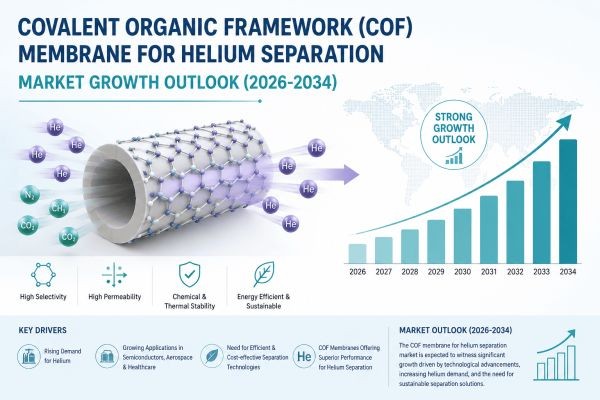
Covalent Organic Framework membranes for helium separation represent one of the most technically sophisticated developments in advanced materials science, constructed through the precise covalent bonding of organic building blocks into highly ordered, crystalline two-dimensional or three-dimensional porous architectures. Their precisely tunable pore sizes—typically in the range of 3 to 10 angstroms—enable exceptional molecular sieving performance, making them particularly effective for isolating helium from mixed gas streams such as natural gas, which typically contains helium concentrations of 0.3% to 3% by volume. These membranes offer a compelling combination of thermal stability, chemical resistance, and scalable fabrication potential, distinguishing them from conventional polymer-based or zeolite membranes in demanding industrial separation environments. Unlike metal-organic frameworks, COFs are composed entirely of light elements through robust covalent bonds, reducing concerns around cost, metal leaching, and environmental impact while simplifying synthesis routes for potential industrial scale-up.
Get Full Report Here: https://www.24chemicalresearch.com/reports/308818/covalent-organic-framework-membrane-for-helium-separation-market
Market Dynamics:
The market's trajectory is shaped by a complex interplay of powerful growth drivers, significant restraints that are being actively addressed, and vast, untapped opportunities that are beginning to attract serious industrial and governmental attention.
Powerful Market Drivers Propelling Expansion
-
Surging Global Demand for High-Purity Helium Across Critical Industries: Helium is an irreplaceable industrial gas with no viable substitute in many of its most critical applications, and this fundamental reality is a powerful force driving investment in advanced separation technologies, including COF membranes. Demand for high-purity helium remains robust across sectors such as semiconductor manufacturing, magnetic resonance imaging, fiber optic production, and aerospace, where purities exceeding 99.999% are routinely required. Conventional helium purification relies heavily on cryogenic distillation and pressure swing adsorption, both of which are energy-intensive and operationally complex. COF membranes offer a compelling alternative by enabling continuous, membrane-based separation at significantly lower energy consumption, positioning them as a strategically important technology for helium-intensive industries seeking to reduce both cost and environmental footprint simultaneously.
-
Exceptional Molecular Sieving Properties Enabling Superior He/N₂ and He/CH₄ Selectivity: The structural precision of Covalent Organic Frameworks—characterized by highly ordered, tunable pore architectures built entirely from light elements through strong covalent bonds—makes them exceptionally well-suited for helium separation. Helium has a kinetic diameter of approximately 2.6 Å, meaningfully smaller than natural gas components such as methane (3.8 Å) and nitrogen (3.64 Å). COF membranes with pore sizes engineered within this narrow range can achieve remarkable He/CH₄ and He/N₂ selectivity, with laboratory-scale studies demonstrating selectivity values that substantially exceed the Robeson upper bound—the theoretical performance benchmark for polymeric membranes. COF membranes derived from imine-linked and triazine-based frameworks have demonstrated helium permeabilities in the range of hundreds to thousands of Barrers in peer-reviewed studies, with He/N₂ selectivity values frequently surpassing 100, performance metrics that validate the fundamental scientific basis driving continued R&D investment. Furthermore, the permanent porosity and rigid backbone of COFs ensure dimensional stability under operational pressures and temperatures encountered in natural gas processing environments, directly addressing a key limitation of flexible polymeric membrane materials.
-
Growing Helium Recovery Mandates and Strategic Resource Conservation Policies: Helium is a finite, non-renewable resource extracted predominantly as a byproduct of natural gas processing, and its scarcity has prompted both governmental and industry-level conservation efforts across major consuming nations. In the United States, the Helium Stewardship Act and subsequent policy discussions around the Bureau of Land Management's Federal Helium Reserve have underscored the strategic importance of efficient helium capture and recycling. Similarly, major helium-consuming regions including Japan, Germany, and South Korea—which import virtually all of their helium supply—have growing incentives to invest in efficient recovery technologies to reduce supply chain vulnerability. COF membranes, by enabling cost-effective and continuous helium recovery from low-concentration feed streams, align well with these conservation mandates and are increasingly attracting policy-driven research funding and industrial piloting interest worldwide.
Download FREE Sample Report: https://www.24chemicalresearch.com/download-sample/308818/covalent-organic-framework-membrane-for-helium-separation-market
Significant Market Restraints Challenging Adoption
Despite its considerable scientific promise, the market faces real and substantive hurdles that must be overcome before COF membranes can achieve broad commercial adoption in helium separation applications.
-
High Capital and Development Costs Relative to Incumbent Helium Purification Technologies: Cryogenic distillation and pressure swing adsorption represent well-established, commercially mature helium purification technologies with extensive operational track records, optimized capital cost structures, and deep supplier ecosystems. COF membrane-based separation systems, by contrast, currently carry substantially higher per-unit costs reflecting the bespoke nature of COF synthesis, the challenges of thin-film fabrication at scale, and the limited number of suppliers capable of producing research-grade COF membrane materials. For helium producers and processors evaluating technology investments, the economics of COF membranes must demonstrate a compelling total cost of ownership advantage—accounting for capital expenditure, energy consumption, membrane replacement frequency, and operational maintenance—to justify displacement of established processes. Until COF membrane synthesis and module fabrication costs decrease meaningfully through scale-up learning curves and supply chain development, high relative cost will remain a structural restraint on market penetration.
-
Technology Readiness Level Constraints Limiting Near-Term Industrial Deployment: The majority of COF membrane research for gas separation applications, including helium separation, currently resides at technology readiness levels of 3 to 5—encompassing proof-of-concept validation and laboratory-scale performance demonstration—with only a limited number of research programs worldwide approaching pilot-scale testing. This early-stage position means that industrial end-users in the helium value chain cannot readily access commercial COF membrane products or validated engineering data required for feasibility studies and investment decisions. Regulatory and permitting requirements for novel membrane materials in natural gas processing facilities introduce an additional layer of restraint, particularly in jurisdictions with stringent requirements around the introduction of new process materials in upstream and midstream gas infrastructure. Qualification testing requirements, material safety documentation for novel COF compounds, and integration engineering for membrane skids into existing process plants all represent time and resource commitments that extend the effective commercialization timeline beyond what the scientific performance data alone might suggest.
Critical Market Challenges Requiring Innovation
Translating laboratory-scale COF membrane breakthroughs into large-area, defect-free membranes suitable for industrial deployment remains one of the most formidable technical challenges facing the field. COF synthesis typically involves solvothermal or interfacial polymerization processes that produce crystalline powders, and converting these powders into continuous, pinhole-free thin films on porous supports requires precise control over nucleation, crystal growth, and interfacial adhesion. Even minor structural defects—including grain boundaries, pinholes, or delamination at the support interface—can dramatically reduce selectivity by creating non-selective transport pathways. Reproducibility across batches and across different membrane fabrication facilities adds another layer of complexity that must be resolved before COF membranes can compete reliably with incumbent separation technologies at commercial scale.
Furthermore, natural gas streams used for helium recovery frequently contain water vapor, hydrogen sulfide, carbon dioxide, and heavy hydrocarbons—contaminants that can compromise the crystallinity and pore integrity of many COF materials over extended operational periods. The COF membrane market also currently lacks the standardized material specifications, testing protocols, and module fabrication supply chains that exist for mature membrane technologies. COF precursor chemicals, while in principle accessible through established organic synthesis routes, are not yet manufactured at commodity scale, contributing to high materials costs and extending commercialization timelines for potential industrial adopters.
Vast Market Opportunities on the Horizon
-
Helium Recovery from Natural Gas Processing Streams as a High-Value Entry Market: Natural gas fields in the United States, Qatar, Algeria, and Russia contain varying concentrations of helium, typically ranging from less than 0.1% to over 7% by volume in certain geological formations. Current extraction economics often result in helium being vented or flared at fields where concentration or volume does not justify the capital investment required for conventional cryogenic recovery plants. COF membranes—by virtue of their energy efficiency, modular scalability, and potential for deployment in distributed or skid-mounted configurations—could unlock economically viable helium recovery from marginal-concentration feed streams that are presently uneconomic to process. This represents a substantial and largely untapped addressable market, as even modest improvements in helium recovery rates from currently non-harvested streams could meaningfully contribute to global supply while providing the first large-scale commercial deployment platform for COF membrane technology.
-
Accelerating Public and Private R&D Investment Creating a Robust Innovation Pipeline: Government research agencies in the United States, European Union, China, and Japan have materially increased funding for advanced membrane materials research, with COF-based gas separation representing a recognized priority area within broader clean energy and critical materials programs. The U.S. Department of Energy's Basic Energy Sciences program and the European Research Council have both supported foundational COF membrane research, while industrial gas companies and specialty chemical firms are increasingly engaging with university research groups through sponsored research agreements and joint development arrangements. This expanding innovation ecosystem is generating a growing pipeline of novel COF chemistries, including mixed-matrix membrane composites incorporating COF fillers within high-performance polymer matrices, which may offer a more accessible near-term pathway to scale than pure COF thin-film membranes while maintaining meaningful selectivity advantages over conventional polymeric materials.
-
Convergence of AI-Driven Materials Discovery with COF Synthesis Research: Computational screening of hypothetical COF structures using molecular simulation tools has identified numerous candidate frameworks with predicted helium selectivity and permeability combinations that exceed current experimental benchmarks, effectively compressing the traditional iterative synthesis-test-modify development cycle. As machine learning models trained on growing experimental COF datasets become more predictive, the time and cost required to identify and validate high-performance COF membrane candidates for helium separation is expected to decrease substantially—lowering barriers to entry for new research programs and increasing the probability of breakthrough performance discoveries that could catalyze accelerated commercialization within the coming decade.
In-Depth Segment Analysis: Where is the Growth Concentrated?
By Type:
The market is segmented into 2D COF Membranes, 3D COF Membranes, Mixed-Matrix COF Membranes, and Thin-Film Composite COF Membranes. 2D COF Membranes currently lead the market, owing to their highly ordered, planar pore architecture that facilitates exceptional molecular sieving of helium from larger gas molecules such as nitrogen and methane. The well-defined and tunable pore sizes inherent to two-dimensional frameworks offer superior selectivity, making them particularly attractive for high-purity helium recovery applications. Mixed-matrix COF membranes, which integrate COF fillers within polymer matrices, are increasingly recognized for their processability advantages and compatibility with existing industrial membrane fabrication infrastructure, positioning them as a commercially viable bridge technology in the near term.
By Application:
Application segments include Natural Gas Helium Recovery, Industrial Gas Purification, Cryogenic Applications, Electronics and Semiconductor Manufacturing, and others. The Natural Gas Helium Recovery segment currently dominates, driven by the critical need to extract and purify helium from natural gas streams before it is irretrievably lost to the atmosphere during processing. COF membranes offer a compelling alternative to energy-intensive cryogenic distillation processes traditionally used in this context. However, the electronics and semiconductor manufacturing segment presents a high-value and rapidly growing niche, where ultra-high purity helium is indispensable as a carrier and cooling gas, creating stringent demand for membrane solutions capable of achieving the necessary purity thresholds.
By End-User Industry:
The end-user landscape includes Oil and Gas, Healthcare and Medical Imaging, Aerospace and Defense, and Research and Academic Institutions. The Oil and Gas industry stands as the foremost end user, given its role as the primary source of commercially extracted helium worldwide. Operators in this sector are under increasing pressure to improve resource efficiency and minimize helium venting, creating strong institutional demand for advanced membrane-based separation technologies. The healthcare and medical imaging sector, particularly driven by the proliferation of MRI systems that rely on liquid helium for superconducting magnet cooling, constitutes a strategically significant and growing end-user group that prioritizes consistent helium supply and purity above all else.
Download FREE Sample Report: https://www.24chemicalresearch.com/download-sample/308818/covalent-organic-framework-membrane-for-helium-separation-market
Competitive Landscape:
The global Covalent Organic Framework Membrane for Helium Separation market is highly specialized and remains largely concentrated within advanced materials manufacturers and research-driven enterprises with demonstrated capabilities in porous polymer synthesis and gas separation membrane fabrication. The competitive landscape is nascent but rapidly evolving, driven by deep-tech research institutions and specialty chemicals companies that are actively investing in bridging the gap between laboratory-scale COF performance and commercially deployable membrane systems. The competitive strategy across leading participants is overwhelmingly focused on R&D to enhance membrane quality, reduce defect density, and lower synthesis costs, alongside forming strategic partnerships with industrial gas companies and natural gas processors to co-develop and validate application-specific COF membrane solutions, thereby securing first-mover advantage in what is widely expected to become a high-value separation technology market.
List of Key Covalent Organic Framework (COF) Membrane Companies Profiled:
-
Evonik Industries AG (Germany)
-
Merck KGaA (Advanced Materials Division) (Germany)
-
TDA Research, Inc. (USA)
-
ProfMOF A/S (Denmark)
-
Framergy, Inc. (USA)
-
Qingdao Chemsourcery Co., Ltd. (China)
The competitive strategy is overwhelmingly focused on R&D to enhance membrane quality and reduce synthesis costs, alongside forming strategic vertical partnerships with industrial gas end-users to co-develop and validate new helium separation applications, thereby securing future demand and establishing credible commercialization pathways.
Regional Analysis: A Global Footprint with Distinct Leaders
-
North America: Is the undisputed leader in the COF Membrane for Helium Separation Market, driven by a robust ecosystem of academic research institutions, national laboratories, and well-established helium production and processing infrastructure. The United States, in particular, holds a strategic advantage given its position as one of the world's largest helium producers and consumers. The region's strong emphasis on advanced materials research, supported by federal funding agencies including the Department of Energy and private venture capital, has accelerated the development and early commercialization of COF-based membrane technologies for helium recovery applications.
-
Europe & Asia-Pacific: Together, they form a powerful and growing secondary bloc. Europe's strength is driven by flagship initiatives such as Horizon Europe and strong academic excellence in porous materials chemistry, particularly in Germany, France, the Netherlands, and the United Kingdom. Asia-Pacific is emerging as the fastest-growing region, propelled by rapid industrialization, expanding semiconductor and electronics manufacturing sectors in China, Japan, and South Korea, and growing government investments in advanced materials research and domestic helium supply security.
-
South America, and Middle East & Africa: These regions represent the emerging frontier of the COF Membrane for Helium Separation Market. While currently smaller in scale, they present meaningful long-term growth opportunities. Brazil and Bolivia hold helium-bearing natural gas reserves, while Qatar has established itself as a notable helium producer through its LNG operations. As global helium markets tighten and regional industrial development accelerates, both regions are expected to increasingly explore COF membrane adoption for domestic helium production, purification, and export initiatives.
Get Full Report Here: https://www.24chemicalresearch.com/reports/308818/covalent-organic-framework-membrane-for-helium-separation-market
Download FREE Sample Report: https://www.24chemicalresearch.com/download-sample/308818/covalent-organic-framework-membrane-for-helium-separation-market
About 24chemicalresearch
Founded in 2015, 24chemicalresearch has rapidly established itself as a leader in chemical market intelligence, serving clients including over 30 Fortune 500 companies. We provide data-driven insights through rigorous research methodologies, addressing key industry factors such as government policy, emerging technologies, and competitive landscapes.
-
Plant-level capacity tracking
-
Real-time price monitoring
-
Techno-economic feasibility studies
International: +1(332) 2424 294 | Asia: +91 9169162030
Website: https://www.24chemicalresearch.com/






