
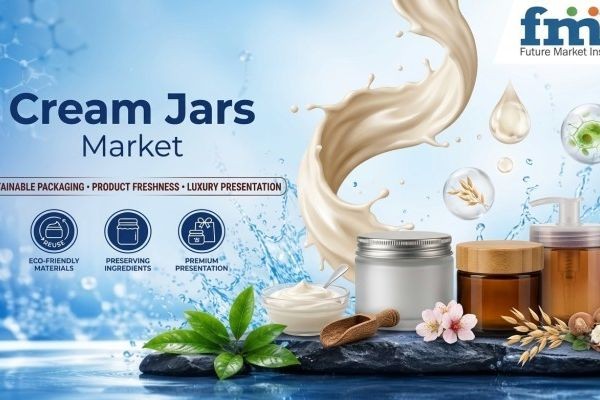
The global cream jars market is entering a sustained growth phase as skincare brands expand product portfolios, upgrade packaging aesthetics, and respond to rising demand for sustainable and refillable formats. According to the latest market analysis by Future Market Insights, the market is valued at USD 3.9 billion in 2026 and is projected to reach USD 7.2 billion by 2036, expanding at a CAGR of 6.3% during the forecast period.
The market was valued at USD 3.6 billion in 2025. Growth is being supported by the continued expansion of skincare products across demographics and price tiers, premiumization in beauty packaging, and increasing adoption of refillable primary containers. Cream jars remain particularly relevant for moisturizers, eye creams, night treatments, face masks, barrier creams, and other viscous formulations where wide-mouth dispensing and premium presentation are important.
Market Overview and Strategic Growth Outlook
Beauty and personal care brands are increasingly viewing primary packaging as a product differentiator. Premium skincare brands are shifting toward glass and aluminum jars to communicate quality, ingredient purity, and sophisticated shelf presence, while polymer jars continue to serve high-volume body care and hair care applications.
Sustainability is creating another growth avenue. Refillable cream jars allow brands to retain durable primary containers while replacing formulations through pouches, cartridges, or refill sachets. This approach can reduce packaging waste while preserving the visual and tactile characteristics associated with premium beauty products.
Key Market Projections and Strategic Insights
- Global Market Value (2025): USD 3.6 Billion
- Market Value (2026): USD 3.9 Billion
- Forecast Market Value (2036): USD 7.2 Billion
- Forecast CAGR (2026–2036): 6.3%
- Leading Material Segment: Glass
- Material Segment Share: 38.7%
- Leading End-Use Segment: Skincare
- End-Use Share: 52.4%
- Key Regional Markets: North America, Western Europe, and East Asia
Analyst Perspective
“Cream jars sit at the intersection of beauty aspiration and packaging functionality,” said Ismail Sutaria, Sr. Consultant at Future Market Insights. “The category is bifurcating: a premium glass and aluminum tier is being driven by skincare premiumization, while a high-volume polymer tier is being sustained by mass market body and hair care. Winners will be producers who build refillable infrastructure and recycled content programs before these become regulatory requirements rather than brand differentiators.”
Competitive Landscape and Market Share Analysis
The competitive environment is increasingly shaped by material versatility, decoration capabilities, refillable system engineering, and sustainability credentials. Leading manufacturers are working to support beauty brands with customized packaging solutions across glass, polymer, aluminum, and bio-based materials.
Key companies operating in the market include:
- Aptar Group
- APackaging Group
- Albea Group
- Berry Global
- Verescence
- Gerresheimer AG
- Pochet Group
- Zhejiang Jinsheng New Materials
- RPC Group
- Stoelzle Glass Group
Manufacturers are focusing on:
- Refillable cream jar systems
- Lightweight glass engineering
- Post-consumer recycled polymer integration
- Premium decoration and finishing
- Airless jar technologies
- Bio-based packaging materials
- Customized jar designs for premium skincare
Consumption Economy Analysis
Skincare represents the largest end-use category, accounting for 52.4% of cream jar demand in 2026. Strong demand comes from moisturizers, eye creams, night treatments, masks, and barrier formulations.
Hair care, body care, cosmetics, and pharmaceutical topical applications provide additional opportunities. The broadening use of cream jars beyond traditional skincare is helping manufacturers diversify demand and strengthen production volumes across multiple beauty and personal care categories.
Country and Regional Opportunity Assessment
North America: The region remains a major market, supported by premium skincare consumption, established beauty brands, and demand for innovative packaging formats.
Western Europe: Sustainability expectations, premium cosmetics consumption, and increasing interest in refillable packaging create opportunities for advanced cream jar suppliers.
East Asia: Strong beauty and skincare markets continue to support demand for premium, customized, and aesthetically differentiated cream jars.
North America, Western Europe, and East Asia are expected to remain dominant regional markets through 2036.
Technology and Innovation Outlook
Innovation is increasingly focused on combining premium aesthetics with improved functionality and sustainability. Airless jar systems are gaining attention in premium skincare because they can help reduce contamination and improve dosage efficiency for sensitive formulations.
Manufacturers are also developing lightweight glass jars, recycled polymer formats, refillable designs, and minimalist packaging aesthetics. Matte and frosted finishes, clean geometric forms, and restrained labeling are increasingly aligned with clinical and premium skincare positioning.
Market Drivers Accelerating Industry Expansion
Primary growth drivers include:
- Expansion of the global skincare category
- Premiumization of beauty packaging
- Rising demand for refillable packaging
- Growing sustainability requirements
- Increasing use of glass and aluminum in prestige skincare
- Expansion into hair care and body care applications
- Development of advanced airless jar systems
Challenges Impacting Market Adoption
The market faces several challenges, including hygiene concerns associated with repeated finger-dipping, competition from airless pumps and tube formats, and the higher weight and fragility of glass jars in e-commerce fulfillment.
Volatility in polymer resin prices can also affect production economics for polymer jar manufacturers. Despite these challenges, premiumization, skincare category expansion, and sustainable packaging development are expected to support long-term market growth.
FMI Custom Research: Strategic Intelligence for Confident Decision-Making
In today's rapidly evolving business environment, leadership teams need more than market data—they need clear, actionable intelligence tailored to their strategic objectives. FMI's Custom Research solutions are designed around the specific business questions organizations need answered, enabling executives to evaluate growth opportunities, validate investments, assess competitive dynamics, and reduce uncertainty before making critical decisions. By combining deep industry expertise, primary research, and proprietary market intelligence, FMI delivers insights that help organizations move from assumptions to evidence-based strategies with greater speed and confidence.
Business Impact
FMI helps organizations transform market complexity into strategic clarity, enabling leadership teams to identify growth opportunities faster, optimize resource allocation, strengthen competitive positioning, and make high-stakes business decisions with confidence.
About Future Market Insights (FMI)
Future Market Insights, Inc. (FMI) is an ESOMAR-certified, ISO 9001:2015 market research and consulting organization, trusted by Fortune 500 clients and global enterprises. With operations in the U.S., UK, India, and Dubai, FMI provides data-backed insights and strategic intelligence across 30+ industries and 1200 markets worldwide.






