
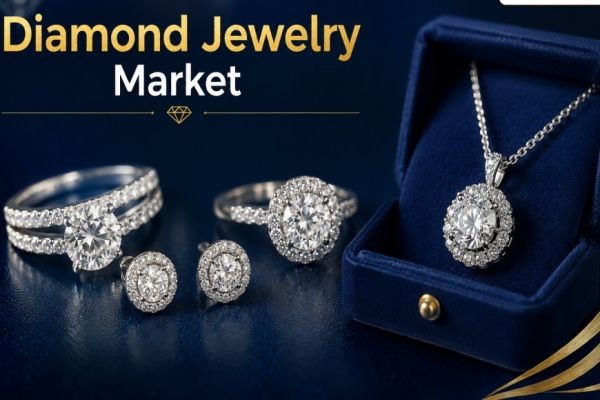
The global Diamond Jewelry Market is projected to grow from USD 408.2 billion in 2026 to USD 652.4 billion by 2036, expanding at a 4.8% CAGR during the forecast period. Growth is being supported by resilient bridal spending, rising self-purchase and gifting, branded jewelry retail expansion, increasing consumer confidence in certified diamonds, wider adoption of diamond jewelry across non-bridal occasions.
According to Future Market Insights (FMI), diamond jewelry is evolving from a predominantly occasion-led purchase into a broader category supported by gifting, self-purchase, celebrations, and premium everyday consumption. Brands are increasingly focusing on sourcing transparency, certification, curated collections, pricing discipline, and consistent retail experiences to strengthen consumer trust.
Quick Stats: Diamond Jewelry Market
- Market Size (2026): USD 408.2 Billion
- Market Size (2036): USD 652.4 Billion
- Growth Rate: 4.8% CAGR (2026–2036)
- Leading Product Type: Earrings (45.0% share)
- Leading Sales Channel: Jewelry Stores (37.6% share)
- Leading End User: Women (60.5% share)
- Fastest-Growing Country: China (7.2% CAGR)
Get detailed market forecasts, competitive benchmarking, and pricing trends through the FMI report: https://www.futuremarketinsights.com/reports/sample/rep-gb-16894
Market Overview
The diamond jewelry market includes earrings, necklaces, rings, bracelets, pendants, and other diamond-adorned formats sold through jewelry stores, online platforms, specialty stores, departmental stores, and other retail channels.
Demand is increasingly supported by multiple purchase occasions. Bridal jewelry continues to generate high-value demand, while self-purchase, gifting, anniversaries, celebrations, and personal milestones are expanding the category's consumer base.
Jewelry stores remain an important sales channel because assisted selling, certification guidance, product inspection, and established brand trust influence high-value purchasing decisions. Online channels are also gaining relevance by providing broader assortments, digital product education, convenient shopping, and verified fulfillment.
Growth Drivers
Key factors supporting market growth include:
- Stable bridal spending across mature and emerging markets.
- Rising self-purchase among consumers.
- Increasing gifting demand for premium jewelry.
- Expansion of branded jewelry chains.
- Growing preference for certified diamonds.
- Increasing trust in organized jewelry retail.
- Wider adoption beyond bridal occasions.
- Premiumization across earrings, rings, necklaces, and pendants.
- Growing digital discovery and online purchasing.
- Stronger emphasis on sourcing transparency.
- Expansion of organized retail in India and China.
- Improved product storytelling and digital merchandising.
FMI analysis indicates that future expansion will depend on disciplined assortment planning, sourcing transparency, consistent product quality, and effective channel execution. Companies that combine core collections with targeted innovation can strengthen sell-through while managing inventory and margin risks.
Analyst Perspective
Rahul Pandita, Principal Consultant for Consumer Products at Future Market Insights, said:
“Diamond jewelry demand is expected to favor brands with trusted sourcing systems and disciplined retail execution. Larger jewelry houses are likely to gain stronger buyer confidence as certified assortments and consistent service quality influence premium purchase decisions.”
Segment Analysis
By Product Type
Earrings are projected to lead the product type segment with a 45.0% share in 2026. Their leadership is supported by accessible pricing compared with larger-ticket formats, strong gifting relevance, styling flexibility, and demand across everyday and premium occasions.
Manufacturers and retailers are expanding earring assortments through differentiated designs, diamond sizes, price tiers, and collection formats. Necklaces, rings, bracelets, and pendants complement the segment by addressing bridal, gifting, and self-purchase requirements.
By Sales Channel
Jewelry stores are expected to account for 37.6% of sales channel demand in 2026. Their leadership is supported by assisted selling, high-ticket purchase requirements, certification support, and consumer preference for trusted physical retail environments.
Branded jewelry chains are prioritizing sourcing documentation, service quality, assortment consistency, and pricing discipline. Online channels are gaining importance for product discovery, comparison, digital education, and customer engagement.
By End User
Women are projected to account for 60.5% of diamond jewelry demand in 2026. Their leading position reflects strong participation in self-purchase, bridal consumption, gifting, and occasion-based jewelry buying.
Women-led demand continues to influence assortment planning, design cycles, promotional calendars, and price-tier development. Brands are increasingly developing collections that address both traditional occasions and contemporary everyday styling.
Regional Outlook
China is projected to be the fastest-growing major country market, registering a 7.2% CAGR through 2036. Growth is supported by premium jewelry consumption, organized retail expansion, digital commerce, and gifting demand.
- China: 7.2% CAGR, supported by premium mix development and digital commerce.
- India: 7.0% CAGR, driven by premiumization and branded jewelry expansion.
- United States: 5.6% CAGR, supported by mature retail and stable bridal demand.
- Germany: 5.4% CAGR, reflecting structured retail and quality-focused purchasing.
- United Kingdom: 5.1% CAGR, supported by organized retail and premium consumption.
Regional growth will vary according to premium spending capacity, retail infrastructure, digital penetration, sourcing requirements, and local design preferences.
Competitive Landscape
Competition is influenced by brand equity, sourcing credibility, product design, certification, retail execution, distribution reach, pricing discipline, and customer experience.
Leading jewelry houses and diversified suppliers are strengthening positions through controlled distribution, structured product tiers, curated collections, digital merchandising, and improved retail services.
Supply-chain transparency is becoming an important differentiator. Companies that maintain reliable sourcing documentation, consistent quality, and dependable availability can strengthen relationships with retail partners and consumers.
Competition is also being shaped by the growing presence of lab-grown diamonds. Brands are increasingly required to communicate differences in sourcing, quality, value, and positioning while maintaining clear portfolio architecture.
Key Companies Profiled
- Tiffany & Co.
- Bulgari S.p.A.
- Cartier
- Signet Jewelers
- De Beers plc
- Pandora Jewellery, LLC
- Chow Tai Fook Jewellery Group Limited
- Swarovski AG
- Petra Diamonds Limited
- Trans Hex Group
Future Outlook
The Diamond Jewelry Market is expected to grow steadily through 2036, supported by bridal demand, self-purchase, gifting, premiumization, and organized retail expansion. Opportunities will focus on earrings, premium collections, branded stores, digital commerce, and high-growth markets such as China and India. Companies with trusted sourcing, disciplined assortments, strong certification, and consistent retail execution will be better positioned for long-term growth.
Explore More Insights from the Consumer Product Industry Analysis
https://www.openpr.com/news/4596765/pet-clothing-market-size-to-reach-usd-11-12-billion-by-2036
FMI Custom Research: Strategic Intelligence for Confident Decision-Making
In today’s rapidly evolving business environment, leadership teams need more than market data — they need clear, actionable intelligence tailored to their strategic objectives. FMI’s Custom Research solutions are designed around the specific business questions organizations need answered, enabling executives to evaluate growth opportunities, validate investments, assess competitive dynamics, and reduce uncertainty before making critical decisions. By combining deep industry expertise, primary research, and proprietary market intelligence, FMI delivers insights that help organizations move from assumptions to evidence-based strategies with greater speed and confidence.
Key Executive Benefits
- Decision-Ready Insights: Research tailored to your specific business challenges, growth plans, and investment priorities.
- Reduced Strategic Risk: Validate market opportunities, customer demand, and competitive positioning before committing resources.
- Market Entry Confidence: Assess opportunity size, regulatory barriers, channel dynamics, and competitive landscapes with precision.
- Competitive Advantage: Gain proprietary intelligence unavailable through syndicated reports or internal datasets.
- Faster Growth Decisions: Accelerate expansion, product development, portfolio optimization, and investment planning.
- Primary Market Validation: Access real-world customer, buyer, and stakeholder insights that support high-confidence decision-making.
- Global Industry Expertise: Powered by 100+ analysts, 20,000+ published reports, and 1.6 million+ hours of research experience.
- Proven Track Record: Over 7,000 market-entry engagements completed across six regions and 14 industry sectors with strong client retention.
Business Impact
FMI helps organizations transform market complexity into strategic clarity, enabling leadership teams to identify growth opportunities faster, optimize resource allocation, strengthen competitive positioning, and make high-stakes business decisions with confidence.
To explore how FMI Custom Research can support your strategic priorities, please connect with our team at — sales@futuremarketinsights.com






