
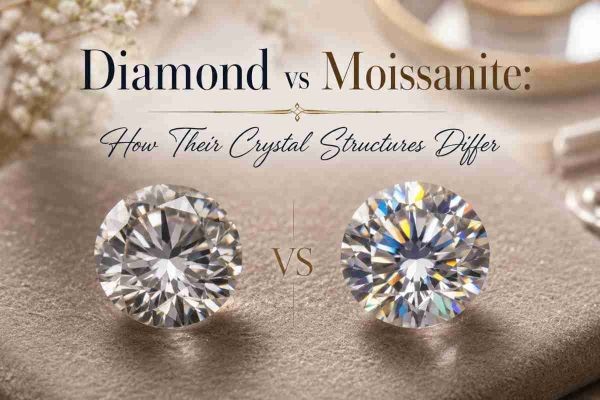
When diamond and moissanite are placed side by side, their appearance can seem surprisingly similar. Both can be cut into brilliant shapes; both are durable enough for everyday jewelry, and both can produce strong flashes of light. Yet beneath that familiar sparkle, they are made from completely different materials. The key difference begins at the atomic level, where each gemstone has its own chemical composition and crystal structure.
Understanding this difference gives a clearer explanation of why diamond and moissanite do not behave exactly alike. Their structure influences hardness, optical properties, and even the way light moves through a finished stone. For anyone comparing these gemstones for jewelry, learning the science behind them can be more useful than judging them only by appearance.
What Does Crystal Structure Mean?
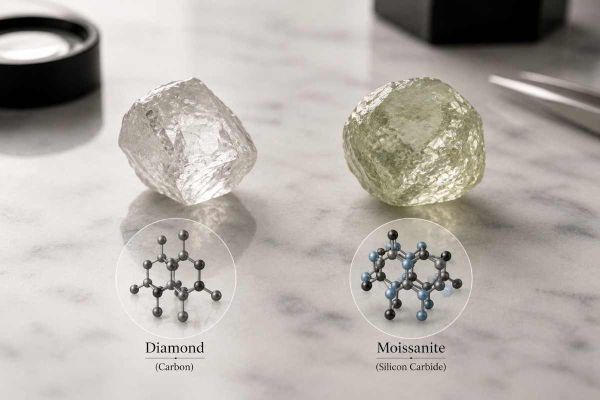
A crystal structure describes the regular way atoms are arranged inside a solid material. Think of it as an internal framework that repeats throughout the crystal. Even when two gemstones look alike from the outside, their internal arrangements can be very different, and those differences can affect how the materials respond to light, pressure, and everyday wear.
This is particularly interesting with diamond and moissanite. Diamond is made entirely from carbon, while moissanite is silicon carbide, a compound containing silicon and carbon. Their different chemical compositions lead to different crystal structures, which helps explain why these two gemstones have their own distinct optical and physical characteristics.
Diamond Has a Strong Three-Dimensional Structure
Diamond has a cubic crystal structure in which each carbon atom is strongly bonded to neighboring carbon atoms in a three-dimensional network. This arrangement creates an exceptionally rigid material and is a major reason diamond is the hardest naturally occurring mineral commonly used in jewelry.
The strength of this network is important in practical terms. Diamond reaches 10 on the Mohs hardness scale, making it highly resistant to scratching. However, hardness should not be confused with being impossible to damage. A diamond can still chip under a sufficiently strong impact, particularly around certain areas of a cut stone. Its structure provides remarkable scratch resistance, but jewelry design and setting quality still matter.
Moissanite Uses Silicon Carbide
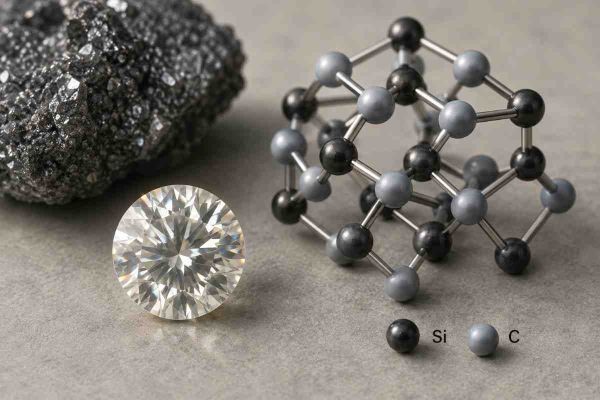
Moissanite has a completely different chemical identity. Its formula is SiC, meaning it consists of silicon and carbon. Gem-quality moissanite is commonly associated with hexagonal silicon carbide structures, including the 6H polytype studied in mineralogical and materials research. In these structures, silicon and carbon atoms form strong tetrahedral bonds, but their repeating arrangement differs from that found in diamond.
That structural difference does not make moissanite a fragile alternative. In fact, it is a very hard gemstone, generally rated around 9¼ on the Mohs scale in gemological references. Its combination of hardness and durability has made it suitable for rings and other jewelry that may be worn regularly. The important point is that moissanite achieves these qualities through silicon carbide rather than the pure-carbon structure found in diamond.
Why Their Structure Changes Their Appearance
One of the most noticeable differences between diamond and moissanite appears when light enters the stone. Gemstones interact with light according to their optical properties, including refractive index, dispersion, and birefringence. These properties are closely connected to the material's internal structure.
Moissanite has relatively high refractive indices and significantly higher dispersion than diamond. Dispersion is responsible for separating white light into flashes of spectral color, sometimes called “fire.” Because moissanite has higher dispersion, its flashes can appear more colorful and noticeable under certain lighting conditions. Diamond, meanwhile, has its own characteristic balance of brilliance and fire.
The Double-Image Effect Is Another Clue
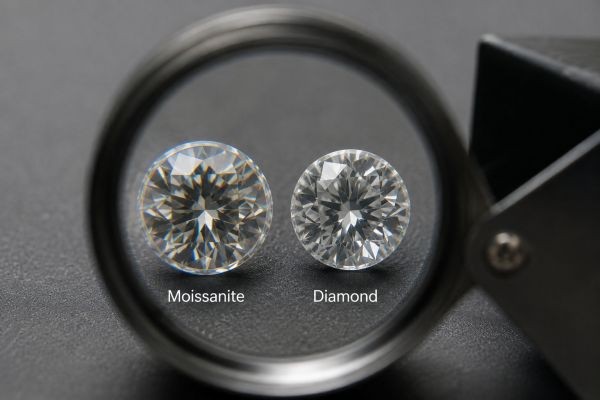
There is another structural feature that helps distinguish the two materials. Moissanite is optically anisotropic, meaning light can behave differently depending on the direction through the crystal. One visible consequence can be a doubling effect around facet junctions when viewed closely. This is one of the gemological clues specialists can use when identifying moissanite.
Diamond behaves differently because of its cubic structure and optical character. This is a good reminder that two stones can share a bright appearance while still revealing very different behavior under professional examination. For jewelry buyers, these differences may be subtle, but they are part of what makes each material scientifically distinct.
What This Means for Everyday Jewelry
The practical comparison becomes more interesting when crystal structure is connected to real jewelry. Diamond offers exceptional scratch resistance, while moissanite also provides excellent resistance to everyday scratching. Neither material should be treated as completely indestructible, however. A well-designed setting, careful handling, and sensible jewelry care remain important regardless of the gemstone selected.
The visual difference can also influence personal preference. Someone who likes the classic balance of diamond brilliance may prefer its optical character, while another person may enjoy the stronger flashes of color associated with moissanite. Even within a jewelry collection from a brand such as ErayaSparkle, the choice between different gemstone styles can come down to the look, design, and feeling a wearer wants from a piece rather than a simple question of which material is “better.”
Choosing Between Diamond and Moissanite
The most useful way to compare these gemstones is to understand what each one actually offers. Diamond stands apart through its pure-carbon composition, cubic crystal structure, exceptional hardness, and familiar optical appearance. Moissanite offers a different combination: silicon carbide, a hexagonal crystal structure in common gem varieties, high hardness, and stronger dispersion that can produce vivid flashes of color.
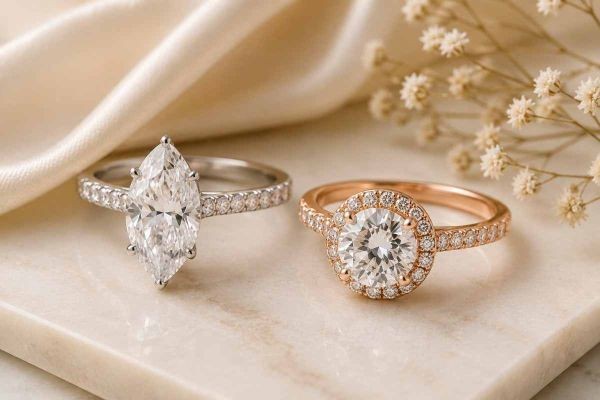
That difference can also be appreciated through jewelry design. A marquise diamond ring , for example, can highlight the elongated shape and distinctive optical character of a diamond, while a rose gold halo rings design can create a completely different visual effect depending on the center gemstone and surrounding stones. The structure of the gemstone remains an important part of that final appearance, even when the setting itself receives most of the attention.
Conclusion: Similar Sparkle, Different Science
Diamond and moissanite may compete for attention in the jewelry world, but their similarities end well before their atomic structures do. Diamond is a carbon crystal with a cubic structure, while moissanite is silicon carbide with commonly encountered hexagonal structures. These differences help explain variations in hardness, optical behavior, dispersion, and the way light travels through each gemstone.
Understanding crystal structure therefore gives buyers a more meaningful way to compare the two. Instead of viewing diamond and moissanite simply as stones that look alike, it is more accurate to see them as two distinct materials with their own scientific identities, visual characteristics, and practical strengths.






