
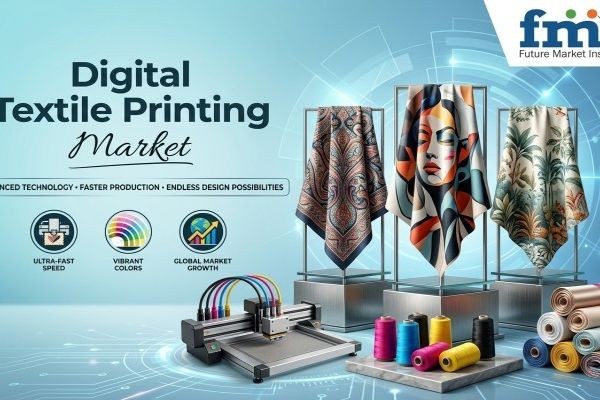
The global digital textile printing market is witnessing robust expansion as textile producers increasingly shift toward on-demand manufacturing, sustainable printing processes, and advanced variable-data inkjet technologies.
The Digital Textile Printing Market was valued at USD 6.1 billion in 2025, is estimated to reach USD 6.6 billion in 2026, and is projected to surpass USD 13.9 billion by 2036, registering a CAGR of 7.7% during the forecast period. The industry is undergoing a major transformation as manufacturers move away from conventional screen-printing techniques toward digitally enabled production systems that provide higher flexibility, shorter lead times, reduced waste, and enhanced customization capabilities.
Get detailed market forecasts, competitive benchmarking, and pricing trends:
https://www.futuremarketinsights.com/reports/sample/rep-gb-7550
Quick Stats: Digital Textile Printing Market
- Market Value (2025): USD 6.1 Billion
- Market Value (2026): USD 6.6 Billion
- Projected Value (2036): USD 13.9 Billion
- Growth Rate: 7.7% CAGR (2026-2036)
- Fastest Growing Countries: India (14.6%), China (13.4%), Turkey (11.0%)
- Leading Application: Apparel Printing (58.0% market share in 2026)
- Dominant Printer Type: Direct-to-Fabric Printing (54.0% share)
- Preferred Ink Type: Reactive Inks (46.0% share)
- Leading Region: East Asia (38.0% share)
Production Economics Driving Industry Transformation
Textile manufacturers are under increasing pressure to accelerate production cycles while minimizing inventory costs and environmental impact. Traditional rotary screen-printing processes require high production volumes and large fabric inventories, often resulting in excess stock and operational inefficiencies.
Digital textile printing enables manufacturers to:
- Produce fabrics on demand
- Eliminate minimum order quantity constraints
- Reduce inventory waste and unsold stock
- Shorten product development timelines
- Enhance customization and design flexibility
As fashion brands increasingly adopt rapid collection cycles and personalized products, digital printing technologies are becoming a critical component of modern textile manufacturing.
Equipment Modernization and Installed Base Expansion
The transition from conventional printing systems to digital platforms is accelerating across major textile-producing economies due to:
- Growing demand for flexible manufacturing capabilities
- Tightening environmental regulations
- Faster design-to-production requirements
- Expansion of print-on-demand business models
Manufacturers are investing in next-generation inkjet systems featuring automated color management, software-driven workflows, and variable-data printing technologies to improve productivity and operational efficiency.
Regional Growth Trends Strengthening Market Expansion
Different regions are supporting market growth through distinct manufacturing strengths:
- India: Rapid modernization of textile clusters supported by favorable government initiatives
- China: Environmental regulations encouraging adoption of water-efficient printing technologies
- Turkey: Increasing demand from European apparel brands seeking shorter lead times
- Italy: Strong focus on premium and luxury textile production
- United States: Growing reshoring initiatives and demand for customized apparel manufacturing
Rising investments in localized production and sustainable textile technologies are further enhancing market growth worldwide.
Apparel Segment Remains the Largest Revenue Contributor
The apparel industry continues to represent the largest application segment for digital textile printing, driven by the need for speed, flexibility, and product personalization.
Key growth factors include:
- Faster introduction of fashion collections
- Expansion of short-run and customized apparel manufacturing
- Lower inventory carrying costs
- Improved design iteration and sampling processes
- Higher profitability from personalized garments
Fashion brands are increasingly adopting web-to-print platforms and micro-collection strategies to respond quickly to evolving consumer preferences.
Direct-to-Fabric Printing Leads Technology Adoption
Direct-to-fabric printing remains the preferred technology owing to its suitability for high-volume industrial textile production.
Major advantages include:
- Continuous roll-to-roll processing
- High productivity and throughput
- Improved fabric handling and tension control
- Superior color consistency
- Seamless integration with existing textile operations
Industrial users are prioritizing production reliability and efficiency when investing in new printing equipment.
Reactive Inks Continue to Dominate Premium Applications
Reactive inks remain the preferred choice for natural fibers such as cotton due to their superior color quality and durability.
Key benefits include:
- Strong chemical bonding with fabric fibers
- Excellent wash resistance
- Vibrant and accurate color reproduction
- Premium retail-grade print quality
- Compatibility with advanced industrial printheads
Manufacturers continue to focus on ink formulations that enhance long-term product performance and reliability.
Sustainability Regulations Accelerating Adoption
Environmental concerns and regulatory pressures are increasingly influencing purchasing decisions across the textile value chain.
Digital textile printing offers several sustainability advantages:
- Lower water consumption
- Reduced chemical usage
- Minimal fabric waste
- Lower energy requirements
- Enhanced compliance with environmental standards
As governments implement stricter pollution-control measures, digital printing technologies are emerging as an attractive alternative to conventional dyeing and printing processes.
Evolving Procurement Priorities
Key buyers include:
- Textile manufacturers
- Apparel producers
- Fashion brands
- Print service providers
- Contract textile converters
Procurement decisions are increasingly based on:
- Production reliability
- Consistent print quality
- Environmental compliance
- Technical support and service capabilities
- Total cost of ownership
Buyers are shifting their focus from upfront equipment costs toward lifecycle value and long-term operational performance.
After-Sales Services Becoming a Competitive Differentiator
Service capabilities are playing an increasingly important role in maintaining equipment productivity and customer loyalty.
Critical service offerings include:
- Predictive maintenance programs
- Remote diagnostics and monitoring solutions
- Automated printhead maintenance systems
- Technical training and support
- Workflow optimization services
Suppliers offering comprehensive service ecosystems are strengthening their position among industrial textile manufacturers.
Competitive Landscape
Leading companies including Kornit Digital, EFI Reggiani, Mimaki Engineering, Seiko Epson, Durst Group, SPGPrints, and Atexco are competing through technological innovation, software integration, advanced print quality, and global service capabilities.
Market participants continue to invest in next-generation printer platforms, eco-friendly ink technologies, and automated production solutions to strengthen their competitive position as demand for customized, sustainable, and agile textile manufacturing continues to rise worldwide.
About Future Market Insights (FMI)
Future Market Insights, Inc. (FMI) is an ESOMAR-certified, ISO 9001:2015 market research and consulting organization, trusted by Fortune 500 clients and global enterprises. With operations in the U.S., UK, India, and Dubai, FMI provides data-backed insights and strategic intelligence across 30+ industries and 1200 markets worldwide.






