
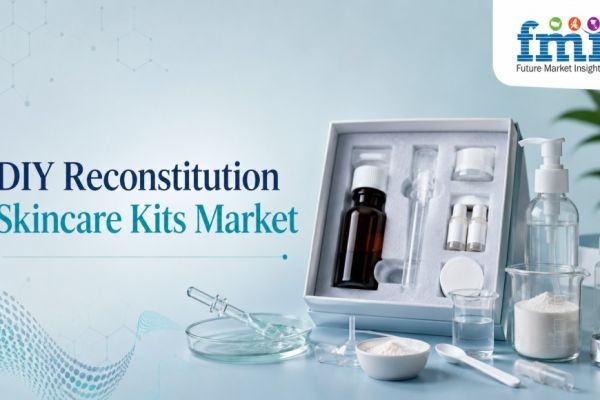
The global DIY reconstitution skincare kits market [https://www.futuremarketinsights.com/reports/diy-reconstitution-skincare-kits-market] is projected to grow from USD 2.28 billion in 2026 to USD 8.14 billion by 2036, expanding at a 14.7% CAGR during the forecast period. Growth is being supported by rising consumer interest in fresh-activated skincare, greater awareness of ingredient stability, demand for personalized routines, and growing adoption of packaging formats designed to protect sensitive actives until the point of use.
According to Future Market Insights (FMI), the DIY reconstitution skincare kits industry is shifting from simple customization toward technically controlled activation and delivery. Manufacturers and skincare brands are increasingly focusing on formulation stability, precise dosing, packaging integrity, ingredient transparency, and repeat-use formats to address demand for effective and convenient personalized skincare solutions.
Quick Stats: DIY Reconstitution Skincare Kits Market
- Market Size (2026): USD 2.28 Billion
- Market Size (2036): USD 8.14 Billion
- Growth Rate: 14.7% CAGR (2026–2036)
- Leading Product Category: Hydration and Barrier Support (47.3% share)
- Leading Skin Area: Face (42.1% share)
- Leading Consumer Positioning: Premium (38.5% share)
- Fastest-Growing Country: South Korea (18.2% CAGR)
Get detailed market forecasts, competitive benchmarking, and industry insights through the FMI report : https://www.futuremarketinsights.com/reports/sample/rep-gb-31761
Market Overview
The DIY reconstitution skincare kits market includes products designed to separate sensitive skincare actives from water-based carriers until activation. Product categories include hydration and barrier support, cleansing, brightening and tone correction, anti-aging and firming, acne and oil control, and soothing and sensitive-skin care.
Reconstitution formats are gaining attention because they can help protect ingredients affected by oxidation, hydrolysis, humidity, light, or prolonged exposure to water. Freeze-drying, encapsulation, dual-chamber packaging, unit-dose ampoules, twist-to-activate closures, and controlled mixing systems are becoming important elements of product development.
Face treatments are expected to remain the leading skin-area segment because consumers generally show greater willingness to pay for targeted facial solutions and frequently repurchase products associated with visible skincare outcomes.
Growth Drivers
Key factors supporting market growth include:
- Rising consumer demand for personalized skincare routines.
- Growing awareness of oxidation, hydrolysis, and pH-related stability challenges.
- Increasing preference for freshly activated skincare formulations.
- Rising adoption of vitamin C, peptide, ceramide, hyaluronic acid, and niacinamide systems.
- Greater use of freeze drying and encapsulation technologies.
- Growing demand for precise dosing and controlled activation.
- Expansion of premium skincare and dermatology-oriented product lines.
- Increasing influence of digital beauty education and ingredient transparency.
- Rising adoption of refill and booster-based skincare ecosystems.
- Greater focus on packaging designed to limit oxygen, moisture, and contamination exposure.
FMI analysis indicates that formulation stability, packaging engineering, controlled activation, claim substantiation, and consumer education will remain important for brands seeking to build repeat purchases and strengthen customer trust.
Segment Analysis
By Product Category
Hydration and barrier support is projected to lead the product category segment with a 47.3% share in 2026. Demand is supported by increasing consumer focus on skin barrier health and the ability of reconstitution formats to protect moisture-sensitive components until activation.
Ceramides, hyaluronic acid, and niacinamide are increasingly relevant to this segment, while controlled reconstitution can support formulation consistency and help manage storage-related changes.
By Skin Area
Face treatments are projected to account for 42.1% of demand in 2026. Higher consumer scrutiny, premium pricing potential, and frequent replenishment support the leading position of facial applications.
Dual-chamber vials, twist-to-activate caps, snap-ampoule boosters, and desiccant-integrated closures are gaining importance in face-focused kits. These formats are particularly suitable for oxidation-sensitive actives such as vitamin C and selected peptide systems.
By Consumer Positioning
Premium products are expected to capture 38.5% of the market in 2026. Premium positioning benefits from consumer interest in controlled activation, precise dosing, clinically supported claims, and high-quality active ingredients.
Premium brands are also developing base-and-booster ecosystems, refill cartridges, and rotating treatment formats that can increase repeat purchases and customer lifetime value.
By Distribution Channel
Direct-to-consumer online channels, marketplaces, specialty beauty retailers, pharmacies, and subscription-based refill programs are supporting market accessibility. Digital channels are particularly important because they allow brands to explain activation procedures, ingredient compatibility, concentration logic, and personalized routines directly to consumers.
Regional Outlook
South Korea is projected to be the fastest-growing major market, registering an 18.2% CAGR through 2036. Japan, China, the United States, and Germany are also expected to record strong growth as consumers increasingly seek science-led, targeted, and personalized skincare solutions.
- South Korea: 18.2% CAGR
- Japan: 16.8% CAGR
- China: 15.9% CAGR
- United States: 13.4% CAGR
- Germany: 12.1% CAGR
South Korea's strong beauty innovation ecosystem and rapid commercialization of advanced skincare formats are supporting market development. Japan is benefiting from demand for precision-led and anti-aging routines, while China is supported by digital beauty retail and expanding consumer interest in ingredient-focused products.
The United States is expected to benefit from demand for clinical positioning, ingredient transparency, and stronger safety substantiation. Germany is supported by evidence-oriented consumers and a quality-focused regulatory environment.
Competitive Landscape
Competition in the DIY reconstitution skincare kits market is increasingly focused on execution, formulation stability, packaging performance, dosing precision, and consumer education rather than customization alone.
Established beauty companies are investing in active ingredient systems, controlled activation technologies, premium packaging, and targeted skincare routines. Companies capable of combining ingredient credibility with reliable packaging and easy-to-follow activation protocols are better positioned to gain consumer trust and encourage repeat purchases.
Key competitive areas include vitamin C systems, peptide boosters, ceramide-based barrier solutions, personalized treatment combinations, dual-chamber delivery, refill ecosystems, and digital education platforms.
Key Companies Profiled
- L'Oréal
- Unilever
- Procter & Gamble
- The Estée Lauder Companies
- Shiseido
- Beiersdorf
- Kao Corporation
- Johnson & Johnson (Consumer Skincare Lines)
- Coty
- LVMH (Beauty Division)
The competitive environment is expected to remain centered on formulation integrity, packaging engineering, controlled activation, validated claims, ingredient transparency, and repeatable consumer routines.
Future Outlook
The DIY Reconstitution Skincare Kits Market is projected to reach USD 8.14 billion by 2036, up from USD 2.28 billion in 2026. Hydration and barrier support, face treatments, premium positioning, and personalized skincare routines will remain key growth areas.
Manufacturers focusing on stable active delivery, precise dosing, moisture- and oxygen-resistant packaging, transparent ingredient communication, and refill-oriented product ecosystems will be better positioned to capture rising demand for fresh-activated and personalized skincare solutions.
Explore More Insights from the Consumer Product Industry Analysis
https://www.openpr.com/news/4599291/second-hand-furniture-market-to-reach-usd-88-1-billion-by-2036-as
https://www.openpr.com/news/4599299/virtual-fitness-market-poised-to-reach-usd-330-7-billion-by-2036
https://www.openpr.com/news/4599302/botanical-cleansing-oil-market-to-reach-usd-2-8-billion-by-2036
FMI Custom Research: Strategic Intelligence for Confident Decision-Making
In today’s rapidly evolving business environment, leadership teams need more than market data — they need clear, actionable intelligence tailored to their strategic objectives. FMI’s Custom Research solutions are designed around the specific business questions organizations need answered, enabling executives to evaluate growth opportunities, validate investments, assess competitive dynamics, and reduce uncertainty before making critical decisions. By combining deep industry expertise, primary research, and proprietary market intelligence, FMI delivers insights that help organizations move from assumptions to evidence-based strategies with greater speed and confidence.
Key Executive Benefits
- Decision-Ready Insights: Research tailored to your specific business challenges, growth plans, and investment priorities.
- Reduced Strategic Risk: Validate market opportunities, customer demand, and competitive positioning before committing resources.
- Market Entry Confidence: Assess opportunity size, regulatory barriers, channel dynamics, and competitive landscapes with precision.
- Competitive Advantage: Gain proprietary intelligence unavailable through syndicated reports or internal datasets.
- Faster Growth Decisions: Accelerate expansion, product development, portfolio optimization, and investment planning.
- Primary Market Validation: Access real-world customer, buyer, and stakeholder insights that support high-confidence decision-making.
- Global Industry Expertise: Powered by 100+ analysts, 20,000+ published reports, and 1.6 million+ hours of research experience.
- Proven Track Record: Over 7,000 market-entry engagements completed across six regions and 14 industry sectors with strong client retention.
Business Impact
FMI helps organizations transform market complexity into strategic clarity, enabling leadership teams to identify growth opportunities faster, optimize resource allocation, strengthen competitive positioning, and make high-stakes business decisions with confidence.
To explore how FMI Custom Research can support your strategic priorities, please connect with our team at — sales@futuremarketinsights.com






