
Anyone who has ever crashed a $1,200 drone into a tree during their first week of flying knows the feeling: a mix of embarrassment, financial regret, and the sudden realization that flying skills aren't something you pick up by instinct alone. This is exactly the gap that drone simulation software was built to close.
As drones move from hobbyist toys into serious commercial tools for agriculture, construction, logistics, filmmaking, and defense, the cost of a single mistake has grown too. A miscalculated flight path isn't just an inconvenience anymore; it can mean damaged equipment, a scrapped survey, or worse, a safety incident near people or property. That's why drone software, and drone simulation software in particular, has quietly become one of the most important tools in the modern drone ecosystem, whether you're training a new pilot, testing an autonomous navigation algorithm, or planning a mapping mission over difficult terrain.
What Is Drone Simulation Software?
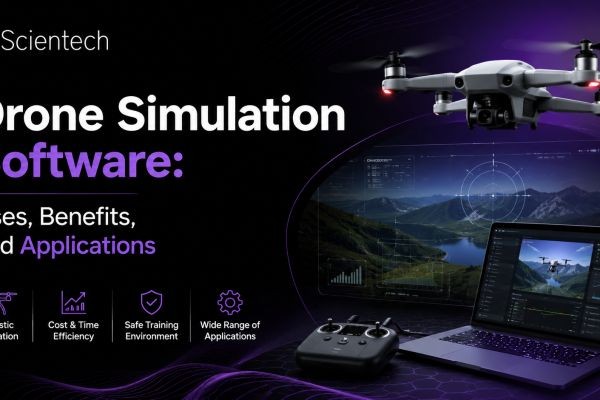
Drone simulation software is a digital environment that recreates the physics, sensors, and surroundings a real drone would experience in flight, without ever leaving the ground. Instead of taking a physical aircraft into the sky, pilots or developers fly a virtual model through a simulated 3D world that mimics wind resistance, gravity, battery drain, GPS signal behavior, and even sensor noise.
At its core, this type of drone software exists to answer one question safely: what happens if I do this? Whether "this" is a sharp turn near a building, a low-battery return-to-home sequence, or an autonomous obstacle-avoidance maneuver, simulation gives you the answer without the risk.
Some simulators are built primarily for pilot training, focusing on realistic flight controls and scenario-based practice. Others are built for developers, offering a sandbox where autonomous flight code, computer vision models, and navigation algorithms can be tested against thousands of virtual flight hours before ever touching hardware.
How Drone Simulation Software Works
Most drone simulators rely on a physics engine paired with a rendering engine. The physics engine calculates how the drone would actually behave, thrust, drag, momentum, and gravity all factor in, while the rendering engine builds the visual world the drone "sees" and flies through.
Many modern platforms also connect to flight controller firmware through what's called software-in-the-loop (SITL) or hardware-in-the-loop (HITL) testing. In SITL, the actual flight control code runs on a computer and interacts with the simulated environment as if it were a real aircraft. In HITL, an actual flight controller board is wired into the simulation, so the physical hardware processes simulated sensor data in real time. This distinction matters a lot for developers, since HITL testing catches hardware-specific quirks that pure software testing can miss.
Sensor simulation has become increasingly sophisticated too. Good drone simulation software doesn't just show a drone flying around; it simulates camera feeds, LiDAR returns, GPS drift, wind gusts, and even simulated failures like a dead motor or a GPS dropout, so pilots and engineers can prepare for situations they'd never want to test for real.
Key Uses of Drone Simulation Software
Pilot Training and Certification Prep
New pilots build muscle memory for throttle control, orientation awareness, and emergency procedures without risking equipment. Flight schools and commercial operators increasingly use simulators as a standard part of onboarding, letting trainees rack up virtual flight hours before their first real takeoff.
Autonomous Flight Algorithm Testing
Developers working on autonomous navigation, obstacle avoidance, or swarm coordination need a repeatable, controllable environment. A simulator lets them run the same scenario a hundred times with slight variations, something that's practically impossible to do consistently outdoors.
Mission Planning and Rehearsal
Before flying an actual mapping or inspection mission, operators can simulate the flight path over a virtual replica of the site. This helps catch problems like insufficient battery range, obstacles in the flight corridor, or gaps in camera coverage before the drone ever leaves the case.
Hardware and Firmware Validation
Manufacturers and hobbyist developers alike use simulation to test new firmware builds, custom flight controllers, or modified drone frames. Catching a bug in simulation is inconvenient. Catching it mid-flight is expensive.
Research and Academic Study
Universities and research labs use drone simulation environments to study aerodynamics, machine learning-based navigation, and multi-drone coordination, often because acquiring FAA or equivalent clearance for repeated real-world testing is slow and costly.
Benefits of Using Drone Simulation Software
Cost savings. Crashes are expensive, and so is the downtime that follows one. Simulation drastically reduces the number of real-world crashes during the learning and testing phase.
Safety. Testing dangerous scenarios, like flying near power lines, in high wind, or with a simulated sensor failure, carries zero real-world risk in a simulated environment.
Repeatability. Weather doesn't cooperate, lighting changes, and terrain isn't always accessible. Simulation lets you recreate the exact same conditions over and over, which is essential for isolating variables during algorithm development.
Accessibility. Not everyone has access to open airspace, especially in urban areas with strict flight regulations. Simulation removes that barrier, letting pilots and developers practice or test regardless of local drone laws or available flying space.
Faster iteration for developers. Testing a new obstacle-avoidance algorithm in the real world means charging batteries, finding a safe location, and manually resetting the scenario each time. In simulation, that cycle can happen in seconds.
Scalability. Training ten pilots or testing a hundred flight scenarios doesn't require ten drones or a hundred physical setups. One simulation license, run on standard computer hardware, scales far more easily than physical fleets.
Drone Mapping Software: Where Simulation Meets Real-World Data
Drone mapping software is where things get particularly interesting, because it sits right at the intersection of simulation and real-world application.
Mapping software processes the images and sensor data a drone collects during flight, typically overlapping aerial photographs, and stitches them into orthomosaics, 3D models, elevation maps, or point clouds. This is heavily used in surveying, agriculture, construction progress tracking, and environmental monitoring.
Here's the connection to simulation: before running an actual mapping mission, many operators use simulation tools to plan and preview the flight grid pattern, the overlap percentage between photos, and the altitude needed for a given ground sample distance. Getting these parameters wrong in the field means incomplete data and a wasted flight. Simulating the mission first, factoring in terrain elevation changes and no-fly zones, helps ensure the mapping software has clean, complete data to work with once the real flight happens.
Some platforms even allow operators to import terrain models into a simulator, essentially rehearsing the exact mapping mission over a digital twin of the site before committing battery life and flight time to the real thing.
Drone Programming Software: Building the Brains Behind the Flight
Drone programming software refers to the development tools, SDKs, and frameworks used to write the code that controls a drone's behavior, everything from basic waypoint navigation to complex autonomous decision-making.
Popular frameworks in this space include open-source flight stacks like PX4 and ArduPilot, middleware like ROS (Robot Operating System) for higher-level autonomy and sensor integration, and manufacturer-specific SDKs that let developers build custom apps for commercial drone platforms. Python and C++ remain the dominant languages for this kind of work, largely because of the strong library support for robotics and computer vision.
This is where drone simulation software becomes indispensable rather than just convenient. Writing autonomous flight code and testing it directly on a physical drone is slow and risky; a single bug in an obstacle-avoidance routine could mean a crashed aircraft. By connecting programming environments to a simulator through SITL, developers can write code, run it against a virtual drone, watch it fail safely, fix the bug, and repeat, often dozens of times in a single afternoon. Only once the logic performs reliably in simulation does it typically move to hardware-in-the-loop testing, and eventually, real-world flight.
Conclusion
Drone simulation software has moved well past being a nice-to-have for hobbyists. It's become foundational infrastructure across the entire drone industry, quietly supporting everything from a first-time pilot's training flight to the autonomous navigation code running on a delivery drone in testing. Drone software as a category keeps expanding, but simulation specifically earns its place because it solves a problem every other tool in this space eventually runs into: real-world flight is expensive, risky, and hard to repeat exactly the same way twice.
Pair that with drone mapping software for planning precise data-collection missions, and drone programming software for building the intelligence behind autonomous flight, and you get a development pipeline where mistakes happen in a virtual world instead of an expensive, sometimes dangerous, real one. For pilots, developers, and organizations serious about doing this well, treating simulation as a starting point rather than an afterthought tends to make everything downstream, training, testing, and actual flight operations, considerably smoother.






