
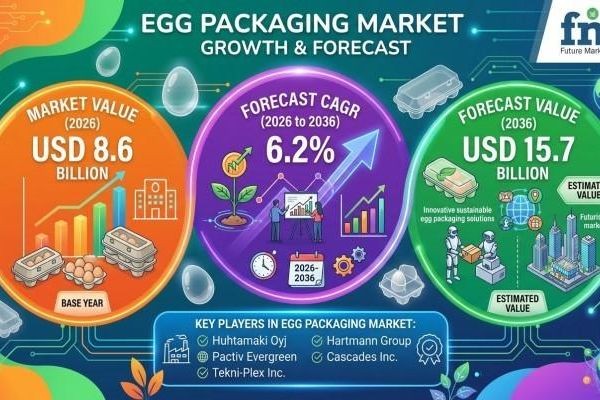
The global Egg Packaging Market is expected to grow from USD 8.60 billion in 2026 to USD 15.70 billion by 2036, registering a CAGR of 6.2% during the forecast period. According to the latest analysis by Future Market Insights, market growth is being fueled not only by increasing global egg consumption, but also by rising sustainability mandates, retail modernization, and the rapid shift away from polystyrene foam packaging toward recyclable molded fiber and recycled PET alternatives.
Traditionally viewed as a basic protective packaging segment, egg packaging is now evolving into a sustainability-centric and regulation-driven industry. Manufacturers are increasingly investing in molded fiber production technologies, recyclable material systems, and retail-ready carton innovations that enhance product protection, improve shelf appeal, and ensure compliance with evolving environmental standards across global food supply chains.
Get detailed market forecasts, competitive benchmarking, and pricing trends:
https://www.futuremarketinsights.com/reports/sample/rep-gb-4015
Market Drivers and Industry Transformation
The expansion of the egg packaging market is strongly tied to growing global demand for affordable protein sources, the expansion of organized retail infrastructure, and stricter environmental regulations targeting single-use plastics and expanded polystyrene packaging materials.
Across North America and Europe, governments and major retailers are implementing sustainability initiatives and packaging compliance frameworks that encourage the adoption of recyclable and compostable egg cartons. As a result, manufacturers are accelerating the transition toward molded fiber, recycled paperboard, and recycled PET packaging solutions.
Simultaneously, the rapid growth of supermarkets and branded egg retailing in emerging economies is generating demand for standardized, shelf-ready egg packaging formats that support branding, logistics efficiency, and product visibility.
Major growth factors include:
- Rising global egg consumption driven by population growth and increasing protein demand
- Regulatory restrictions on expanded polystyrene foam packaging in multiple countries
- Growing adoption of molded fiber and recycled PET egg cartons
- Expansion of supermarket and organized retail distribution networks
- Increasing consumer preference for recyclable and compostable packaging materials
Despite strong growth prospects, the market faces challenges including high capital investment requirements for molded fiber manufacturing, volatility in recycled fiber supply costs, and pricing competition from low-cost plastic packaging alternatives in developing markets.
Segment and Regional Analysis
Paper-based egg packaging is projected to account for 46.8% of the material segment in 2026, supported by strong regulatory backing and rising consumer preference for recyclable molded fiber cartons and trays.
Cartons continue to dominate the product segment, capturing 39.5% market share due to their widespread use across supermarkets, grocery chains, and retail distribution channels.
Retailing remains the leading application segment with a 42.3% share, driven by growing demand for consumer-friendly packaging formats that support shelf visibility, transportation safety, and brand communication.
Region-wise:
- Germany is projected to lead market growth with a CAGR of 7.1% through 2036, supported by strict sustainability regulations and premium egg product demand
- The United States is expected to expand at 6.8% CAGR, driven by high egg consumption volumes and increasing state-level bans on polystyrene packaging
- South Korea and the United Kingdom are witnessing strong growth due to sustainability-focused packaging transitions and organized retail expansion
- Brazil and Japan continue to experience rising demand through packaging modernization and increasing egg consumption trends
Countries such as Germany, the United States, South Korea, the United Kingdom, Brazil, and Japan remain critical hubs for both egg consumption and sustainable packaging innovation.
Competitive Landscape
The competitive landscape is dominated by large-scale molded fiber and sustainable packaging manufacturers with established production infrastructure and strong relationships with egg producers and retail chains.
Leading companies operating in the market include Huhtamaki Oyj, Pactiv Evergreen, Hartmann Group, Cascades Inc., and Tekni-Plex Inc..
Key competitive strategies include:
- Expanding molded fiber production capacity
- Investing in recyclable and sustainable packaging portfolios
- Strengthening long-term partnerships with retailers and egg producers
- Improving recycled fiber sourcing and supply chain resilience
- Developing premium retail-ready packaging formats
Why FMI’s Egg Packaging Market Report Stands Out
Conventional market research reports typically focus on:
- Market size and CAGR projections
- Basic segmentation and regional analysis
- Competitive landscape summaries
In contrast, FMI provides deeper industry intelligence through:
- Material transition analysis covering the shift from polystyrene foam to molded fiber and recycled PET
- Production benchmarking and molded fiber manufacturing investment analysis
- Regulatory mapping of sustainability mandates and recyclable packaging compliance
- Supplier ecosystem intelligence focused on recycled paper sourcing and molded pulp supply chains
- Retail packaging trend analysis for shelf-ready carton formats and procurement strategies
- Trade flow tracking across North America, Europe, and Asia-Pacific
- Competitive movement analysis covering capacity expansions, product innovation, and geographic expansion
- End-use demand intelligence for retailing, transportation, and commercial distribution packaging
Why This Matters for Buyers
- Supports sustainable packaging procurement strategies
- Enables supplier benchmarking and sourcing optimization
- Reduces regulatory and compliance risks
- Helps align manufacturing capacity with long-term retail demand trends
Who Should Use This Report
- Egg packaging manufacturers
- Molded fiber and recycled paper suppliers
- Retail packaging distributors
- Egg producers and food processing companies
- Retail chains and supermarket procurement teams
- Investors and packaging industry stakeholders
Strategic Business Benefits
- Identify high-growth packaging product categories
- Optimize sustainable material sourcing strategies
- Align molded fiber production with future demand growth
- Strengthen retail and supermarket distribution channels
- Position recyclable packaging solutions for sustainability-focused consumers
- Build partnerships with retailers and egg producers
- Identify high-growth regions and emerging packaging technologies
- Benchmark against leading global molded fiber competitors
Egg Packaging Market Snapshot (2036)
- Market Value (2026): USD 8.60 Billion
- Forecast Value (2036): USD 15.70 Billion
- CAGR (2026–2036): 6.2%
- Leading Material Segment: Paper-Based Egg Packaging (46.8% share)
- Leading Product Category: Cartons (39.5% share)
- High-Growth Countries: Germany, USA, South Korea, UK, Brazil, and Japan
- Key Companies: Huhtamaki Oyj, Pactiv Evergreen, Hartmann Group, Cascades Inc., Tekni-Plex Inc.






