
A consistent operational scale-up is redefining aerospace engineering protocols and avionics manufacturing pipelines, fueled by the commercial and defense necessity to deploy highly precise, flight-certified display hardware capable of maintaining absolute performance reliability under demanding environmental stresses worldwide.
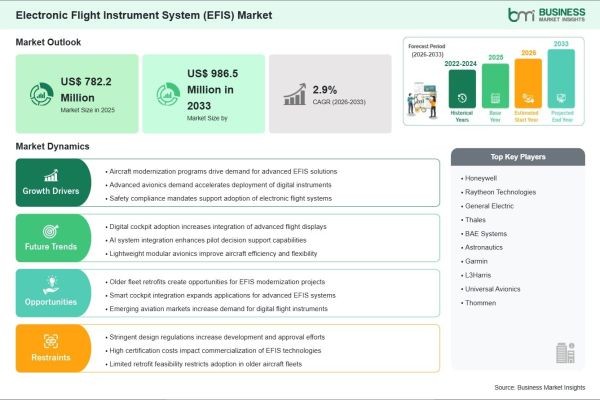
Based on market intelligence from Business Market Insights, the global Electronic Flight Instrument System (EFIS) Market is anticipated to reach US$ 986.5 million by 2033, mounting from its 2025 value of US$ 782.22 million at a projected CAGR of 2.9% from 2026 to 2033.
Technological advancements in active-matrix liquid-crystal displays (AMLCD), next-generation synthetic vision systems (SVS), flight management system (FMS) integration, and highly reliable multi-core processing units are transforming the Electronic Flight Instrument System (EFIS) Market. Aerospace manufacturers and operators are increasingly deploying advanced glass cockpit architectures to streamline complex flight data visualization across commercial, military, and general aviation aircraft. As international flight corridors become more congested, sophisticated digital flight decks are emerging as a critical component of global airspace efficiency strategies.
Download Sample Report : https://www.businessmarketinsights.com/sample/BMIPUB00035604
What Is Electronic Flight Instrument System (EFIS)?
An Electronic Flight Instrument System (EFIS) is an advanced aircraft cockpit instrument display system that presents flight, navigation, and engine data digitally using electronic display technology rather than traditional electromechanical gauges. A standard EFIS installation consists of a Primary Flight Display (PFD), a Multi-Function Display (MFD), and a dedicated Engine Indication and Crew Alerting System (EICAS) or Electronic Centralized Aircraft Monitor (ECAM).
The technology offers significant advantages including highly customizable information layouts, enhanced graphical situational awareness, reduced physical pilot workload, and substantial weight savings over heavy analog instrumentation networks. With support for terrain awareness warning systems (TAWS), real-time weather radar mapping, and traffic collision avoidance systems (TCAS), modern EFIS setups are becoming an indispensable baseline standard across all tiers of modern aviation architectures.
Market Drivers
A major driver of the Electronic Flight Instrument System (EFIS) Market is the worldwide modernization of aging commercial and military aircraft fleets. Airlines and defense departments are aggressively retrofitting older airframes with modern glass cockpits to replace obsolete analog instruments that suffer from high failure rates and expensive replacement parts. Digital systems offer drastically improved reliability, lowering scheduled maintenance overheads and preventing costly aircraft-on-ground (AOG) situations.
Strict international aviation safety regulations and next-generation airspace management initiatives are also accelerating market growth. Global civil aviation authorities are enforcing complex navigation mandates, such as Automatic Dependent Surveillance-Broadcast (ADS-B) out and Performance-Based Navigation (PBN). To comply with these real-time satellite-tracking flight paths, aircraft require high-resolution, integrated EFIS units capable of processing and displaying vast streams of geographical and navigational telemetry dynamically.
The rapid expansion of the urban air mobility (UAM) sector, commercial drone networks, and light business jet travel is creating additional opportunities for market expansion. Emerging vertical takeoff and landing (eVTOL) aircraft require exceptionally lightweight, ultra-compact, and energy-efficient avionics systems. This pushes electronic component designers to pioneer highly integrated, multi-functional touchscreen EFIS displays optimized for small-scale electric cockpit spaces.
Market Segmentation
By Subsystem
- Primary Flight Display (PFD): The largest segment by volume, acting as the pilot's core source of real-time flight telemetry including airspeed, altitude, attitude, and heading data.
- Multi-Function Display (MFD): Experiencing high growth due to its ability to display complex navigational route mapping, weather radar, and secondary system checklists simultaneously.
- Engine Indication and Crew Alerting System (EICAS): Vital for displaying real-time propulsion metrics, fuel utilization parameters, and automated maintenance alerts.
By Platform
- Commercial Aviation: Represents the dominant market segment, driven heavily by large-scale narrowbody and widebody passenger jet production lines from global aerospace giants.
- Military Aviation: Scaling steadily as global defense forces invest in multi-role fighter jets, heavy transport aircraft, and tactical helicopter cockpit retrofits.
- General Aviation: Witnessing consistent deployment across private turboprops, business helicopters, and light recreational aircraft lines.
By Fit Type
- Line-Fit: Dominates production volume as aircraft OEMs install standardized glass cockpit configurations directly on assembly lines.
- Retrofit: Experiencing strong momentum as commercial operators extend the operational life of existing fleets through modern digital avionics overhauls.
The Primary Flight Display (PFD) subsystem dominated the market in 2025 because it is a foundational safety-critical necessity for every modern flight station. Commercial aviation accounted for the largest platform share due to surging international passenger transit volumes and massive backlogs of commercial jetliner orders. Line-fit installations represented the dominant choice due to the absolute standard inclusion of digital display tech in all newly manufactured aircraft platforms.
Regional Insights
- North America holds the largest market share, anchored by the presence of prominent aircraft manufacturing corporations, large commercial airline fleets, and heavy institutional military avionics modernization funding across the United States.
- Europe remains a major hub for digital flight deck innovation, supported directly by stringent European Union Aviation Safety Agency (EASA) mandates and robust production lines for commercial jetliners and military transport airframes.
- Asia-Pacific is the fastest-growing market, driven by rapid regional airport infrastructure development, massive commercial fleet expansions in China and India, and rising localized aerospace defense spending.
- Middle East & Africa is observing steady growth, fueled by premium long-haul international airline hub expansions and defense fleet upgrade initiatives.
- South & Central America is gradually expanding as regional airlines modernize regional jet networks to improve flight safety and operational cost efficiencies.
Top Players in the Electronic Flight Instrument System (EFIS) Market
The market is highly consolidated and governed by strict regulatory safety certifications, with leading aerospace tech firms focusing on system integration, multi-core processing safety, and intuitive user interfaces.
- Collins Aerospace (RTX Corporation)
- Honeywell International Inc.
- Garmin Ltd.
- Thales Group
- L3Harris Technologies, Inc.
- Universal Avionics Systems Corporation
- Astronautics Corporation of America
- Avidyne Corporation
- Genesys Aerosystems
- Dynon Avionics
These corporations continue investing heavily in synthetic vision software, modular open systems architectures (MOSA), touchscreen durability, and strategic alignment with major airframe manufacturers to capture long-term production contracts.
Technological Innovations
Technological innovation is transforming the Electronic Flight Instrument System (EFIS) Market through the development of Synthetic Vision Systems (SVS), enhanced flight deck touchscreen responsiveness, and the integration of Artificial Intelligence for predictive crew alerting. These developments directly focus on decreasing pilot fatigue and ensuring absolute safety during adverse weather landings.
The integration of Synthetic Vision Systems (SVS) represents a massive leap forward in pilot navigation. By combining highly accurate internal 3D terrain databases with real-time GPS telemetry, modern EFIS displays can generate a clear, virtual representation of the external landscape, runways, and obstacles. This allows flight crews to maintain excellent situational awareness even during zero-visibility instrument meteorological conditions (IMC).
Additionally, avionics engineers are transitioning away from heavy mechanical bezel buttons toward multi-touch, high-definition capacitive screens. Designed with advanced anti-glare coatings and extreme temperature tolerance, these next-generation displays allow pilots to interact with flight plans, navigation maps, and radio frequencies much more rapidly, maximizing space efficiency across modern aircraft control panels.
Future Market Outlook
The future outlook for the Electronic Flight Instrument System (EFIS) Market remains highly favorable. Continuous commercial aircraft production backlogs, widespread deployment of connected military air fleets, and the emergence of autonomous urban air taxis will guarantee strong demand for advanced glass cockpit architectures through 2033.
As flight decks transition toward more cohesive, cloud-connected software environments, the EFIS will evolve from a basic passive telemetry viewer into an active, intelligent flight optimization platform. Aerospace tech providers who emphasize modular open software standards, highly ruggedized large-format displays, and seamless touchscreen integration are expected to lead the global aviation electronics sector.
Frequently Asked Questions (FAQs)
What is the projected size of the Electronic Flight Instrument System (EFIS) Market by 2033?
The market is projected to reach US$ 2.8 Billion by 2033, rising from US$ 1.9 Billion in 2025.
What is the CAGR for the Electronic Flight Instrument System (EFIS) Market?
The market is expected to grow at a CAGR of 5.1% from 2026 to 2033.
Which subsystem segment dominates the market?
The Primary Flight Display (PFD) segment held the largest market share due to its fundamental role in providing critical flight safety telemetry directly within the pilot's primary field of view.
Which platform segment leads the market?
Commercial aviation dominated the market because of extensive global commercial passenger jet production volumes and mandatory digital airspace tracking updates.
Which region accounts for the largest share?
North America holds the largest market share, driven by its expansive domestic civil aviation industry, major aircraft OEMs, and massive aerospace defense investments.
Browse More Reports:
https://www.businessmarketinsights.com/reports/specialty-advanced-ceramics-market
https://www.businessmarketinsights.com/reports/specialty-tapes-market
https://www.businessmarketinsights.com/reports/sprayed-concrete-market
About Us
Business Market Insights is a market research platform that provides subscription service for industry and company reports. Our research team has extensive professional expertise in domains such as Electronics & Semiconductor; Aerospace & Defense; Automotive & Transportation; Energy & Power; Healthcare; Manufacturing & Construction; Food & Beverages; Chemicals & Materials; and Technology, Media, & Telecommunications.
Contact Us
If you have any questions about this report or would like further information, please contact us:
Contact person: Ankit Mathur
Email: sales@businessmarketinsights.com
Phone: +16467917070






