
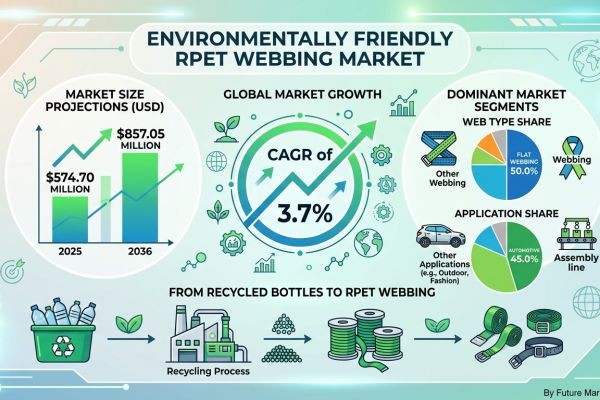
The global environmentally friendly RPET webbing market is projected to witness steady expansion over the next decade, supported by tightening vehicle recycled content regulations and rising brand sustainability commitments across consumer sectors. The market is expected to grow steadily, reaching approximately USD 857.05 million by 2036, registering a CAGR of 3.7%, according to the latest analysis by Future Market Insights (FMI).
Market growth is being shaped by increasing government mandates for sustainable materials, growing consumer awareness regarding plastic waste reduction, and rapid adoption of advanced recycling technologies. Environmentally friendly RPET webbing, manufactured from recycled polyethylene terephthalate sourced from post-consumer plastic bottles and industrial PET waste streams, has evolved from an optional green alternative into an essential regulatory requirement across various industrial sectors. While traditional virgin polyester continues to hold historical presence, manufacturers are increasingly transitioning to RPET configurations to comply with modern eco-friendly expectations and achieve circular economy targets.
Environmentally Friendly RPET Webbing Market Snapshot (2026–2036)
- Market size outlook toward 2036: USD 857.05 million
- Forecast CAGR: 3.7%
- Dominant application category: Automotive (45.0% share)
- Fastest-growing segment: Flat webbing formats (~50.0% share)
- Key growth countries: China, India, Germany, United States, Brazil, Japan
- Primary demand channel: OEM sustainable material substitution
Momentum in the Market
Beginning from steady commercial adoption levels, the environmentally friendly RPET webbing market demonstrates accelerated growth throughout the forecast period as structural substitution becomes mandatory across multiple countries. Between 2026 and 2036, expanding commercial applications and rising automotive production are expected to significantly boost demand for recycled narrow fabrics. Increasing industrialization and strict corporate climate goals are encouraging brands and automakers to prioritize waste diversion technologies.
From 2036 onward, innovation in high-performance circular textile engineering and integration with global supply chain certification platforms is expected to further strengthen market expansion. High-strength RPET webbings capable of delivering mechanical performance comparable to virgin materials while reducing petroleum feedstock consumption are emerging as key differentiators in modern manufacturing lines.
The Reasons Behind the Market’s Growth
Demand for environmentally friendly RPET webbing is rising due to multiple structural and technological factors reshaping the global manufacturing ecosystem.
Extended Producer Responsibility and Safety Regulations
Governments across various nations are enforcing mandatory circular frameworks to reduce plastic pollution and align with global climate standards. RPET webbing is increasingly becoming a preferred component in compliance audits and carbon footprint reduction strategies.
Growing Automotive and Commercial Scaling
Rapid expansion of advanced automotive manufacturing hubs is driving large-scale OEM adoption of recycled seatbelt components and cargo management systems.
Rising Brand Sustainability Commitments
Brands and tier-1 suppliers are prioritizing textile formulations equipped with verified recycled content, accelerating adoption across consumer-facing safety products and structural gear.
Industrial Recycling Infrastructure Expansion
The rise of mature PET bottle collection networks and optimized chemical sorting setups is creating a highly consistent supply of premium rPET yarn tailored to high-strength narrow fabrics.
Top Segment Application Type
Automotive Leads Market Demand
The automotive segment accounts for the majority of RPET webbing installations across global markets, supported by increasing vehicle production and regulatory mandates requiring multiple recycled interior elements.
Webbing Configuration Analysis
- Flat Webbing: Dominating with a 50.0% market share as the preferred layout for versatile industrial and consumer applications.
- Tubular Webbing: Expanding steadily across heavy-duty towing, climbing, and safety harnesses.
- Specialty formats: Gaining traction as brand requirements demand unique widths, thicknesses, and tensile specifications.
Regional Development: Global Recycling Ecosystem Drives Expansion
The global industrial landscape is rapidly evolving into an advanced hub for automotive and textile component optimization, supported by localized recycling infrastructure and expanding supply chains.
- China: Leading global expansion at a 5.0% CAGR through 2036, driven by massive domestic PET recycling scale and automotive seatbelt production volume.
- India: Following closely at a 4.6% CAGR, fueled by expanding textile recycling capabilities and automotive hub growth.
- Germany: Registering a 4.3% CAGR, strongly anchored by stringent EU recycled content mandates for automotive components.
- United States: Maintaining a stable 3.5% growth trajectory backed by corporate green conversion goals.
- Brazil & Japan: Expanding at 3.9% and 2.8% respectively, supported by localized bottle collection frameworks.
Challenges, Trends, Opportunities, and Drivers
Drivers
- Mandatory circular material regulations
- Rising demand for recycled automotive textiles
- Expanding corporate sustainability targets
- Scale of post-consumer PET bottle recycling
Opportunities
- Verified high-tensile RPET safety harnesses
- Advanced anti-abrasion and fire-retardant finishes
- Recyclable and multi-lifecycle webbing blends
- Integration into premium outdoor and consumer goods
Trends
- Transition toward verified traceability platforms
- AI-enabled optical sorting in recycling plants
- Increased deployment of 100% post-consumer materials
- Eco-friendly dying and coloring innovations
Challenges
- Cost premiums over cheap virgin polyester feedstock
- Meeting ultra-strict safety qualification requirements
- Ensuring continuous purity of collected waste streams
Country Growth Outlook (Global Region)
The market’s growth trajectory is closely tied to standard industrialization and regulatory implementation across major economies:
- China: Scaling material volume and structural manufacturing output.
- India: Upgrading chemical textile infrastructure and commercial conversion.
- Germany: Leading premium compliance and regional supply chain integration.
- United States: Transforming private consumer brand procurement models.
- Japan: Enhancing technical industrial grade optimization.
The Competitive Environment
The global environmentally friendly RPET webbing market is competitive, with safety technology providers and narrow fabric specialists competing through innovation, localized manufacturing, and regulatory compliance.
Leading industry market players are investing heavily in processing efficiency, lightweight engineering, and safety-compliant yarn structures while forming long-term raw material partnerships with recycling conglomerates to secure continuous supply chains and accelerate structural market deployment.
Future Outlook: Toward Sustainable and Smarter Material Systems
The global environmentally friendly RPET webbing market is entering a transformative decade shaped by circularity, automation, and stricter material expectations. Future webbing systems are expected to function as fully traceable components working alongside automated supply networks that favor verifiable environmental footprints. As industrial product lines mature and green awareness strengthens, RPET webbing will remain central to achieving low-carbon emission ecosystems throughout the global manufacturing landscape.
For a comprehensive strategic outlook and detailed analysis of technological developments shaping the industry, readers can explore the full report on the official Future Market Insights website: https://www.futuremarketinsights.com/reports/environmentally-friendly-rpet-webbing-market






