
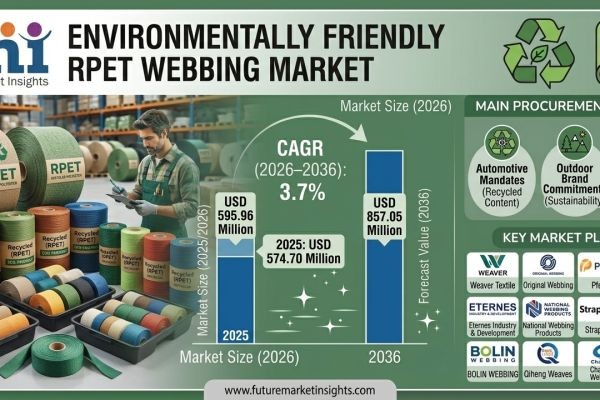
The global environmentally friendly RPET webbing market is poised for steady expansion over the next decade, driven by rising demand for sustainable textile materials, tightening recycled-content regulations, and increasing adoption of circular manufacturing practices across industries. According to the latest insights by Future Market Insights, the market is projected to grow from approximately USD 595.96 million in 2026 to nearly USD 857.05 million by 2036, registering a CAGR of 3.7% during the forecast period.
Market momentum is being fueled by the growing transition from virgin polyester webbing toward recycled polyethylene terephthalate (RPET) solutions derived from post-consumer plastic waste. Automotive manufacturers, outdoor equipment brands, and safety gear producers are increasingly integrating RPET webbing into their supply chains to meet sustainability commitments while maintaining high-performance standards.
Environmentally Friendly RPET Webbing Market Snapshot (2026–2036)
- Market size in 2026: USD 595.96 million
- Forecast market value by 2036: USD 857.05 million
- Forecast CAGR (2026–2036): 3.7%
- Dominant webbing type: Flat RPET webbing
- Leading application segment: Automotive applications
- Fastest-growing regions: China and India
- Primary growth driver: Rising recycled-content mandates and sustainability targets
Momentum in the Market
The environmentally friendly RPET webbing market is transitioning from a niche sustainability-focused category into a mainstream industrial material segment. Beginning from growing adoption across automotive seatbelt systems and outdoor recreational products, demand is accelerating as manufacturers prioritize recycled materials capable of delivering both environmental and mechanical performance benefits.
Between 2026 and 2036, the market is expected to witness increasing procurement conversion from virgin polyester to RPET webbing due to regulatory pressures and corporate ESG initiatives. Automotive OEMs, luggage manufacturers, safety equipment suppliers, and pet accessory brands are progressively integrating RPET webbing into standard product specifications.
From 2030 onward, improvements in recycled fiber processing technologies and enhanced chain-of-custody verification systems are expected to strengthen market penetration further. Advanced traceability solutions are emerging as critical differentiators, particularly for automotive and safety applications requiring verified recycled content documentation.
The Reasons Behind the Market’s Growth
Rising Sustainability Commitments Across Industries
Global manufacturers are increasingly committing to sustainability targets aimed at reducing carbon emissions and plastic waste. RPET webbing supports these objectives by utilizing recycled plastic feedstock while maintaining product durability and functionality.
Automotive Recycled Content Mandates
Automotive manufacturers are accelerating adoption of RPET webbing in seatbelts, cargo restraints, and interior components due to evolving recycled-material regulations and environmental compliance standards.
Expansion of Circular Economy Policies
Governments and regulatory bodies across Europe and Asia-Pacific are introducing extended producer responsibility (EPR) frameworks and recycled-content mandates, encouraging the use of sustainable textile materials.
Growing Consumer Preference for Eco-Friendly Products
Consumers are increasingly favoring products made with recycled materials, encouraging brands in outdoor gear, luggage, and sports equipment industries to integrate RPET webbing into product portfolios.
Advancements in Recycling Technology
Technological improvements in PET recycling and fiber processing are helping RPET webbing achieve performance levels comparable to virgin polyester, supporting adoption in load-bearing and safety-critical applications.
Top Segment Analysis
Flat RPET Webbing Leads Market Demand
Flat RPET webbing is projected to remain the dominant webbing type, accounting for nearly 50% of market share in 2026. Its versatility, cost efficiency, and broad application range across automotive, luggage, and industrial sectors continue to drive demand.
Automotive Applications Dominate the Market
The automotive segment is expected to hold approximately 45% market share in 2026, supported by increasing use of recycled materials in seatbelt systems, cargo restraints, and vehicle interiors. Automakers are actively incorporating RPET webbing to meet sustainability goals and evolving regulatory standards.
Outdoor and Recreational Equipment Gains Momentum
Outdoor brands are increasingly specifying minimum RPET content in backpacks, climbing gear, camping products, and pet accessories as consumers prioritize sustainable product choices.
Regional Development: Asia Leads Global Expansion
Asia-Pacific is emerging as the strongest growth region for environmentally friendly RPET webbing production and consumption, supported by large-scale textile manufacturing ecosystems and expanding recycling infrastructure.
China
China is projected to lead global growth with a CAGR of 5.0% through 2036, driven by extensive PET recycling capacity, automotive manufacturing dominance, and strong textile industry infrastructure.
India
India is forecast to expand at a CAGR of 4.6%, supported by increasing textile recycling capabilities, growing environmental awareness, and rising automotive manufacturing activities.
Germany
Germany remains a major European market due to strict environmental regulations, advanced automotive manufacturing, and strong circular economy initiatives.
United States
The United States market is benefiting from corporate sustainability programs and growing consumer demand for eco-friendly industrial and consumer products.
Challenges, Trends, Opportunities, and Drivers
Drivers
- Rising recycled-content mandates
- Growing automotive sustainability programs
- Increasing demand for eco-friendly textile solutions
- Expansion of global recycling infrastructure
Opportunities
- Smart traceability and certification systems
- RPET integration into safety-critical applications
- Growth in sustainable outdoor equipment manufacturing
- Expansion of recycled textile innovations
Trends
- Transition toward verified recycled-content sourcing
- Integration of circular manufacturing practices
- Growing adoption of Global Recycled Standard (GRS) certifications
- Increasing use of RPET in automotive interiors and restraints
Challenges
- Supply chain traceability limitations
- Fluctuating recycled PET feedstock availability
- Certification compliance complexities
- Higher processing costs compared to virgin materials
Competitive Landscape
The environmentally friendly RPET webbing market remains moderately fragmented, with manufacturers competing through sustainability certifications, recycled fiber processing capabilities, and product performance innovation.
Key companies operating in the market include:
- Weaver Textile
- Original Webbing
- Pfeiffer
- Huida Webbing
- National Webbing Products
- Strapworks
- Jude Webbing
- Qiheng Weaves
These companies are investing in advanced recycling technologies, traceability systems, and automotive-grade RPET solutions to strengthen their global market positions.
Future Outlook: Toward Circular and Sustainable Textile Manufacturing
The environmentally friendly RPET webbing market is entering a transformative phase shaped by sustainability regulations, recycled-material adoption, and growing consumer environmental awareness. As industries continue transitioning toward circular manufacturing ecosystems, RPET webbing is expected to become a standard material across automotive, industrial, and consumer applications.
Future growth will likely be supported by improved recycling efficiency, expanded certification frameworks, and technological advancements enabling RPET webbing to achieve parity with virgin polyester in both performance and durability.
For a comprehensive strategic analysis and detailed industry insights, readers can explore the full report on the official Future Market Insights website:
https://www.futuremarketinsights.com/reports/environmentally-friendly-rpet-webbing-market






