
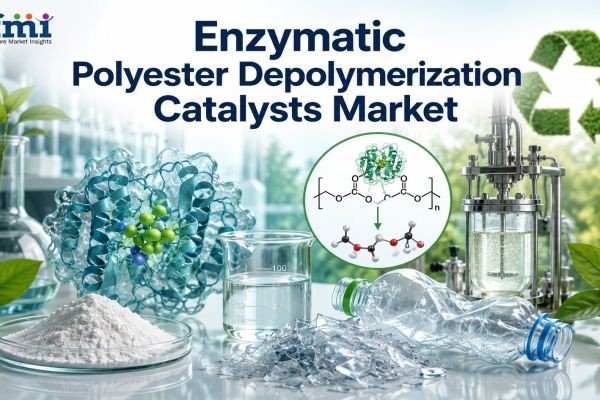
According to Future Market Insights, the global enzymatic polyester depolymerization catalysts market is witnessing rapid growth as recycling companies and polymer manufacturers increasingly adopt enzyme-based solutions for high-purity polyester recycling. Valued at USD 53.4 million in 2025, the market is projected to reach USD 389.7 million by 2036, registering a robust CAGR of 19.8% during the forecast period. Expanding PET recycling infrastructure, stringent sustainability regulations, and continuous advancements in enzyme engineering are expected to fuel long-term market expansion.
Market Growth Path
The enzymatic polyester depolymerization catalysts market is expanding rapidly as governments, brand owners, and recycling companies seek sustainable solutions to reduce plastic waste. Growing adoption of enzyme-based recycling technologies enables efficient conversion of polyester waste into high-quality reusable monomers, supporting circular economy initiatives. Increasing commercialization of enzymatic recycling plants and rising investments in biotechnology are further accelerating market growth.
Get Detailed Market Forecasts, Competitive Benchmarking, and Pricing Trends: https://www.futuremarketinsights.com/reports/sample/rep-gb-33134
Market Overview
Enzymatic polyester depolymerization catalysts are specialized biological catalysts that break down polyester polymers into reusable monomers under controlled conditions. These catalysts are increasingly used for recycling PET packaging, polyester textiles, films, and blended polyester materials while maintaining superior material quality compared to conventional recycling methods.
As sustainability goals become more ambitious across packaging, textiles, and consumer goods industries, enzyme-based recycling technologies are emerging as an attractive alternative to mechanical and chemical recycling. Their ability to recover high-purity monomers while reducing carbon emissions continues to strengthen market adoption.
Key Growth Drivers
The implementation of recycled-content regulations across major economies remains one of the strongest growth drivers for the market. Packaging manufacturers are increasingly seeking food-grade recycled PET to comply with sustainability mandates, creating significant demand for enzymatic recycling catalysts.
Growing volumes of polyester textile waste are also driving catalyst adoption. Enzyme-based depolymerization enables efficient recycling of complex polyester waste streams that are difficult to process using traditional recycling technologies.
Increasing investments in biotechnology, industrial enzyme development, and commercial-scale recycling facilities are further supporting market expansion. Collaboration between enzyme developers, polymer manufacturers, and recycling operators is accelerating commercialization across global markets.
Technology & Innovation Trends
Technological innovation continues to transform the enzymatic polyester depolymerization catalysts industry. Companies are developing next-generation engineered PET hydrolases, PETase variants, cutinases, and immobilized enzyme systems that significantly improve depolymerization efficiency while reducing processing time.
Artificial intelligence-assisted enzyme engineering, advanced protein optimization, and high-performance biocatalysts are improving reaction speed, enzyme stability, and monomer recovery rates. Continuous innovation in reactor technologies and enzyme recycling systems is also enhancing commercial viability for large-scale recycling operations.
Market Challenges & Restraints
Despite exceptional growth prospects, several challenges continue to influence market expansion. High research and development costs associated with enzyme engineering remain a major barrier for emerging companies. Commercial-scale deployment also requires significant investments in specialized recycling infrastructure.
Feedstock quality, pretreatment requirements, and maintaining consistent enzyme performance across diverse polyester waste streams remain technical challenges. Additionally, regulatory approvals and lengthy commercialization timelines may delay broader industrial adoption.
Segment Analysis
Engineered PET Hydrolases
Engineered PET hydrolases are expected to account for 44.0% of catalyst type demand in 2026 owing to their superior catalytic activity, higher monomer recovery, and improved process economics.
PET Packaging Feedstock
PET packaging is projected to capture 48.0% of feedstock demand in 2026 as beverage bottles and food containers remain the largest source of recyclable polyester waste.
Slurry Reactors
Slurry reactors are expected to account for 36.0% of reactor demand due to their ability to maximize enzyme-substrate interaction and improve depolymerization efficiency.
Technology Licensing
Technology licensing is forecast to represent 46.0% of sales model demand in 2026 as commercial recycling plants increasingly license proprietary enzyme technologies before large-scale enzyme procurement.
Regional Analysis
China is expected to emerge as the fastest-growing major market, registering a remarkable 23.5% CAGR through 2036. Rapid expansion of PET manufacturing capacity, strong recycling investments, and commercialization of enzyme-based recycling technologies continue to support regional growth.
The United States follows with a projected 21.0% CAGR, driven by increasing recycling infrastructure investments and growing demand for food-grade recycled plastics. France is forecast to grow at 20.4%, supported by commercial biorecycling projects and advanced biotechnology capabilities. India is expected to register a CAGR of 18.9%, fueled by expanding packaging demand and strengthening plastic waste management initiatives. The United Kingdom is projected to grow at 16.1% through the forecast period as sustainability regulations continue to encourage advanced recycling technologies.
Competitive Landscape
The enzymatic polyester depolymerization catalysts market remains highly innovation-driven, with biotechnology companies focusing on advanced enzyme development, commercial licensing agreements, strategic partnerships, and pilot-scale recycling projects. Competition increasingly centers on catalyst efficiency, monomer recovery performance, intellectual property, and industrial scalability.
Leading Companies Analysis
Key market participants include Carbios, Novonesis, Samsara Eco, Protein Evolution, Wankai New Materials, Epoch Biodesign, and Basecamp Research. These companies continue investing in enzyme engineering, commercial recycling technologies, industrial partnerships, and global licensing agreements to strengthen their market positions.
Investment & Strategic Developments
Industry participants are significantly increasing investments in commercial PET biorecycling facilities, AI-driven enzyme development platforms, and advanced industrial biotechnology solutions. Strategic collaborations between enzyme developers, packaging manufacturers, and recycling companies are accelerating commercialization across multiple regions.
Recent developments include the expansion of commercial PET biorecycling facilities, exclusive technology licensing agreements for Asian markets, and continuous innovation in engineered enzyme platforms designed to improve recycling efficiency and economic feasibility.
Future Outlook
The enzymatic polyester depolymerization catalysts market is expected to experience exceptional growth through 2036, supported by expanding circular economy initiatives, increasing regulatory pressure for recycled plastics, and continuous technological innovation.
As industries increasingly transition toward sustainable polymer production and closed-loop recycling systems, demand for advanced enzymatic depolymerization catalysts is expected to accelerate, creating significant opportunities for biotechnology companies, recycling operators, and packaging manufacturers worldwide.
Purchase Full Report for Detailed Insights: https://www.futuremarketinsights.com/reports/enzymatic-polyester-depolymerization-catalysts-market
Explore More Related Studies Published by FMI Research:
https://www.openpr.com/news/4518046/magnetic-resonance-imaging-mri-market-outlook-2036-north
https://www.openpr.com/news/4511971/glutaraldehyde-market-grows-as-south-korea-eu-boost-healthcare
https://www.openpr.com/news/4517140/aluminum-chemicals-market-sees-north-america-lead-as-kemira-geo
Custom Research and Consulting Services
Future Market Insights provides customized research solutions, competitive benchmarking, procurement intelligence, market entry strategy development, sustainability consulting, and strategic advisory services tailored to client-specific business objectives.
For custom research inquiries and strategic consulting support, contact the FMI team directly.
About Future Market Insights (FMI)
Future Market Insights, Inc. (ESOMAR certified and a recipient of the Stevie Award) is a leading global provider of market intelligence, consulting services, and syndicated research reports across chemicals, advanced materials, biotechnology, packaging, sustainability, industrial automation, and renewable energy sectors. FMI delivers actionable insights that help organizations navigate evolving market dynamics and capitalize on emerging growth opportunities.
Contact
Future Market Insights Inc.
Christiana Corporate, 200 Continental Drive, Suite 401, Newark, Delaware 19713, USA
Email: sales@futuremarketinsights.com
Website: www.futuremarketinsights.com






