
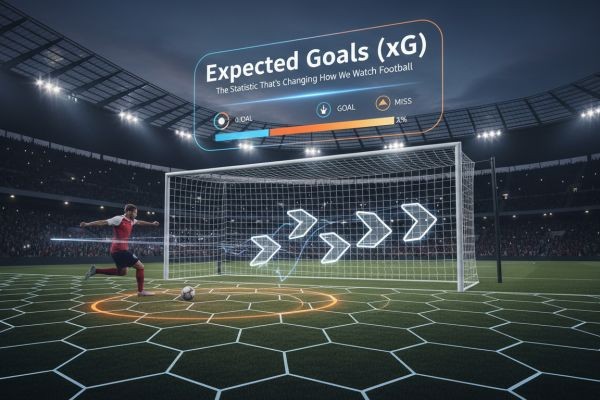
Understanding the xG Revolution
Five years ago, most football fans had never heard of Expected Goals. Today, it's arguably the most influential advanced statistic in the sport. Broadcasters display xG graphics during matches, pundits reference it in post-game analysis, and clubs use it to evaluate players worth tens of millions of euros. This metric has fundamentally changed how we understand football performance.
Expected Goals (xG) assigns a probability value to every shot based on historical data. A one-on-one with the goalkeeper might have an xG of 0.70 (70% chance of scoring), while a long-range effort carries an xG of 0.03. The model considers shot location, angle, defensive pressure, assist type, and even which body part was used. Over time, these probabilities paint a clearer picture of team performance than raw goal tallies.
Why Traditional Stats Mislead
Goals are what matter—we all know this. But goals contain massive randomness. A team might dominate possession, create quality chances, yet lose 1-0 to a deflected strike from 30 yards. Traditional statistics (shots, possession, corners) don't distinguish between chance quality. Ten poor shots aren't equivalent to three excellent opportunities, yet conventional stats treat them equally.
This is where xG excels. It reveals underlying performance quality. A team consistently outperforming their xG might be riding a hot goalkeeper or clinical finishing; a team underperforming likely faces regression to the mean. Over a season, xG predicts future results more accurately than actual goals scored.
Real-World Applications
Liverpool's recruitment strategy relies heavily on xG analytics. When they signed Mohamed Salah from Roma, many questioned the £43 million fee. But Liverpool's analysts saw something crucial: Salah's xG suggested he was underperforming his quality, creating high-value chances that weren't converting due to variance. They bet on regression to the mean—and won spectacularly.
Coaches use xG to evaluate tactical effectiveness. Did our pressing create quality chances? Are we conceding dangerous opportunities? These questions receive quantifiable answers through xG analysis, informing training ground adjustments that traditional stats couldn't illuminate.
The Limitations
xG isn't perfect. It struggles with context: a shot taken when the score is 3-0 differs psychologically from one at 0-0 in a cup final. The metric also can't fully capture elite finishing ability—some strikers consistently beat their xG because they're genuinely exceptional at converting chances.
Still, xG represents a massive leap forward in football analysis. It transformed a sport once dominated by subjective observation into one where performance can be objectively measured and understood. That's revolutionary.
Details here: https://pelota-2010.fr






