
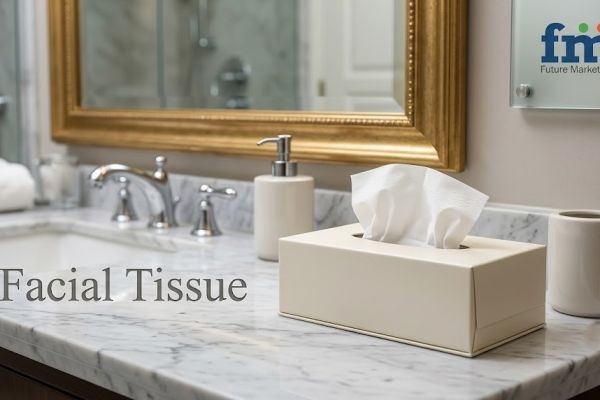
According to the latest industry analysis by Future Market Insights (FMI), the global facial tissue market is witnessing stable growth driven by increasing hygiene awareness, expanding institutional procurement, rising urbanization, and growing adoption across residential, commercial, and healthcare applications. Valued at USD 11.7 billion in 2025, the market is projected to reach USD 12.1 billion by 2026-end and further expand to USD 16.7 billion by 2036, registering a CAGR of 3.3% during the forecast period.
The market is evolving from a conventional household consumables category into a broader hygiene and institutional supply ecosystem supported by product innovation, expanding retail distribution, and increasing demand for sustainable and high-performance tissue solutions. Growing preference for convenience-based packaging, recyclable products, and premium-quality tissues is reshaping consumer purchasing behavior globally.
Quick Stats Snapshot
• Market size (2026): USD 12.1 billion
• Forecast (2036): USD 16.7 billion
• CAGR (2026-2036): 3.3%
• Leading product segment: Regular facial tissue (41.3% share)
• Dominant packaging segment: Box packaging (58.1% share)
• Fastest-growing country: China (10.2% CAGR)
• Leading distribution channels: Departmental stores, online retail, convenience stores, and specialty stores
• Key product trend: Growing demand for recyclable and premium facial tissue products
• Top application areas: Residential hygiene, institutional use, hospitality, healthcare, and commercial facilities
• Key performance driver: Expanding hygiene awareness and institutional procurement demand
Get detailed market forecasts, competitive benchmarking, and strategic insights: https://www.futuremarketinsights.com/reports/sample/rep-gb-11752
Market Size and Growth Outlook
The facial tissue market is forecast to grow at a CAGR of 3.3% between 2026 and 2036. Growth is primarily supported by increasing hygiene consciousness, rising urban population, growing institutional consumption, and expanding demand from healthcare and hospitality sectors.
Consumers and institutional buyers are increasingly prioritizing product quality, softness, absorbency, convenience, and sustainability. This trend is accelerating the adoption of premium tissue products, recyclable materials, and innovative packaging formats across developed and emerging economies.
Market Trends
• Rising demand for recyclable and eco-friendly facial tissue products
• Growing preference for premium and skin-friendly tissue formulations
• Expansion of online retail and direct-to-consumer sales channels
• Increasing institutional procurement across healthcare and hospitality sectors
• Growing consumer preference for convenient box packaging solutions
• Rising awareness regarding hygiene and personal care routines
• Expansion of sustainable manufacturing and biodegradable packaging initiatives
Key Market Drivers
1. Increasing Hygiene Awareness and Consumer Lifestyle Changes
Growing awareness regarding personal hygiene, cleanliness, and health safety is significantly driving demand for facial tissue products across residential and commercial applications worldwide.
2. Expansion of Institutional Procurement
Healthcare facilities, hospitality businesses, offices, and educational institutions are increasingly adopting facial tissue products as part of standardized hygiene and sanitation protocols.
3. Growth of Retail and E-Commerce Distribution
Online retail platforms and modern retail chains are improving product accessibility and enabling consumers to compare product quality, packaging formats, and pricing more efficiently.
4. Rising Demand for Sustainable Tissue Solutions
Consumers are increasingly favoring recyclable, biodegradable, and environmentally friendly tissue products, encouraging manufacturers to invest in sustainable production and packaging innovations.
Key Challenges
• Intense price competition across mass-market product categories
• Margin pressure from institutional procurement consolidation
• Rising raw material and pulp pricing volatility
• Competition from low-cost regional and private-label products
• Consumer price sensitivity in developing economies
Emerging Opportunities
• Expansion of recyclable and biodegradable facial tissue products
• Growth of premium tissue categories with enhanced softness and durability
• Increasing adoption of subscription-based household supply services
• Rising demand from healthcare, hospitality, and commercial sectors
• Product innovation in anti-viral and skin-sensitive tissue solutions
Segmentation Insights: Regular Facial Tissue Leads Product Demand
By Product Type
Regular facial tissue dominates the market with a 41.3% share in 2026, supported by strong demand across household, healthcare, hospitality, and institutional applications.
Anti-viral and recyclable tissue products are also witnessing growing adoption as consumers increasingly seek hygiene-focused and environmentally sustainable solutions.
By Packaging Type
Box packaging accounts for 58.1% of the market, reflecting strong consumer preference for convenience-oriented, easy-dispense packaging formats suitable for residential and commercial environments.
Pocket packaging formats continue to gain traction among on-the-go consumers seeking portability and convenience.
Speak to Analyst: Customize insights for your business strategy: https://www.futuremarketinsights.com/customization-available/rep-gb-11752
Regional Analysis
• China (10.2% CAGR): Infrastructure expansion, rising hygiene awareness, and increasing institutional procurement are driving strong market growth
• Japan (9.7% CAGR): Stable growth supported by modernization programs and premium tissue product adoption
• Singapore (9.4% CAGR): Demand growth driven by commercial infrastructure development and hospitality sector expansion
• India (3.1% CAGR): Institutional modernization and rising hygiene awareness continue to support market expansion
• United States (2.3% CAGR): Replacement demand and mature institutional procurement sustain steady market growth
Europe remains the largest regional market due to strong consumer spending on hygiene products, mature retail infrastructure, and established institutional procurement systems.
Competitive Landscape
The market remains highly competitive, with leading companies focusing on product innovation, manufacturing scale expansion, sustainable packaging development, and distribution network strengthening.
Major players include Procter & Gamble, Koch Industries, Kimberly-Clark Corporation, Svenska Cellulosa Aktiebolaget SCA, Sofidel Group, Hengan International, WEPA Group, Asia Pulp & Paper, C&S Paper Co. Ltd, and Kruger Products L.P.
Competitive advantage is increasingly defined by:
• Sustainable product innovation and recyclable material integration
• Strong retail and institutional distribution networks
• Manufacturing scale and procurement efficiency
• Product quality, softness, and durability
• Expansion into emerging markets and premium product categories
Future Outlook
The facial tissue market is expected to continue evolving toward a more hygiene-focused and sustainability-driven industry ecosystem supported by increasing institutional procurement, expanding eco-friendly product innovation, and growing consumer preference for premium tissue solutions.
Companies investing in sustainable manufacturing, supply chain reliability, and product differentiation are expected to strengthen their competitive positioning over the next decade, while high-growth markets such as China and Southeast Asia will remain key demand centers.
Purchase Full Report for Comprehensive Insights: https://www.futuremarketinsights.com/reports/facial-tissue-market
Executive Takeaways
• Market projected to grow from USD 11.7 billion (2025) to USD 16.7 billion (2036)
• CAGR of 3.3% supported by rising hygiene awareness and institutional demand
• Regular facial tissue leads with 41.3% market share
• Box packaging dominates with 58.1% share
• China represents the fastest-growing national market
• Competitive advantage increasingly depends on sustainability, pricing, and distribution strength
• Long-term market evolution shifting toward premium, recyclable, and convenience-oriented tissue solutions
Why Choose FMI: https://www.futuremarketinsights.com/why-fmi
לא נמצאו הערות






