
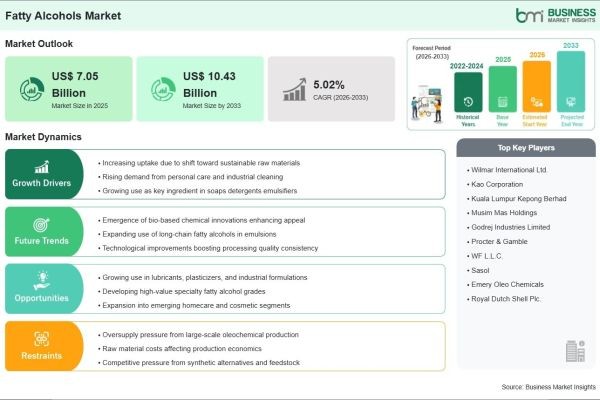
A critical operational and material transition is reshaping chemical production pipelines worldwide, fueled by the commercial necessity to supply sustainable, bio-based fatty alcohols that satisfy escalating ecological regulations and consumer wellness standards.
Based on market intelligence from Business Market Insights, the global Fatty Alcohols Market is anticipated to reach US$ 10.43 Billion by 2033, mounting from its 2025 value of US$ 7.05 Billion at a projected CAGR of 5.02% from 2026 to 2033.
Recent shifts toward eco-conscious consumerism are fundamentally altering market dynamics. Leading chemical manufacturers are heavily investing in sustainable sourcing—primarily relying on renewable feedstocks like palm kernel oil and coconut oil—to produce biodegradable surfactants and emulsifiers that meet strict global mandates for environmental safety and water system protection.
Download Sample Report : https://www.businessmarketinsights.com/sample/BMIPUB00033935
What Are Fatty Alcohols?
Fatty alcohols are high-molecular-weight, long-chain straight alcohols that can be derived from two primary sources: natural fats and oils (oleochemicals) or crude oil (petrochemicals). While they are technically "alcohols," they do not possess the volatile, drying properties of shorter-chain alcohols like ethanol or isopropyl alcohol. Instead, fatty alcohols typically appear as oily liquids or waxy solids that are exceptionally adept at moisturizing and binding water to oil.
Because of their unique amphiphilic molecular structure—meaning they have both water-loving and oil-loving properties—they are widely utilized as emulsifiers, thickeners, emollients, and surfactants. In the personal care industry, they act as the secret ingredient that gives lotions their smooth texture and prevents creams from separating. In industrial applications, they are chemically reacted to create powerful foaming agents and detergents.
Market Drivers
The primary driver accelerating the Fatty Alcohols Market is the booming global demand for personal care and cosmetic products. As disposable incomes rise globally, consumers are spending heavily on premium skincare, haircare, and cosmetic formulations. Because fatty alcohols (such as cetyl and stearyl alcohol) are highly valued for their non-irritating, skin-conditioning properties, they have become non-negotiable raw materials for global cosmetic brands, driving massive, sustained volumetric demand.
Furthermore, the aggressive shift toward bio-based, sustainable chemical manufacturing is acting as a powerful market catalyst. Environmental regulations, such as the EU's stringent REACH guidelines regarding the biodegradability of detergents, are forcing industrial and household cleaner manufacturers to abandon synthetic petrochemical surfactants. Consequently, companies are aggressively transitioning to natural, oleochemical-based fatty alcohols derived from sustainably sourced palm and coconut oils, directly boosting the green chemical sector.
Additionally, the rapid industrialization of emerging economies is propelling the demand for industrial lubricants and plasticizers. Fatty alcohols serve as critical precursors in the synthesis of specialized lubricants used in heavy mechanical equipment and automotive transport. As manufacturing and infrastructure development scale across the Asia-Pacific region, the foundational demand for industrial-grade fatty alcohol derivatives continues to multiply.
Market Segmentation
By Type
- Short Chain
- Pure and Mid Cut
- Long Chain
- Higher Chain
By Application
- Industrial & Domestic Cleaning
- Personal Care & Cosmetics
- Plasticizers
- Lubricants
- Pharmaceutical Formulation
- Food & Nutrition
- Other Applications
By End User
- Building & Infrastructure
- Mechanical Equipment
- Automotive & Other Transport
- Other End Users
The Pure and Mid Cut segment holds the dominant market share by type, primarily because C12-C14 carbon chains are the optimal length for synthesizing Sodium Laureth Sulfate (SLES) and other high-demand surfactants. By application, the Industrial & Domestic Cleaning segment currently generates the absolute majority of revenue, driven by the universal need for laundry detergents, dishwashing liquids, and industrial sanitizers. The Personal Care segment, however, maintains the highest premium pricing structures due to the strict purity requirements of cosmetic formulations.
Regional Insights
- Asia-Pacific completely dominates the global fatty alcohols market, acting as both the largest producer and consumer. This dominance is anchored by Southeast Asia—specifically Indonesia and Malaysia—which controls the global supply of palm oil and palm kernel oil, the primary raw materials for natural fatty alcohols. Coupled with a massive population base driving detergent and cosmetic consumption in China and India, the region dictates global market pricing.
- Europe holds a highly strategic and heavily regulated market position. Driven by intense consumer awareness regarding sustainability and eco-labeling, the European market heavily favors 100% bio-based fatty alcohols. Growth is propelled by rigid environmental mandates forcing chemical companies to achieve zero-carbon and high-biodegradability targets in their cleaning and industrial formulations.
- North America represents a mature but steady market, heavily focused on premium personal care and advanced pharmaceutical formulations. The region is seeing renewed growth driven by consumer pushback against synthetic chemicals in cosmetics (the "clean beauty" movement), which is forcing major US brands to reformulate products using natural fatty alcohols.
- Middle East & Africa and South America are experiencing accelerating growth, primarily fueled by rising urbanization and changing hygiene standards. As domestic cleaning products and basic personal care items become more accessible across these developing regions, the base demand for fatty alcohol-derived surfactants is steadily climbing.
Top Players in the Fatty Alcohols Industry
The competitive landscape is heavily consolidated around massive oleochemical processors and diversified multinational chemical giants. Proximity to raw materials and vertical integration are the absolute keys to profitability in this sector.
- BASF SE
- Wilmar International Ltd
- Kao Corporation
- Procter & Gamble (P&G Chemicals)
- Sasol Limited
- Musim Mas Group
- Emery Oleochemicals
- Godrej Industries Limited
- Royal Dutch Shell plc
- KLK OLEO
To sustain market dominance, these top-tier entities invest heavily in vertically integrated supply chains—often owning the palm plantations, refining facilities, and final chemical synthesis plants. Furthermore, they are aggressively seeking RSPO (Roundtable on Sustainable Palm Oil) certifications to secure premium contracts with eco-conscious Western consumer brands.
Technological Innovations
Technological innovations in Catalytic Hydrogenation are actively revolutionizing the production efficiency of fatty alcohols. The traditional process of converting natural oils into fatty alcohols requires extreme high-pressure hydrogenation, which consumes massive amounts of energy. Recent breakthroughs in engineered nano-catalysts allow this chemical reduction to occur at significantly lower temperatures and pressures. This not only drastically cuts the carbon footprint of the manufacturing process but also increases the overall yield of the highly desired "mid-cut" alcohol chains, maximizing profitability per ton of raw oil.
Furthermore, the industry is seeing cutting-edge advancements in Biotechnological Synthesis via Fermentation. To reduce global reliance on palm oil—which is frequently tied to deforestation concerns—biotech firms are developing genetically modified yeast and bacteria capable of fermenting agricultural waste (like sugarcane bagasse) directly into high-purity fatty alcohols. While still scaling, this precision fermentation process promises a future where fatty alcohols can be produced entirely independent of the volatile agricultural commodity markets.
Future Market Outlook
The long-term trajectory for the Fatty Alcohols Market is inherently tied to the global "green chemistry" revolution. As consumers become hyper-aware of ingredient sourcing, the market will aggressively pivot away from petrochemical-derived synthetic alcohols toward 100% traceable, sustainably sourced oleochemicals.
Moving forward, the industry will see a heightened focus on specialized, high-performance derivatives. Standard surfactants are becoming commoditized; therefore, major players will focus on synthesizing advanced fatty alcohol ethoxylates and specialized emollients that cater specifically to the high-margin dermatological and pharmaceutical delivery sectors. Companies that can guarantee a zero-deforestation, carbon-neutral supply chain will capture the most lucrative contracts in the next decade of chemical manufacturing.
Frequently Asked Questions (FAQs)
Are fatty alcohols bad for your skin like regular alcohol?
No, quite the opposite. While "simple" alcohols like ethanol or rubbing alcohol are volatile and strip moisture from the skin, "fatty" alcohols (like cetyl or stearyl alcohol) are derived from fats and oils. They act as emollients, meaning they trap moisture, soothe the skin, and give lotions a smooth, hydrating texture.
Why are fatty alcohols so important for cleaning products?
Fatty alcohols are the primary raw material used to make surfactants (surface-active agents). Surfactants are the chemical engines in soaps and detergents that allow water to mix with oils and dirt so they can be washed away. Without fatty alcohol derivatives, modern laundry detergents wouldn't foam or clean effectively.
Why is the market moving away from petrochemical sources?
Fatty alcohols can be made from crude oil or natural plant oils. The market is shifting rapidly toward plant oils (like palm or coconut) because consumers and governments are demanding biodegradable, renewable products that do not contribute to long-term environmental toxicity or rely on fossil fuels.
What is a "Mid Cut" fatty alcohol, and why is it the most popular?
Fatty alcohols are categorized by the length of their carbon chains. "Mid Cut" refers to carbon chains that are 12 to 14 atoms long (C12-C14). This specific length is the absolute perfect chemical structure for creating the high-foaming, skin-safe surfactants used in almost all global shampoos, body washes, and dish soaps.
Browse More Reports:
https://www.businessmarketinsights.com/reports/interventional-radiology-market
https://www.businessmarketinsights.com/reports/law-enforcement-and-public-safety-drone-market
https://www.businessmarketinsights.com/reports/liquid-filtration-market
About Us
Business Market Insights is a market research platform that provides a comprehensive subscription service for targeted industry and company intelligence reports. Our research team has extensive professional expertise across dynamic industrial domains such as Electronics & Semiconductor; Aerospace & Defense; Automotive & Transportation; Energy & Power; Healthcare; Manufacturing & Construction; Food & Beverages; Chemicals & Materials; and Technology, Media, & Telecommunications.
Contact Us
If you have any questions about this report or would like further information, please contact us:
Contact person: Ankit Mathur
Email: sales@businessmarketinsights.com
Phone: +16467917070






