
Market Overview and Growth Outlook
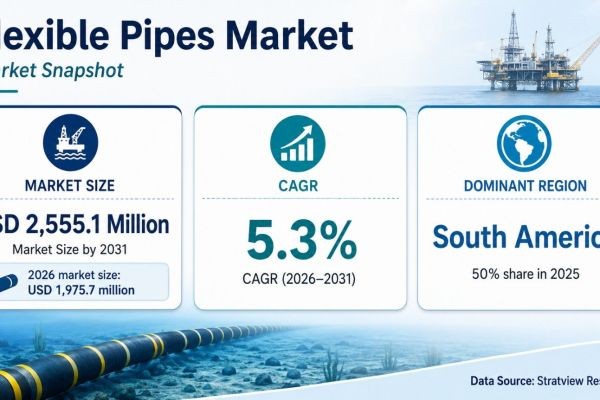
The Flexible Pipes Market is projected to expand from USD 1,837.9 million in 2025 to USD 1,975.7 million in 2026. This represents annual growth of 7.5%. By 2031, market demand is forecast to reach USD 2,555.1 million, highlighting recovering offshore activity and expanding acceptance of flexible piping across applications.
“The Flexible Pipes Market is expected to grow at a CAGR of 5.3% during 2026-2031.” Forecast sales over the period will total approximately USD 13.6 billion. The top ten companies generated more than 95% of the market’s 2025 sales, indicating a concentrated competitive landscape with limited global and regional participants.
Market concentration places product capability, distribution reach, and operating track record at the center of competitive positioning. At the same time, offshore investment expands the addressable opportunity for established suppliers. This interaction between concentrated supply and growing subsea demand defines the evolving Flexible Pipes Market share environment through 2031.
Request a free sample report:
https://www.stratviewresearch.com/Request-Sample/flexible-pipes-market#form
Market Segmentation Analysis
Based on the application type, the flexible pipes market is segmented as flowlines, risers, jumpers and tie-ins, and other applications. Flowlines currently lead and are expected to remain dominant. Wider use across risers and increasing penetration in deep-water, ultra-water, and subsea applications are supporting overall application demand.
Based on the diameter type, the flexible pipes market is segmented as <2.5 inch, 2.5-5 inch, 5-7.5 inch, 7.5-10 inch, and above 10-inch. The 5-7.5 inch segment will remain dominant, while above 10-inch is forecast to grow fastest. The leading size category offers flow capacity, flexibility, and cost efficiency.
Based on the internal pressure sheath material type, the flexible pipes market is segmented as PA, PVDF, PE, and XLPE/ITPE. PA currently dominates, while PVDF is expected to lead during the next five years. Higher temperatures, sour-service operating conditions, and chemical-resistance requirements are accelerating the use of advanced materials.
Based on the use type, the flexible pipes market is segmented as oil production, multi-phase production, oil export/dead crude, gas, water, and others. Gas is expected to remain the dominant use. Growth is supported by offshore gas developments, subsea tiebacks, and requirements for flexible systems in high-pressure gas transportation.
Based on the design application type, the flexible pipes market is segmented as sour and sweet. Sour is expected to remain the dominant design application through 2031. The increasing development of high-CO₂ and hydrogen sulfide-rich reservoirs strengthens requirements for corrosion-resistant materials and advanced pipe designs.
Based on the bore type, the flexible pipes market is segmented as rough bore and smooth bore. Rough bore currently dominates and is expected to maintain its leadership. Deepwater developments, multiphase-flow requirements, and higher-pressure conditions support demand for robust and turbulence-tolerant rough-bore configurations.
Regional Market Insights
South America held a 50% market share in 2025, generating the largest demand across regions. It is expected to remain the leading market through 2031. Offshore exploration recovery, horizontal and pad-drilling advancements, and shale oil and gas resources are identified as the factors supporting regional leadership.
Africa is the second-largest regional market and is projected to register the highest growth rate during the forecast period. Offshore activity in Nigeria and other countries supports its regional outlook. Recovering oil and gas operations remain the primary stated factor increasing flexible pipe demand across Africa.
Emerging Trends Shaping the Flexible Pipes Market
Competitive positioning will increasingly reflect capabilities in high-temperature and high-pressure flexible systems. This stated industry shift raises the relevance of materials and designs capable of serving sour reservoirs and demanding deepwater conditions. It also reinforces the value of established portfolios, manufacturing experience, distribution capabilities, and long operating track records.
The expansion of long-distance subsea tiebacks is creating further demand for flexible pipe technologies. Tieback systems connect subsea developments with production infrastructure, increasing requirements for reliable flowlines and related components. This trend aligns with growing FPSO deployments, offshore investment, project sanctions, and requirements for integrity monitoring over the asset lifecycle.
Key Growth Drivers of the Market
- Recovering regional activity: Improving oil and gas exploration expands the number of projects requiring flexible production and transportation systems.
- Deepwater project growth: Flexible pipes’ ability to withstand vessel motion, dynamic loading, and pressure strengthens adoption in complex developments.
- FPSO deployment: Increasing installations directly raise demand for the flexible risers and flowlines used in offshore production.
- Capital spending and sanctions: Higher offshore expenditure and additional Final Investment Decisions enlarge the addressable project pipeline.
- Cost and performance benefits: Advantages over steel pipes support greater acceptance across applications and expand the broader market ecosystem.
Competitive Landscape
Top Companies in the Market
TechnipFMC
Baker Hughes
National Oilwell Varco (NOV)
Prymsian Group
Conclusion and Strategic Outlook
The Flexible Pipes Market will reach an estimated USD 2,555.1 million in 2031, expanding at a CAGR of 5.3% during 2026-2031. Recovery in offshore activity, deepwater developments, FPSO installations, project sanctions, and wider flexible-pipe acceptance will sustain demand across the industry value chain.
The competitive landscape will remain concentrated, with established market positions supported by broad portfolios, distribution networks, and industry track records. Future strategic demand will center on flowlines, gas applications, rough bore systems, sour designs, PVDF materials, South American projects, and faster-growing African offshore activity.
FAQs – Flexible Pipes Market
1. What is the projected Flexible Pipes Market value?
The Flexible Pipes Market is projected to reach USD 1,975.7 million in 2026 and USD 2,555.1 million by 2031. Forecast cumulative sales during 2026-2031 total USD 13.6 billion.
2. What CAGR is forecast for the market?
The Flexible Pipes Market is expected to grow at a CAGR of 5.3% during 2026-2031. Its projected 2031 demand is approximately 1.3 times its expected 2026 value.
3. What drives the industry’s growth trends?
Deepwater projects, FPSO installations, increasing offshore investment, project sanctions, and recovering oil and gas activity drive demand. Flexible pipes also offer cost and performance benefits compared with steel pipes.
4. How is regional demand distributed?
South America generated 50% of demand in 2025 and is forecast to remain the largest market. Africa is the second-largest market and is expected to register the fastest growth through 2031.
5. What should investors consider before entering the market?
The market is highly concentrated, with the top ten companies accounting for more than 95% of 2025 sales. Investors must also assess manufacturing costs, raw-material volatility, integrity management, maintenance requirements, and regulatory compliance.






