
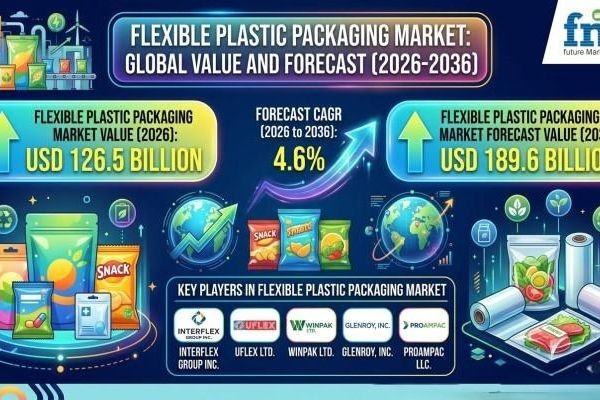
The global flexible plastic packaging market is experiencing consistent growth as food manufacturers, pharmaceutical companies, and personal care brands increasingly adopt lightweight, high-barrier, and recyclable packaging formats. The shift toward efficient packaging solutions that enhance product protection, reduce material consumption, and support sustainability goals is positioning flexible plastic packaging as a critical component of modern packaging ecosystems.
The Flexible Plastic Packaging Market was valued at USD 120.9 billion in 2025 and is projected to reach USD 126.5 billion in 2026. By 2036, the market is expected to attain a value of USD 189.6 billion, expanding at a CAGR of 4.6% during the forecast period. Growing emphasis on shelf-life extension, transportation efficiency, and circular packaging strategies continues to drive investment across the industry.
Get detailed market forecasts, competitive benchmarking, and pricing trends:
https://www.futuremarketinsights.com/reports/sample/rep-gb-4174
Quick Market Highlights
- Market Value (2025): USD 120.9 Billion
- Market Value (2026): USD 126.5 Billion
- Forecast Value (2036): USD 189.6 Billion
- CAGR (2026–2036): 4.6%
- Fastest-Growing Markets: India (7.0%), China (6.5%), Brazil (5.5%)
- Leading Product Segment: Films & Wraps (36.8% market share in 2026)
- Leading Material Segment: Oil-Based Polymers (58.0% market share in 2026)
Rising Demand for Lightweight and High-Performance Packaging
Demand for flexible plastic packaging is increasing as brand owners seek packaging solutions that deliver superior barrier properties while minimizing weight and logistics costs. The market is benefiting from:
- Growing adoption of barrier films for meat, dairy, and ready-to-eat food packaging
- Expansion of refill-pack formats across personal care and household product categories
- Increasing pharmaceutical requirements for sterile pouches, sachets, and medical packaging
- Rising emphasis on moisture resistance and shelf-life preservation
Flexible packaging enables manufacturers to optimize transportation efficiency, lower storage requirements, and improve production-line performance.
Sustainability Initiatives Reshape Packaging Design
Evolving environmental regulations are prompting packaging manufacturers to redesign film structures with sustainability and recyclability in mind. Industry participants are focusing on:
- Enhanced recycling compatibility
- Improved oxygen and moisture barrier performance
- Material reduction through downgauging
- Strong sealing integrity and production efficiency
Mono-material polyethylene (PE) and polypropylene (PP) solutions are gaining traction as converters transition away from complex multilayer laminates to meet future recycling objectives.
At the same time, modified atmosphere packaging (MAP) and advanced high-barrier films continue to support food preservation and pharmaceutical product protection.
Product and Material Segment Insights
Films and wraps remain the dominant product category due to their versatility across multiple applications, including:
- Retail food packaging
- Industrial wrapping solutions
- Shrink and stretch packaging
- Pallet and logistics protection
Oil-based polymers such as polyethylene and polypropylene continue to lead the material segment owing to:
- Reliable sealing performance
- High-speed processing capabilities
- Broad raw material availability
- Cost-effective manufacturing characteristics
Demand for premium high-barrier films is also growing rapidly as food and pharmaceutical companies prioritize oxygen and moisture control to maintain product quality and extend shelf life.
Regional Packaging Industry Developments
Market growth patterns vary across regions based on industrial activity and packaging consumption trends:
- India continues to benefit from expanding consumer goods production and plastics exports.
- China remains a major hub for film conversion and packaged food manufacturing.
- Brazil is witnessing increasing demand for pouches and laminated food packaging formats.
- The United States is experiencing strong adoption of lightweight healthcare and food packaging solutions.
- Germany is advancing recyclable packaging technologies and compliance-focused film innovations.
Packaging converters worldwide are investing in recycle-ready materials, downgauging technologies, and expanded pouch-conversion capabilities to strengthen market competitiveness.
Evolving Procurement and Buyer Expectations
Packaging procurement strategies are increasingly centered around sustainability, performance, and operational efficiency. Buyers are prioritizing:
- Recyclable and mono-material packaging formats
- Reduced total lifecycle packaging costs
- Verified barrier protection performance
- Consistent sealing quality
- Seamless integration with high-speed filling lines
Food, healthcare, and consumer goods manufacturers are evaluating suppliers based on their ability to deliver both environmental benefits and operational reliability.
Focus on Operational Efficiency and Technical Support
Long-term packaging performance has become a major purchasing consideration. Key customer priorities include:
- Pre-commercial technical validation
- Faster packaging-line implementation
- Reduced material waste generation
- Stable and reliable resin sourcing
- Lower transportation and warehousing expenses
Suppliers offering comprehensive technical assistance and sustainability-focused packaging solutions are increasingly strengthening customer relationships and retention rates.
Regulatory Compliance Drives Innovation
Governments and regulatory authorities across the globe are introducing stricter packaging requirements focused on:
- Recyclability and circular economy targets
- Plastic waste reduction initiatives
- Material transparency and traceability
- Environmental compliance standards
- Extended Producer Responsibility (EPR) programs
In particular, European sustainability regulations are accelerating investments in mono-material film and pouch technologies designed to improve recyclability without compromising performance.
Competitive Landscape
Leading market participants including Amcor plc, Mondi Group, Constantia Flexibles Group GmbH, Huhtamäki Oyj, Sealed Air Corporation, ProAmpac LLC, and UFlex Ltd. are competing through:
- Development of advanced barrier film technologies
- Expansion of recycle-ready pouch portfolios
- Growth in healthcare packaging solutions
- Enhanced compatibility with high-speed packaging lines
- Global manufacturing and supply-chain expansion
The market is also witnessing strategic acquisitions and partnerships as companies strengthen their capabilities in film science, sustainable materials, and flexible packaging innovation.
About Future Market Insights (FMI)
Future Market Insights, Inc. (FMI) is an ESOMAR-certified, ISO 9001:2015 market research and consulting organization, trusted by Fortune 500 clients and global enterprises. With operations in the U.S., UK, India, and Dubai, FMI provides data-backed insights and strategic intelligence across 30+ industries and 1200 markets worldwide.






