
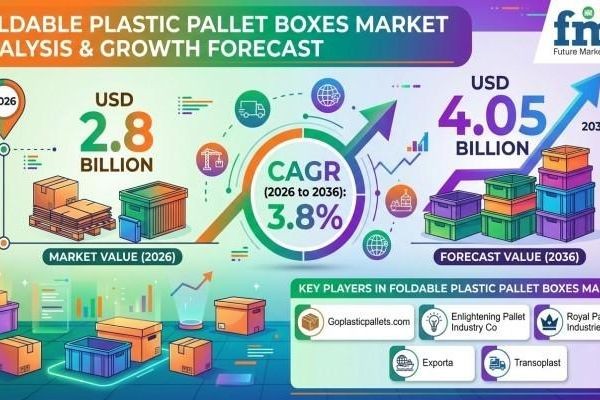
The global foldable plastic pallet boxes market is transitioning from a conventional logistics utility into a strategic supply chain optimization solution. Valued at USD 2.80 billion in 2026, the market is projected to reach USD 4.05 billion by 2036, expanding at a CAGR of 3.8% during the forecast period.
The market’s evolution reflects a structural transformation across warehousing, transportation, and industrial logistics operations, where businesses are increasingly replacing single-use wooden pallets with reusable, collapsible, and traceable transport packaging systems designed to improve operational efficiency, reduce supply chain costs, and support long-term sustainability objectives.
Quick Stats at a Glance
- Market Size (2026): USD 2.80 billion
- Forecast Value (2036): USD 4.05 billion
- CAGR (2026–2036): 3.8%
- Incremental Opportunity: USD 1.25 billion
- Leading Material Type: HDPE (37.0% market share)
- Leading End Use: Logistics and Shipping (21.0% market share)
Get detailed market forecasts, competitive benchmarking, and pricing analysis:
https://www.futuremarketinsights.com/reports/sample/rep-gb-13481
Market Size and Structural Shift
The foldable plastic pallet boxes market is entering a sustained growth cycle as industries modernize logistics infrastructure and prioritize reusable packaging systems over disposable transport solutions.
Traditional wooden pallets have historically dominated industrial logistics due to lower upfront costs. However, recurring replacement expenses, higher product damage rates, sanitation limitations, and inefficient reverse logistics are driving companies toward foldable plastic pallet box systems that offer long operational lifespans, multi-trip durability, and collapsible return efficiency.
These solutions are becoming increasingly important in closed-loop supply chains, where repeated shipment cycles significantly improve cost-per-trip economics and optimize asset utilization.
As businesses focus on reducing empty return transportation costs and warehouse space consumption, foldable plastic pallet boxes are evolving from basic storage products into integrated logistics assets capable of supporting automated handling systems, inventory visibility, and digital tracking operations.
Key Growth Drivers Accelerating Market Expansion
Supply Chain Cost Optimization
Organizations are increasingly adopting foldable pallet systems to reduce transportation losses associated with damaged goods, inefficient stacking, and underutilized return freight capacity.
Collapsible pallet box designs substantially reduce reverse logistics volume, improving truck utilization rates and lowering transportation costs across recurring shipment networks.
Sustainability Regulations and Circular Packaging Initiatives
Governments and regulatory authorities across Europe and Asia are tightening packaging waste regulations and encouraging circular economy practices.
Reusable plastic pallet systems align closely with sustainability mandates by reducing dependence on disposable wooden pallets and minimizing packaging waste throughout extended lifecycle operations.
Organized Retail and E-Commerce Fulfillment Growth
The rapid expansion of e-commerce fulfillment centers and organized retail distribution networks is increasing demand for standardized, stackable, and RFID-compatible logistics containers.
Large-scale warehouse operators increasingly require transport packaging solutions that support automation, high-volume inventory movement, and real-time supply chain visibility.
Market Constraints Remain a Key Consideration
Despite accelerating adoption, several operational and economic challenges continue to influence market penetration.
Higher initial acquisition costs compared to traditional wooden pallets remain a barrier for one-way shipping operations and cost-sensitive export logistics environments.
The economic benefits of foldable plastic pallet boxes are highly dependent on return frequency and closed-loop transport efficiency. In fragmented logistics ecosystems where asset recovery remains inconsistent, adoption rates continue to develop more gradually.
In addition, varying requirements for pallet dimensions, material specifications, and load-bearing performance across industries create procurement complexity for multinational supply chain operators.
To address these challenges, pallet pooling and rental models are emerging as scalable solutions that reduce capital expenditure requirements while improving packaging asset utilization.
Emerging Opportunities Reshaping the Industry
Several high-value opportunities are expected to define the next phase of market growth:
- RFID-enabled tracking and traceability systems integrated into pallet containers
- Automotive parts logistics requiring durable returnable transport packaging
- E-commerce warehousing operations adopting collapsible logistics containers
- Sustainable export packaging replacing disposable wood-based systems
- Robotics-compatible pallet systems designed for automated warehouses
Manufacturers capable of combining durability, operational efficiency, and digital traceability are expected to secure long-term contracts with global logistics providers and industrial supply chain operators.
Competitive Landscape
Competition within the foldable plastic pallet boxes market is evolving beyond product manufacturing toward integrated logistics performance and lifecycle value optimization.
Leading companies including CABKA Group, Schoeller Allibert, SSI SCHAEFER, Nefab Group, and Goplasticpallets.com are increasingly differentiating through:
- RFID and smart tracking integration
- Product durability and lifecycle optimization
- Regional distribution and service capabilities
- Automation-compatible pallet designs
- Sustainable material innovation initiatives
Procurement priorities are increasingly shifting away from upfront purchase costs toward long-term operational efficiency, traceability, and total lifecycle value.
Future Outlook: From Packaging Product to Smart Logistics Asset
Over the next decade, foldable plastic pallet boxes are expected to evolve into digitally connected logistics infrastructure components rather than standalone transport products.
Key trends expected to shape future market expansion include:
- Wider deployment of RFID-enabled returnable packaging systems
- Growth of pallet pooling and rental business models
- Integration with warehouse automation and robotics platforms
- Development of lightweight, high-strength recyclable materials
- Adoption of circular economy logistics frameworks across industrial sectors
As supply chains become increasingly data-driven and sustainability-focused, reusable foldable pallet systems are expected to become standard infrastructure across global industrial logistics networks.
Executive Takeaways
- Foldable plastic pallet boxes are evolving into strategic supply chain optimization tools.
- Cost-per-trip advantages are accelerating adoption across closed-loop logistics systems.
- Sustainability regulations are driving demand for reusable transport packaging worldwide.
- Automotive, food, retail, and e-commerce sectors remain primary growth engines.
- RFID integration and automation compatibility are emerging as major competitive differentiators.
- Future market growth will increasingly focus on traceability, logistics integration, and lifecycle efficiency rather than simple packaging replacement.
About Future Market Insights (FMI)
Future Market Insights, Inc. (FMI) is an ESOMAR-certified, ISO 9001:2015 market research and consulting organization, trusted by Fortune 500 clients and global enterprises. With operations in the U.S., UK, India, and Dubai, FMI provides data-backed insights and strategic intelligence across 30+ industries and 1200 markets worldwide.






