
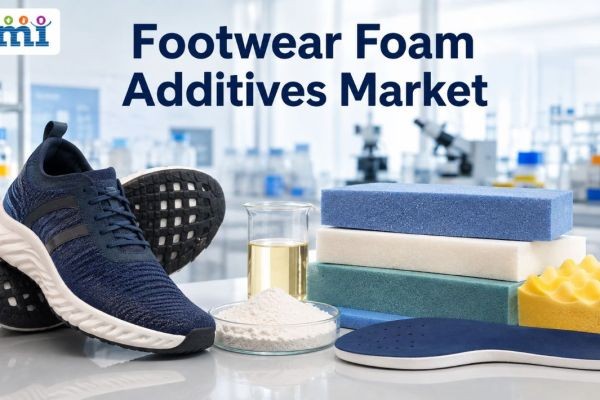
According to Future Market Insights (FMI), the Footwear Foam Additives Market [https://www.futuremarketinsights.com/reports/footwear-foam-additives-market] was valued at USD 1,381.25 million in 2025 and is estimated at USD 1,480.7 million in 2026, reaching USD 2,967.7 million by 2036 at a 7.2% CAGR from 2026 to 2036. Growth is expected to be supported by demand for molded midsoles and odor-control insoles. Blowing agents are projected to account for a 42.0% share in 2026, driven by their role in controlled expansion for molded components.
The market is increasingly influenced by comfort-focused footwear production, where midsoles and insoles must balance cushioning, lightweight construction, rebound, and durability. Manufacturers are also focusing on additive systems that support density control, foam consistency, odor management, and production efficiency.
Get Detailed Market Forecasts, Competitive Benchmarking, and Pricing Trends: https://www.futuremarketinsights.com/reports/footwear-foam-additives-market
Quick Stats for Footwear Foam Additives Market
- Footwear Foam Additives Market Value (2025): USD 1,381.25 million
- Market Value (2026): USD 1,480.7 million
- Market Forecast Value (2036): USD 2,967.7 million
- Market Forecast CAGR: 7.2%
- Leading Additive Type: Blowing Agents (42.0%)
- Leading Foam Type: EVA Foam (52.5%)
- Fastest-growing Country: China (8.4% CAGR)
Why is the Footwear Foam Additives Market Growing?
Demand for footwear foam additives is increasing as manufacturers focus on lightweight footwear, density control, and improved rebound performance. The widespread use of EVA foam in existing molding equipment supports easier integration of additive technologies. Sports footwear production is also driving demand through requirements for enhanced rebound, cushioning, and long-term fatigue resistance.
Opportunity Pathways -- Footwear Foam Additives Market
The market presents several opportunities as manufacturers expand sports, casual, and comfort-focused footwear programs.
- Pathway A -- Lightweight Footwear: Demand for lightweight construction is increasing the need for controlled foam expansion and density reduction.
- Pathway B -- Sports Footwear Performance: Sports footwear production is creating demand for enhanced rebound, cushioning, and fatigue resistance.
- Pathway C -- Odor Control: Growing demand for durable daily-wear footwear is expanding opportunities for odor-control additives.
- Pathway D -- Manufacturing Efficiency: Additive packages that reduce rejects and improve process consistency can deliver greater commercial value.
- Pathway E -- Asia Manufacturing Expansion: China and India are expanding footwear production capacity, supporting demand for advanced foam additive technologies.
- Pathway F -- Technical Support: Suppliers offering formulation expertise and plant-trial assistance can strengthen long-term customer relationships.
Segmental Analysis
Demand is segmented by additive type, foam type, application, end use, and sales channel. Additive types include blowing agents, crosslinking agents, stabilizers, and antimicrobial or odor-control additives.
By Additive Type, Blowing Agents Account for 42.0% Share
The blowing agents segment is projected to account for 42.0% share in 2026, supported by demand for controlled foam expansion and low-density footwear components.
- Processor trials compare cell size and scorch control before price.
- Controlled expansion supports lightweight midsole production.
By Foam Type, EVA Foam Accounts for 52.5% Share
EVA foam is estimated to represent 52.5% share in 2026 due to its processing familiarity and broad use in molded footwear production.
- EVA compounders prefer additive systems that work in existing molding equipment.
- PU and TPU foam systems gain use when rebound targets justify higher material cost.
By Application, Midsoles Account for 46.0% Share
Midsoles are anticipated to account for 46.0% share in 2026 due to cushioning and energy-return requirements.
- Midsole formulations face stricter fatigue checks than upper padding.
- Lightweighting is increasing demand for optimized foam density.
- Insoles create additional demand for odor-control additives in daily-wear shoes.
By End Use, Sports Footwear Accounts for 38.5% Share
Sports footwear is expected to hold 38.5% share in 2026 due to lighter foam and repeatable energy-return requirements.
- Sports footwear buyers compare rebound after repeated loading.
- Lightweight foam supports performance and comfort positioning.
By Sales Channel, Direct to Compounders Accounts for 61.0% Share
Direct to compounders is projected to represent 61.0% share in 2026 due to recipe support needs.
- Distributors serve smaller converters that use standard additive systems.
- Direct supply wins larger accounts that need plant-level tuning.
- Technical assistance can reduce formulation risks during production trials.
What are the Drivers, Restraints, and Key Trends?
Drivers: Midsole lightweighting, rebound durability, sports footwear production, EVA foam adoption, odor-control requirements, and demand for improved manufacturing consistency are supporting market expansion.
Restraints: Compliance pressure, chemical disclosure requirements, formulation complexity, and cost considerations can restrict low-value additive substitutions.
Key Trends: The market is moving toward additive systems that provide foam cell control, lightweighting, rebound retention, odor management, stable cushioning, and improved production efficiency.
What is the Demand for Footwear Foam Additives in Different Countries?
- China: 8.4% CAGR
- India: 8.1% CAGR
- South Korea: 7.5% CAGR
- United States: 6.9% CAGR
- Germany: 6.8% CAGR
- Japan: 6.6% CAGR
- France: 6.5% CAGR
- United Kingdom: 6.2% CAGR
China leads country growth with an 8.4% CAGR by 2036, supported by large footwear output and high-volume foam conversion. India follows with an 8.1% CAGR, driven by increasing non-leather footwear production capacity.
South Korea is projected to grow at 7.5% CAGR, while the United States is expected to expand at 6.9% CAGR. Germany, Japan, France, and the United Kingdom are projected to record CAGRs of 6.8%, 6.6%, 6.5%, and 6.2%, respectively.
How do Country-Level CAGRs Compare in the Footwear Foam Additives Market?
China leads country growth. The United Kingdom records the most cautious expansion outlook among profiled markets.
- China is forecast to record 8.4% CAGR by 2036 due to large footwear output.
- India is expected to expand at 8.1% CAGR by 2036 due to non-leather footwear capacity growth.
- South Korea is projected to grow at 7.5% CAGR by 2036 with sports-fashion demand supporting comfort foam.
- The United States is estimated to rise at 6.9% CAGR by 2036 due to brand specifications.
- Germany is forecast to grow at 6.8% CAGR by 2036 due to safety-footwear demand.
- Japan is expected to advance at 6.6% CAGR by 2036 with quality-focused buyers using stable foam parts.
- France is projected to post 6.5% CAGR by 2036 due to stronger durability expectations.
- The United Kingdom is forecast to grow at 6.2% CAGR by 2036 with retail demand guiding specification.
Why Does China Lead Country Growth in the Footwear Foam Additives Market?
An 8.4% CAGR by 2036 reflects large footwear output and high-volume foam conversion.
China Footwear Foam Additives Market Snapshot
- Market Size in 2025: USD 317.7 million
- Market Size in 2026: USD 344.4 million
- Market Forecast in 2036: USD 771.6 million
- CAGR (2026 to 2036): 8.4%
- Leading Sub-Region: Guangdong, Fujian, Zhejiang, Jiangsu
China Footwear Foam Additives Market Outlook
China is the scale test for footwear foam additive suppliers. EVA and TPU molders need additives that hold cell shape across many factories.
Key Growth Drivers
- World Footwear reported Chinese production at about 13 billion pairs in 2024. That scale supports strong need for stable foam additives.
- NBS reported industrial value added rose 5.8% in 2024. This wider factory base helps additive suppliers serve footwear clusters.
Key Restraints
- APICCAPS reported Chinese footwear export value fell 8.8% from January to August 2025. This price pressure can slow premium additive trials.
- Export buyers can delay additive changes when seasonal orders become uncertain.
What Makes China Unique
China is unique for very large molding networks that test recipe consistency.
Key Companies
- ANTA Sports
- Li-Ning
- Xtep International
- 361 Degrees
- Belle International
- Yue Yuen Industrial
Future Outlook
The Footwear Foam Additives Market is projected to reach USD 2,967.7 million by 2036, expanding at a 7.2% CAGR from 2026 to 2036. Growth will continue to be supported by demand for lightweight footwear, molded midsoles, sports footwear, improved rebound performance, odor control, and manufacturing efficiency.
As footwear manufacturers prioritize lightweight construction, consistent rebound, cushioning, durability, and production efficiency, additive suppliers will increasingly compete on formulation expertise, technical support, material performance, and the ability to reduce manufacturing scrap.
Explore More Related Studies Published by FMI Research
https://www.openpr.com/news/4579745/cosmetic-film-formers-market-to-reach-usd-5-5-billion-as
https://www.openpr.com/news/4581234/carbon-neutral-fiber-yarns-market-reaches-usd-3-2-billion-driven
https://www.openpr.com/news/4581257/united-kingdom-welding-consumables-market-reaches-usd-3-4
FMI Custom Research: Strategic Intelligence for Confident Decision-Making
In today's rapidly evolving healthcare environment, leadership teams need more than market data—they need actionable intelligence tailored to their strategic priorities. FMI's Custom Research solutions help organizations evaluate growth opportunities, validate investments, assess competitive dynamics, understand technology adoption, and reduce uncertainty before making critical business decisions.
Key Executive Benefits
- Decision-Ready Insights: Research tailored to specific business challenges, expansion plans, technology priorities, and investment requirements.
- Reduced Strategic Risk: Validate market opportunities, customer demand, competitive positioning, and technology adoption before committing resources.
- Market Entry Confidence: Assess opportunity size, regulatory barriers, distribution dynamics, healthcare infrastructure, and competitive landscapes.
- Competitive Advantage: Gain proprietary intelligence unavailable through syndicated reports or internal datasets.
- Faster Growth Decisions: Accelerate market expansion, product development, portfolio optimization, partnerships, and investment planning.
Business Impact
FMI helps organizations transform market complexity into strategic clarity, enabling leadership teams to identify growth opportunities faster, optimize resource allocation, strengthen competitive positioning, and make high-stakes business decisions with confidence.
To explore how FMI Custom Research can support your strategic priorities, connect with the team at sales@futuremarketinsights.com.






