
Market Overview and Growth Outlook
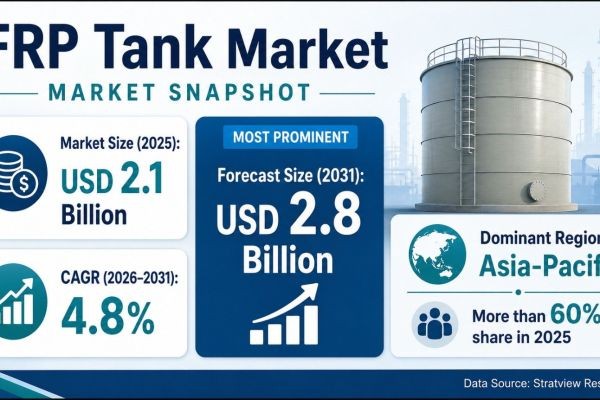
The FRP Tank Market is forecast to reach USD 2.8 billion by 2031, rising from USD 2.2 billion in 2026. Annual demand stood at USD 2.1 billion in 2025. Market-share patterns reflect strong concentration by region, country, and company, alongside differing competitive structures across Asia-Pacific and North America.
The FRP Tank Market is expected to grow at a CAGR of 4.8% during 2026–2031. The forecast period represents a cumulative sales opportunity exceeding USD 15.3 billion. The top ten countries generated more than 80% of annual market sales in 2025, illustrating the importance of demand concentration within global market strategy.
Competitive concentration is also significant. The top ten companies represented approximately 50%–70% of the market in 2025, equivalent to USD 1.0 billion to USD 1.5 billion. Nevertheless, market structure differs by region: North America is highly consolidated, while Asia-Pacific remains comparatively fragmented because of its large population of midsized and small manufacturers.
Regional concentration is central to FRP Tank Market share analysis. Asia-Pacific accounted for more than 60% of global demand in 2025. Its manufacturing base, industrial activities, water infrastructure investment, urban development, and environmental-management programs support both its present leadership and its faster expected growth.
Request a free sample report:
https://www.stratviewresearch.com/Request-Sample/frp-tank-market#form
Market Segmentation Analysis
By Application Type, the market includes Fuel/Petroleum, Water/Wastewater, Rainwater and Stormwater Collection, Plumbing Engineered Solutions, Wastewater, Others, Chemical/Industrial, Chemical Storage, Chemical Processing, Others (Pulp & Paper etc.), and Oil & Gas. Water/Wastewater is expected to remain dominant, while Chemical/Industrial is projected to be the fastest-growing application.
The dominant Water/Wastewater segment covers septic systems, municipal wastewater storage, stormwater management, oil-water separators, potable water storage, fire protection systems, and industrial wastewater facilities. Its scale reflects the broad requirement for corrosion-resistant, durable, and low-maintenance tanks throughout public and industrial water-management infrastructure.
Chemical/Industrial is projected to gain momentum through expanding petrochemical capacity and investment in chemical-processing facilities. Storage requirements for acids, caustics, solvents, process chemicals, and industrial liquids favor materials that can maintain structural integrity under corrosive exposure. This demand profile supports the segment’s faster forecast growth.
By Resin Type, the market is segmented into Polyester, Vinyl Ester, and Others. Polyester is expected to retain the largest position because it combines corrosion resistance and mechanical performance with cost-effectiveness. Its established application base includes water/wastewater systems, underground petroleum storage, and light chemical containment.
Vinyl Ester will be the fastest-growing resin segment. Its chemical-resistance profile supports containment of strong acids, bases, solvents, and bleaching agents. Chemical-processing, offshore, marine, and industrial storage applications use Vinyl Ester where operating conditions require higher resistance than conventional resin systems may provide.
By Manufacturing Process Type, the market is classified into Filament Winding, Hand Lay-up, Spray Lay-up, and Others. Spray Lay-up will remain dominant because of high production efficiency and compatibility with large or irregularly shaped tank geometries. Faster processing and cost-effective fabrication support its continued demand share.
Filament Winding is expected to record the fastest process growth. Precise placement of continuous glass reinforcement produces strong and durable tanks capable of operating under harsh chemical and environmental conditions. Its performance and cost position support wider adoption across infrastructure, industrial, chemical, and high-demand storage applications.
By Installation Type, the market comprises Underground Tanks and Aboveground Tanks. Underground Tanks will maintain the largest share, supported by petroleum, fuel, water, and septic applications. Aboveground Tanks are expected to grow faster because of increasing chemical, petroleum, municipal water, and industrial process-storage requirements.
Regional Market Insights
Asia-Pacific is both the dominant and fastest-growing region. It held more than 60% of the FRP Tank Market in 2025. The region benefits from a large industrial and manufacturing base, water and wastewater investment, infrastructure modernization, and environmental-management initiatives. China remains the principal demand center.
India is expected to be an important regional growth engine. Malaysia and other Southeast Asian markets also offer opportunities connected to municipal water, environmental infrastructure, and industrial-facility investment. Urbanization and smart-city water projects provide additional support for Asia-Pacific’s regional outlook through 2031.
Emerging Trends Shaping the FRP Tank Market
Consolidation is changing company-level market positioning. Acquisitions involving fiberglass tank manufacturers have expanded portfolios, manufacturing footprints, tank-transportation capabilities, and regional reach. Manufacturers are integrating operations to strengthen their presence across chemical, infrastructure, energy, agricultural, petroleum, and convenience-store applications.
Advanced FRP storage solutions are increasingly designed for longer service life and reduced maintenance. Recent portfolio development has focused on water, wastewater, and chemical-treatment applications requiring chemical compatibility and structural integrity. This direction strengthens competition around product performance rather than relying only on initial tank pricing.
Double-wall systems with leak monitoring are advancing underground storage technology. Secondary containment and hydrostatic monitoring improve environmental protection and regulatory alignment. These features are particularly important in petroleum-storage applications, where leaks can create compliance exposure and increase the operational consequences of containment failure.
Key Growth Drivers of the Market
- Water-supply and wastewater-treatment investment expands demand for tanks used in municipal, septic, stormwater, potable-water, fire-protection, separation, and industrial-treatment systems.
- Regulatory requirements for corrosion-resistant underground petroleum tanks increase FRP adoption and create replacement demand for aging steel and concrete storage infrastructure.
- Industrial and chemical-capacity expansion generates demand for tanks capable of storing acids, caustics, solvents, process chemicals, and other corrosive liquids with low maintenance requirements.
- FRP’s combination of lower weight and high structural strength improves transportation and installation, supporting use where conventional steel tanks create handling or structural-load challenges.
- Corrosion resistance and long service life create lifecycle advantages, encouraging end-users to replace conventional storage materials and strengthening demand throughout manufacturing, distribution, and installation ecosystems.
Competitive Landscape
Top Companies in the Market
Mattr (ZCL Composites Inc.)
Lianyungang Zhongfu Lianzhong Composites Group Co., Ltd.
National Oilwell Varco
Future Pipe Industries
Amiantit Fiberglass Industries Limited
Balmoral Tanks
LF Manufacturing
Hengrun Group Co. Ltd.
Hebei Chengda FRP Co., Ltd.
Companies compete on product quality, manufacturing capabilities, geographic reach, regulatory compliance, and pricing. Quality consistency can be particularly important in fragmented markets. The ability to demonstrate dependable long-term performance can differentiate established suppliers from smaller manufacturers operating in highly price-competitive environments.
Conclusion and Strategic Outlook
The FRP Tank Market is expected to maintain a stable growth trajectory through 2031. A CAGR of 4.8% will take annual demand from USD 2.2 billion in 2026 to USD 2.8 billion. Infrastructure investment, storage regulation, industrial expansion, and material replacement support this forecast.
Market-share strategies should account for concentration across Asia-Pacific, leading countries, and major suppliers. At the same time, growth opportunities exist in Chemical/Industrial, Vinyl Ester, Filament Winding, and Aboveground Tanks. Competitive success will depend on balancing quality, compliance, manufacturing efficiency, regional presence, and price within a market serving demanding containment applications.
FAQs – FRP Tank Market
1. What are the current and forecast values of the FRP Tank Market?
The FRP Tank Market was valued at USD 2.1 billion in 2025 and is expected to reach USD 2.2 billion in 2026. It is forecast to generate USD 2.8 billion in annual demand by 2031.
2. What is the expected CAGR through 2031?
The FRP Tank Market is expected to expand at a CAGR of 4.8% during 2026–2031. Cumulative sales during the period are projected at more than USD 15.3 billion.
3. What is driving shifts in market share?
Water infrastructure investment, chemical expansion, petroleum-storage regulations, and replacement of conventional tanks influence demand distribution. Product quality, manufacturing capabilities, compliance, geographic reach, and pricing influence supplier-level competition.
4. Which region holds the largest FRP Tank Market share?
Asia-Pacific held more than 60% of global demand in 2025. It is expected to remain the largest and fastest-growing regional market during the forecast period.
5. What competitive risks should market participants monitor?
Alternative materials can constrain adoption in price-sensitive or less-corrosive applications. Participants should also monitor supplier fragmentation, quality consistency, regulatory compliance, entrenched specifications, and competition from established steel, concrete, and thermoplastic supply chains.






