
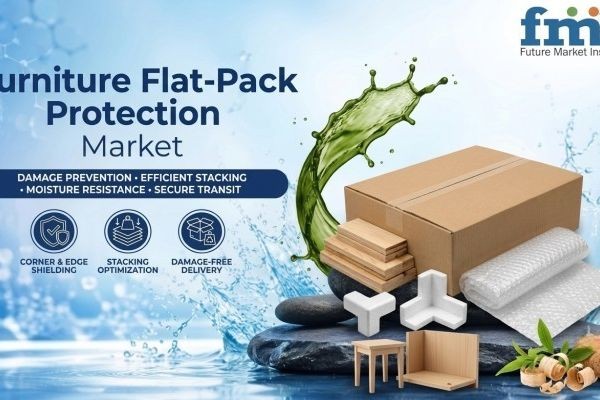
The global Furniture Flat-Pack Protection Market is projected to grow from USD 313.0 million in 2026 to USD 509.8 million by 2036, registering a 5.0% CAGR during the forecast period, according to Future Market Insights (FMI).
The market is being shaped by a practical packaging problem: furniture kits and other flat-pack products can pass through several conveyors, manual transfers, parcel networks, and LTL handling points before reaching the customer. Protection therefore has to control surface, edge, cushioning, and compression risks without adding unnecessary material or slowing packing operations.
Recent fulfillment developments reinforce this requirement. Sealed Air launched its AUTOBAG 850HB hybrid system in September 2025 for paper and poly mailers, connecting protective packaging material selection with pack-line execution. The development is relevant to furniture programs where packaging performance increasingly depends on both the protective structure and how efficiently it is applied at the packing station.
E-commerce keeps protection tied to shipment exposure
Individual consumer shipments create more handling events than controlled pallet movement. A visible damaged corner can result in a return even when the furniture itself remains usable.
The U.S. Census Bureau reported in August 2026 that second-quarter e-commerce sales increased 12.2% year over year and represented 17.1% of retail sales. For furniture suppliers, this shift keeps transit durability, package dimensions, and packing consistency closely connected to fulfillment economics.
The report estimates that the e-commerce and parcel end-use segment will account for 34.0% of the market in 2026.
Japan provides another indication of the channel's importance. METI's August 2025 survey reported that the 2024 e-commerce ratio for household goods and furniture reached 32.58%, reinforcing the role of individual shipment protection in furniture fulfillment.
Standard formats remain central to repeatable packaging programs
Standard formats are projected to account for 44.0% of the format type category in 2026. Repeatable furniture geometries allow packaging engineers to specify protection once and apply the design across recurring production runs.
The same standardization can help distributors maintain commonly used dimensions for replenishment programs. Signode documented an office-furniture program in May 2025 in which engineers assessed the application before producing prototypes and manufacturing the final design locally.
This type of qualification process illustrates why furniture protection is not simply a material-selection exercise. Changes to dimensions, cushioning, or construction can require additional validation before a new specification is accepted commercially.
Paper-based protection gains relevance
Paper-based systems are expected to represent 31.0% of the market in 2026. Fiber structures can address cushioning, surface protection, blocking, and edge reinforcement across multiple furniture pack configurations.
Regulatory considerations are also entering material decisions. Germany's ZSVR published its 2025 minimum standard in August and established a 2030 goal of at least 70% recyclability for packaging. Such requirements increase the importance of material documentation when businesses evaluate paper-based protection as replacement formats.
At the same time, recyclability changes can create requalification work when a revised material changes the documented pack specification or recovery characteristics.
Standard-duty protection leads performance class
Standard duty is projected to hold 42.0% share in 2026. Routine parcel and regional distribution lanes generally require verified protection against shock and compression without automatically requiring the material intensity of heavy-duty construction.
Automation is becoming part of this equation. Ranpak introduced three automated packaging systems in January 2025, including a PadPak configuration capable of serving up to ten pack stations. The development links paper protection with pack-line throughput and automation economics.
Storopack also updated AUTO.PROTECT in September 2025 with vision-based void detection and automated paper or air padding placement. For furniture programs, such systems can provide a measurable way to connect material use, packing speed, and protection performance.
Regional growth varies across key markets
Saudi Arabia is projected to record the highest CAGR among the profiled countries at 6.3% through 2036, followed by the UAE at 6.0%. South Korea is forecast at 5.7%, the USA at 5.4%, and the UK at 5.1%.
Saudi furniture distributors can require local cushioning and structural protection inventory as imported materials face replenishment constraints. In the UAE, regional redistribution creates demand for broader material coverage across varying furniture dimensions and destinations.
South Korean fulfillment operations face space and labor considerations during online order peaks. In the USA, mixed parcel and LTL routes make lane-specific validation relevant to national furniture programs. In the UK, producer-responsibility considerations place greater attention on recyclability alongside damage prevention and packing efficiency.
Competitive landscape
The Furniture Flat-Pack Protection Market includes broad protective packaging providers, structural packaging specialists, and companies serving temperature-assured applications.
Storopack, Sealed Air, Pregis, Ranpak, Smurfit Westrock, Signode, Cold Chain Technologies, and ThermoSafe are identified as notable companies in the report.
The competitive environment spans protective media and pack-station systems, corrugated structures, engineering support, and qualified temperature-assurance formats. Market participation therefore depends on the ability to support specific protection requirements with design, testing, deployment, or integration capabilities.
Analyst Perspective
“Furniture flat-pack protection earns its margin when packaging engineers match edge, surface and compression controls to the actual parcel or LTL lane. Commercial proposals should quantify damage exposure and packing labor ahead of any request for material requalification or station automation.”
Nandini Roy Choudhury, Principal Consultant, Future Market Insights
Report Scope
The Furniture Flat-Pack Protection Market is segmented by format type, material, performance class, end use, sales channel, and region.
Format types include standard, recyclable-optimized, premium and custom-engineered formats. Materials cover paper-based, foam, air and film, and thermal insulated systems.
Performance classes include standard duty, heavy duty, and temperature-assured protection. End-use categories include e-commerce and parcel, electronics and industrial, pharma and healthcare, and food and grocery.
The study covers North America, Latin America, Europe, East Asia, South Asia and Pacific, and the Middle East and Africa, with country-level analysis across Saudi Arabia, UAE, South Korea, USA, UK, and more than 20 countries.
FMI Custom Research: Strategic Intelligence for Confident Decision-Making
In today’s rapidly evolving business environment, leadership teams need more than market data—they need clear, actionable intelligence tailored to their strategic objectives. FMI’s Custom Research solutions are designed around the specific business questions organizations need answered, enabling executives to evaluate growth opportunities, validate investments, assess competitive dynamics, and reduce uncertainty before making critical decisions. By combining deep industry expertise, primary research, and proprietary market intelligence, FMI delivers insights that help organizations move from assumptions to evidence-based strategies with greater speed and confidence.
Business Impact
FMI helps organizations transform market complexity into strategic clarity, enabling leadership teams to identify growth opportunities faster, optimize resource allocation, strengthen competitive positioning, and make high-stakes business decisions with confidence.
About Future Market Insights (FMI)
Future Market Insights, Inc. (FMI) is an ESOMAR-certified, ISO 9001:2015 market research and consulting organization, trusted by Fortune 500 clients and global enterprises. With operations in the U.S., UK, India, and Dubai, FMI provides data-backed insights and strategic intelligence across 30+ industries and 1200 markets worldwide.






