
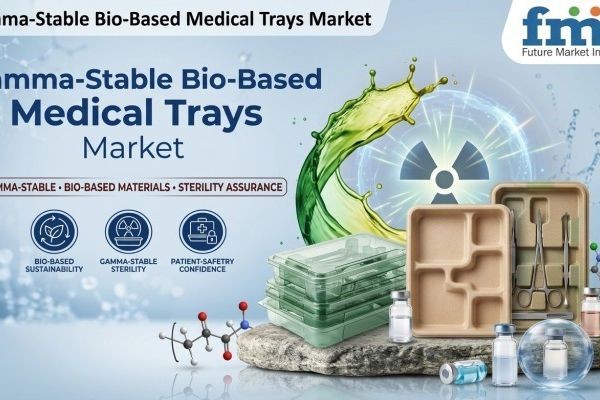
The global gamma-stable bio-based medical trays market is entering a significant growth phase as medical device manufacturers increasingly evaluate renewable polymers capable of maintaining mechanical and sterile integrity during high-dose gamma sterilization. According to the latest market analysis by Future Market Insights, the market is projected to grow from USD 0.9 billion in 2026 to USD 1.7 billion by 2036, expanding at a CAGR of 6.57% during the forecast period.
The market was valued at USD 0.8 billion in 2025. Growth is being supported by healthcare procurement mandates focused on reducing the carbon footprint of single-use surgical kits, advances in bio-based resin formulation, and the phase-out of selected fossil-based additives in high-regulation markets.
Gamma-stable bio-based medical trays are designed to replace conventional fossil-based rigid trays in terminally sterilized medical device packaging. These systems must withstand exposure to approximately 25 to 50 kGy of gamma radiation while maintaining impact resistance, dimensional stability, microbial barrier integrity, and visual clarity.
Get detailed market forecasts, competitive benchmarking, and pricing trends:
https://www.futuremarketinsights.com/reports/sample/rep-gb-32296
Market Overview and Strategic Growth Outlook
Quality assurance teams across the MedTech industry are increasingly shifting attention from simple material substitution toward complete sterile barrier system lifecycle performance. The critical consideration is whether bio-based trays can maintain required mechanical properties throughout sterilization, transportation, and extended shelf-life periods.
The validation of five-year shelf-life stability is emerging as a key inflection point for wider adoption. Once orthopedic and other medical device OEMs complete ISO 11607 validation for bio-based formats, procurement is expected to shift from experimental qualification toward standardized sourcing.
Hospitals and purchasing organizations are also placing greater emphasis on verifiable lifecycle assessment data, creating additional opportunities for suppliers capable of combining clinical performance with measurable sustainability attributes.
Key Market Projections and Strategic Insights
- Global Market Value (2026): USD 0.9 Billion
- Forecast Market Value (2036): USD 1.7 Billion
- Forecast CAGR (2026–2036): 6.57%
- Leading Material Segment: Poly Lactic Acid (PLA)
- PLA Share: 41.2%
- Leading Application Segment: Orthopedic Implants
- Application Share: 34.6%
- Leading End-Use Segment: Hospitals
- End-Use Share: 48.2%
- Fastest-Growing Market: India
- India CAGR: 9.4%
- China CAGR: 8.8%
- United States CAGR: 7.2%
Segment Analysis and Market Opportunities
Poly Lactic Acid (PLA) is expected to account for 41.2% share in 2026, supported by its visual clarity and suitability for thermoformed medical packaging. Its ability to support high-stiffness tray designs makes it particularly relevant for surgical kits requiring robust protection and pre-surgical device inspection.
Orthopedic implants represent the leading application segment, accounting for 34.6% share in 2026. Heavy devices, complex geometries, and sharp edges increase the need for rigid packaging with high impact resistance and dimensional stability.
Hospitals are projected to hold a dominant 48.2% share, reflecting their growing influence over sustainable procurement standards. Hospital purchasing groups are increasingly evaluating environmental performance alongside clinical and packaging requirements.
Regional Growth Outlook
India is projected to register the fastest growth at a 9.4% CAGR, supported by MedTech park development and expanding domestic medical device manufacturing. China follows with an 8.8% CAGR, driven by green manufacturing initiatives and increasing bio-based resin production.
The United States market is forecast to expand at 7.2% CAGR, supported by hospital procurement requirements and growing demand for packaging transparency. Germany is expected to record a 6.4% CAGR, while Brazil follows at 6.9%. The United Kingdom and Japan are projected to grow at 5.8% and 5.1%, respectively.
Across Asia Pacific, new medical device facilities provide opportunities to integrate bio-based packaging directly into modern production systems, avoiding some of the revalidation challenges associated with legacy packaging lines.
Technology and Innovation Outlook
Innovation is centered on:
- Radiation-stable bio-resin formulations
- Advanced antioxidant and stabilizing packages
- High-clarity bio-based polymers
- High-modulus medical trays
- Thermoformed bio-based packaging
- Improved dimensional stability after irradiation
- Five-year shelf-life validation
- Recyclability and lifecycle assessment integration
Manufacturers that can demonstrate consistent molecular weight distribution, resistance to embrittlement and yellowing, and validated performance after gamma exposure are positioned to gain an advantage in medical packaging procurement.
Competitive Landscape and Market Share Analysis
The competitive environment is moderately concentrated because medical-grade thermoforming, cleanroom production, regulatory validation, and specialized resin compounding create significant barriers to entry.
Key companies operating in the market include:
- Nelipak Healthcare Packaging
- TEQ (Sonoco)
- Novolex
- Placon
- DuPont
- Mitsubishi Chemical
- NatureWorks LLC
- Arkema
- Oliver Healthcare Packaging
- Steripack Group
Leading participants are focusing on material engineering, validation packages, radiation resistance, lifecycle assessment, and long-term supply reliability.
Market Drivers and Challenges
Primary growth drivers include:
- Sustainable procurement mandates from healthcare organizations
- Rising demand for lower-carbon medical packaging
- Advances in radiation-stable bio-resins
- Growth in medical device manufacturing
- Increasing lifecycle and carbon-accounting requirements
- Demand for high-performance sterile barrier systems
The primary challenge remains the lack of standardized validation protocols for certain bio-resins following gamma exposure. Customized testing and long-term shelf-life validation can increase qualification costs and extend adoption timelines.
Strategic Implications for Industry Participants
MedTech R&D teams are increasingly encouraged to begin long-term shelf-life validation studies early, while sourcing managers can reduce supply risks by establishing relationships with medical-grade bio-resin producers. Hospitals and category managers are also expected to place greater emphasis on lifecycle performance, recyclability, and environmental data during procurement decisions.
Related Reports:
https://www.openpr.com/news/4599195/perfume-bottle-market-size-to-reach-usd-1-025-83-billion-by-2036
https://www.openpr.com/news/4599196/pe-coated-paper-industry-in-europe-market-to-reach-usd-1-131-1
https://www.openpr.com/news/4599201/pet-cup-market-to-reach-usd-1-100-7-million-by-2036-driven
FMI Custom Research: Strategic Intelligence for Confident Decision-Making
In today's rapidly evolving business environment, leadership teams need more than market data—they need clear, actionable intelligence tailored to their strategic objectives. FMI's Custom Research solutions are designed around the specific business questions organizations need answered, enabling executives to evaluate growth opportunities, validate investments, assess competitive dynamics, and reduce uncertainty before making critical decisions. By combining deep industry expertise, primary research, and proprietary market intelligence, FMI delivers insights that help organizations move from assumptions to evidence-based strategies with greater speed and confidence.
Business Impact
FMI helps organizations transform market complexity into strategic clarity, enabling leadership teams to identify growth opportunities faster, optimize resource allocation, strengthen competitive positioning, and make high-stakes business decisions with confidence.
To explore how FMI Custom Research can support your strategic priorities, please connect with our team at - sales@futuremarketinsights.com
About Future Market Insights (FMI)
Future Market Insights, Inc. (FMI) is an ESOMAR-certified, ISO 9001:2015 market research and consulting organization, trusted by Fortune 500 clients and global enterprises. With operations in the U.S., UK, India, and Dubai, FMI provides data-backed insights and strategic intelligence across 30+ industries and 1200 markets worldwide.






