
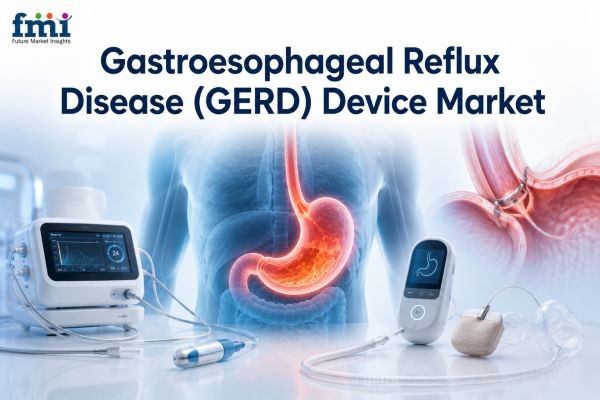
According to Future Market Insights, the global gastroesophageal reflux disease (GERD) devices market is experiencing steady growth as healthcare providers increasingly invest in advanced diagnostic and therapeutic technologies to improve reflux management outcomes. Valued at USD 1.3 billion in 2025, the market is projected to reach USD 1.9 billion by 2036, registering a CAGR of 3.9% during the forecast period.
Growth is being fueled by rising incidence of chronic reflux disorders, increasing utilization of endoscopic procedures, growing demand for objective reflux confirmation, and expanding availability of minimally invasive treatment options across global healthcare systems.
Market Growth Path
The growth of the gastroesophageal reflux disease devices market is being driven by the increasing prevalence of chronic acid reflux, rising awareness of gastrointestinal disorders, and growing demand for accurate diagnostic and minimally invasive treatment solutions. Healthcare providers are increasingly adopting advanced GERD devices to improve diagnosis, enhance treatment outcomes, and reduce patient recovery times.
Technological advancements in endoscopy systems, pH monitoring devices, and reflux treatment platforms are further supporting market expansion.
Get Detailed Market Forecasts, Competitive Benchmarking, and Pricing Trends: https://www.futuremarketinsights.com/reports/sample/rep-gb-1741
Market Overview
The gastroesophageal reflux disease devices market has become an important component of modern gastrointestinal healthcare. GERD devices are widely utilized for diagnosing, monitoring, and treating chronic reflux disease through technologies including esophagoscopes, gastroscopes, manometry systems, pH monitoring systems, fundoplication devices, sphincter augmentation systems, and radiofrequency ablation platforms.
As physicians increasingly require objective evidence before recommending advanced reflux treatments, demand for specialized GERD diagnostic and therapeutic devices continues to expand.
Key Growth Drivers
The growing prevalence of GERD worldwide remains one of the strongest growth drivers for the market. Increasing rates of obesity, lifestyle-related disorders, aging populations, and dietary changes are contributing to rising patient volumes requiring long-term reflux management.
Growing utilization of endoscopy is also supporting market expansion. Persistent reflux symptoms frequently require direct esophageal visualization before treatment decisions can be made, creating sustained demand for upper gastrointestinal imaging technologies.
The increasing adoption of minimally invasive reflux treatment procedures is further accelerating market growth.
Technology & Innovation Trends
Technological innovation continues to reshape the GERD devices industry. Manufacturers are developing advanced endoscopic imaging platforms, next-generation pH monitoring systems, and improved reflux treatment devices that enhance diagnostic accuracy and procedural effectiveness.
Wireless reflux monitoring technologies are gaining popularity due to improved patient comfort and higher diagnostic yield. Meanwhile, minimally invasive and implantable treatment platforms are increasingly being utilized to provide durable reflux control while reducing surgical complexity.
Market Challenges & Restraints
Despite favorable growth prospects, the market faces several challenges. High procedure costs and specialist training requirements continue to limit broader adoption of implantable and advanced treatment technologies.
Healthcare providers also face increasing reimbursement pressures that can affect purchasing decisions for high-value reflux treatment systems. Regulatory requirements, clinical evidence expectations, and procedural standardization further contribute to commercialization complexity.
Segment Analysis
Esophagoscopes and Gastroscopes
Esophagoscopes and gastroscopes are expected to account for 42.0% of the product type segment in 2026. Their essential role in upper gastrointestinal visualization and reflux assessment supports their leading position within the market.
Fundoplication Procedures
Fundoplication procedures are projected to capture 35.0% of procedure demand in 2026. Their established effectiveness in managing refractory GERD cases continues to support strong utilization across gastrointestinal treatment centers.
Hospital End Users
Hospitals are expected to account for 60.0% of total market demand in 2026. Their access to advanced diagnostic equipment, specialized gastrointestinal teams, and integrated treatment capabilities supports continued market leadership.
Minimally Invasive Technologies
Minimally invasive technologies are forecast to represent 45.0% of technology demand in 2026. Increasing preference for reduced procedural burden and faster patient recovery continues to drive adoption across eligible patient populations.
Regional Analysis
The United States is expected to emerge as the fastest-growing major market, registering a CAGR of 5.2% through 2036. Strong reflux testing infrastructure, advanced procedure availability, and increasing access to specialized gastrointestinal care continue to support market growth.
India follows closely with a projected CAGR of 4.5%, driven by expanding hospital endoscopy capacity, growing healthcare investments, and increasing adoption of advanced diagnostic technologies.
China is forecast to grow at 3.6%, supported by strengthening medical device standards and expanding hospital diagnostic capabilities. Brazil is expected to register a CAGR of 3.2%, benefiting from private hospital investments and improving healthcare infrastructure.
Germany and France are projected to grow at 2.0% and 2.1%, respectively, supported by established medical technology ecosystems and stable demand for advanced gastrointestinal care solutions.
Competitive Landscape
The gastroesophageal reflux disease devices market remains highly competitive, with manufacturers focusing on endoscopic innovation, reflux testing technologies, minimally invasive treatment systems, and physician training programs.
Competition increasingly centers on diagnostic accuracy, procedural effectiveness, clinical evidence generation, and the ability to provide comprehensive reflux management solutions across healthcare settings.
Leading Companies Analysis
Key industry participants include Olympus Corporation, Fujifilm Holdings Corporation, PENTAX Medical, KARL STORZ SE & Co KG, Johnson & Johnson MedTech, Merit Medical Systems, LABORIE, Diversatek, and Mederi Therapeutics. These companies continue investing in advanced endoscopy systems, reflux monitoring technologies, and innovative treatment platforms to strengthen market positions.
Investment & Strategic Developments
Industry participants are increasing investments in advanced imaging technologies, reflux testing systems, minimally invasive treatment platforms, and physician education initiatives. Strategic acquisitions and product launches are accelerating technology development and market penetration.
Recent developments include expanded indications for reflux management systems, acquisitions of specialized reflux therapy companies, and introduction of next-generation endoscopic imaging platforms designed to improve diagnostic performance.
Future Outlook
The gastroesophageal reflux disease devices market is expected to maintain stable growth through 2036, supported by rising reflux prevalence, expanding diagnostic requirements, and increasing utilization of minimally invasive treatment technologies.
As healthcare providers increasingly seek objective reflux confirmation and durable treatment outcomes, demand for advanced GERD devices is expected to strengthen across both developed and emerging healthcare markets.
Purchase Full Report for Detailed Insights: https://www.futuremarketinsights.com/reports/gastroesophageal-reflux-diseases-devices-market
Explore More Related Studies Published by FMI Research:
https://www.openpr.com/news/4536573/congenital-hyperinsulinism-treatment-market-led-by-north
https://www.openpr.com/news/4536599/home-sleep-apnea-testing-market-led-by-u-s-as-resmed-and-philips
https://www.openpr.com/news/4534916/fucosidosis-therapeutics-market-driven-by-north-america-as
Custom Research and Consulting Services
Future Market Insights provides customized research solutions, procurement intelligence, competitive analysis, market entry strategy development, and sustainability-focused consulting tailored to client-specific business objectives.
For custom research inquiries and strategic consulting support, contact the FMI team directly.
About Future Market Insights (FMI)
Future Market Insights, Inc. (ESOMAR certified, recipient of the Stevie Award, and a member of the Greater New York Chamber of Commerce) provides deep insights into governing factors elevating demand in the market. FMI stands as a leading global provider of market intelligence, consulting services, and syndicated research reports across chemicals, materials, energy, industrial automation, sustainability, and renewable energy sectors.
With a global presence and extensive industry expertise, FMI delivers actionable insights that enable organizations to navigate evolving market dynamics and capitalize on emerging opportunities.
Contact
Future Market Insights Inc.
Christiana Corporate, 200 Continental Drive, Suite 401, Newark, Delaware 19713, USA
Email: sales@futuremarketinsights.com
Website: www.futuremarketinsights.com






