
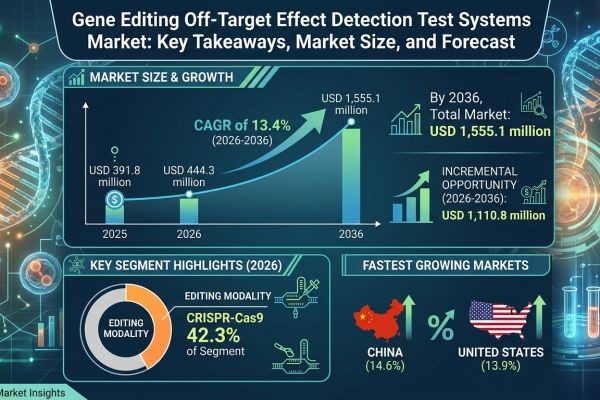
The global gene editing off-target effect detection test systems market is expected to experience substantial growth between 2026 and 2036, fueled by increasing adoption of CRISPR technologies, expanding gene therapy research, and growing regulatory emphasis on genomic safety validation. According to the latest analysis by Future Market Insights (FMI), the market is projected to expand steadily throughout the forecast period as biotechnology companies and research institutions intensify efforts to improve gene-editing accuracy and minimize unintended genomic modifications.
Growing investments in precision medicine, cell and gene therapies, and next-generation sequencing technologies are significantly strengthening demand for advanced off-target detection platforms. As gene editing technologies continue to move toward clinical commercialization, accurate identification of unintended edits has become a critical requirement across pharmaceutical, biotechnology, and academic research environments.
Gene Editing Off-target Effect Detection Test Systems Market Snapshot (2026–2036)
- Forecast period: 2026–2036
- Market growth outlook: Strong double-digit expansion expected
- Key technology focus: CRISPR off-target detection systems
- Major end users: Biotechnology companies, pharmaceutical firms, academic research institutes
- Leading application areas: Gene therapy development, oncology research, rare disease therapeutics
- Fastest-growing demand segment: Next-generation sequencing-based detection platforms
- Primary growth regions: North America, Europe, and Asia Pacific
Momentum in the Market
The gene editing off-target effect detection test systems market is gaining momentum as gene editing applications rapidly expand across therapeutic development and biomedical research. Between 2026 and 2036, increasing commercialization of CRISPR-based therapeutics is expected to create significant demand for reliable genomic safety assessment tools.
As regulatory agencies place stronger emphasis on validation of genome-editing precision, biotechnology and pharmaceutical companies are increasingly investing in advanced off-target detection systems to support preclinical and clinical workflows. The growing pipeline of gene-modified cell therapies and personalized medicine programs is further accelerating adoption.
From 2030 onward, advancements in artificial intelligence-assisted genomic analysis and high-throughput sequencing technologies are expected to improve detection sensitivity, scalability, and workflow efficiency, enabling broader implementation across research and clinical laboratories.
The Reasons Behind the Market’s Growth
Demand for gene editing off-target effect detection test systems is increasing due to several scientific, regulatory, and technological developments shaping the global biotechnology landscape.
Rapid Expansion of CRISPR-based Research
CRISPR and related genome-editing technologies are witnessing widespread adoption across therapeutic research, agricultural biotechnology, and molecular biology applications. This expansion is creating strong demand for precise off-target assessment tools.
Increasing Focus on Genomic Safety
Regulatory authorities and healthcare stakeholders are emphasizing safety validation for gene editing therapies, particularly in clinical applications involving human genome modification.
Growth in Cell and Gene Therapy Development
The rapid advancement of cell and gene therapy pipelines is significantly increasing the need for comprehensive genomic integrity testing and validation systems.
Advancements in Sequencing Technologies
Next-generation sequencing (NGS) platforms are improving the accuracy and scalability of off-target effect detection, enabling researchers to identify unintended edits with higher precision.
Top Segment Analysis
Technology Type: NGS-based Detection Platforms Lead Market Expansion
Next-generation sequencing-based off-target detection systems are expected to dominate market demand due to their high sensitivity, scalability, and ability to analyze complex genomic datasets. These platforms are becoming increasingly important in clinical-grade gene editing validation workflows.
Application Analysis
- Gene therapy research remains the leading application area
- Oncology-focused genome editing programs are expanding rapidly
- Rare disease therapeutic development continues to drive investment
- Stem cell engineering applications are creating new opportunities
Regional Development: Biotechnology Innovation Strengthens Global Demand
The market is witnessing strong regional expansion supported by increasing biotechnology investments and genomic research activities.
- North America: Leading region due to strong biotechnology infrastructure and extensive gene therapy research
- Europe: Growing regulatory focus on genomic safety and precision medicine innovation
- Asia Pacific: Rapidly emerging biotechnology ecosystem and expanding clinical research activities
- China and Japan: Significant investments in genome-editing technologies and sequencing capabilities
Strategic collaborations between biotechnology firms, sequencing technology providers, and research institutes are accelerating innovation and commercialization of advanced off-target detection systems.
Challenges, Trends, Opportunities, and Drivers
Drivers
- Rising adoption of CRISPR and gene editing technologies
- Expanding cell and gene therapy pipelines
- Increasing regulatory scrutiny regarding genomic safety
- Growing investments in precision medicine research
Opportunities
- AI-driven genomic analysis platforms
- High-throughput automated detection systems
- Clinical-grade off-target validation services
- Expansion of personalized medicine applications
Trends
- Integration of machine learning in genomic analysis
- Development of ultra-sensitive sequencing workflows
- Growing adoption of cloud-based bioinformatics platforms
- Increased focus on single-cell genomic analysis
Challenges
- High operational and sequencing costs
- Complexity of genomic data interpretation
- Standardization limitations across detection platforms
- Regulatory uncertainties in emerging markets
Country Growth Outlook
The market’s long-term growth is closely linked to biotechnology infrastructure expansion and increasing genomic research funding worldwide.
- United States: Dominates due to strong gene therapy commercialization and research funding
- Germany: Expanding precision medicine and biotechnology innovation
- China: Rapidly increasing investment in CRISPR and genomic research
- Japan: Advanced sequencing technology adoption supporting market growth
- South Korea: Emerging biotechnology research and therapeutic development hub
The Competitive Environment
The gene editing off-target effect detection test systems market is highly innovation-driven, with companies competing through sequencing advancements, bioinformatics capabilities, and research collaborations.
Leading companies are focusing on:
- Advanced NGS-based detection technologies
- AI-powered genomic analytics platforms
- High-throughput laboratory automation
- Strategic partnerships with biotechnology and pharmaceutical companies
Industry participants are also investing in expanding clinical research capabilities and improving detection sensitivity to support commercialization of gene editing therapies.
Future Outlook: Advancing Precision in Genome Editing
The gene editing off-target effect detection test systems market is expected to play a critical role in the future of precision medicine and therapeutic genome engineering. As gene-editing technologies continue to evolve, the need for highly accurate genomic safety assessment tools will become increasingly essential across both research and clinical applications.
Future advancements are likely to focus on ultra-sensitive detection methods, AI-assisted genomic interpretation, and fully integrated sequencing workflows capable of supporting large-scale therapeutic development programs. With increasing emphasis on safety, regulatory compliance, and precision therapeutics, off-target detection systems will remain central to the next generation of genome-editing innovation.
Report Link:
https://www.futuremarketinsights.com/reports/gene-editing-off-target-effect-detection-test-systems-market






