
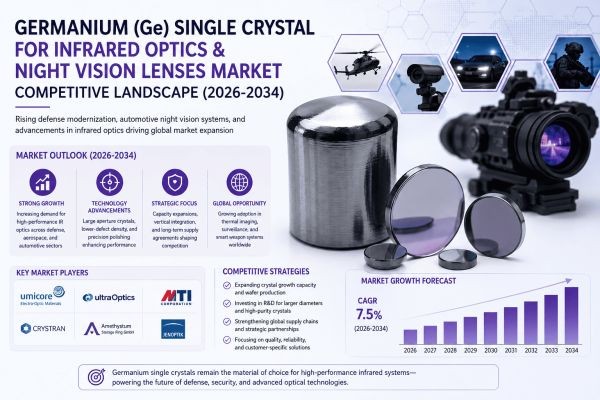
Germanium (Ge) single crystal is a high-purity semiconductor material widely recognized for its exceptional optical transparency in the 2–12 micrometer infrared wavelength range, making it indispensable for thermal imaging, infrared optics, and night vision lens systems. Grown through advanced crystal growth techniques such as the Czochralski method, single-crystal germanium offers superior optical homogeneity, precise refractive index consistency, and low absorption losses — properties that are critical for high-performance IR optical components including lenses, windows, domes, and prisms used across defense, surveillance, and commercial thermal imaging applications. Unlike polycrystalline or alternative IR-transmitting substrates, single-crystal germanium's uniform lattice structure eliminates grain boundary scattering, delivering consistently high transmission efficiency that system designers in mission-critical applications simply cannot compromise on.
The market is witnessing robust growth driven by escalating defense budgets globally, rising adoption of thermal imaging systems in military and law enforcement, and expanding commercial applications in automotive night vision, industrial thermography, and medical diagnostics. Furthermore, increasing geopolitical tensions have accelerated procurement of advanced night vision and targeting systems, directly boosting demand for precision Ge single crystal optics. Umicore N.V., Grinm Advanced Materials Co., Ltd., and Jenoptik AG are among the prominent players operating in this space with established production capabilities and diversified optical component portfolios.
Get Full Report Here: https://www.24chemicalresearch.com/reports/308907/germanium-single-crystal-for-infrared-optics-night-vision-lenses-market
Market Dynamics:
The market's trajectory is shaped by a complex interplay of powerful growth drivers, significant restraints that are being actively addressed, and vast, untapped opportunities.
Powerful Market Drivers Propelling Expansion
-
Surging Defense Expenditure and Military Modernization Fueling Demand for Germanium-Based IR Optics: Global defense budgets have expanded substantially over the past decade, with NATO member states collectively increasing military spending and several Asia-Pacific nations accelerating procurement of advanced surveillance and targeting systems. Germanium single crystal remains the substrate of choice for thermal imaging lenses and night vision systems due to its exceptional transmission window in the 2–12 micrometer mid-wave and long-wave infrared range, combined with a high refractive index of approximately 4.0 that enables compact, high-performance optical designs. Ground vehicles, rotary-wing aircraft, unmanned aerial vehicles, and naval platforms are increasingly being fitted with multi-band electro-optical and infrared sensor suites, each requiring precision-ground germanium optics. This sustained procurement cycle is creating a structurally elevated baseline demand for high-purity, dislocation-free germanium single crystal boules produced via the Czochralski method.
-
Proliferation of Commercial Thermography, Automotive Night Vision, and Border Surveillance Applications Broadening the Market Base: Beyond purely military end-uses, germanium single crystal optics are finding growing adoption in commercial and industrial thermography cameras used for predictive maintenance, building diagnostics, and process monitoring. The automotive sector represents a particularly dynamic growth vector, with leading original equipment manufacturers integrating long-wave infrared camera systems into driver-assistance and autonomous vehicle platforms to enhance pedestrian and obstacle detection under low-visibility conditions. Border and perimeter security installations operated by governmental agencies worldwide are also deploying fixed and pan-tilt-zoom thermal cameras at scale. Because uncooled and cooled thermal detector arrays in these applications require high-transmission, low-scatter germanium lenses, this commercial diversification significantly reduces the market's historical dependence on defense procurement cycles and supports more resilient revenue trajectories for germanium optics manufacturers.
-
Technological Advancements in Crystal Growth and Precision Optical Fabrication Reinforcing Demand: Manufacturers are investing in improvements to Czochralski and zone-refining crystal growth techniques to produce larger-diameter, lower-dislocation-density germanium boules, enabling higher yields of precision optical blanks. Progress in diamond-turned and precision-molded aspheric germanium optics is allowing system designers to consolidate multi-element lens assemblies into fewer components, improving system reliability while sustaining demand for premium-grade single crystal material. Furthermore, the integration of germanium lenses with advanced detector arrays operating at higher frame rates and smaller pixel pitches is driving requirements for tighter optical tolerances, reinforcing the value proposition of consistently high-crystalline-quality germanium over polycrystalline or alternative substrate materials. Advances in anti-reflection coating technologies, including multi-layer chalcogenide coatings, are further enhancing optical transmission efficiency and durability of germanium lenses under field conditions, making them more competitive across a wider range of end-use applications.
Download FREE Sample Report: https://www.24chemicalresearch.com/download-sample/308907/germanium-single-crystal-for-infrared-optics-night-vision-lenses-market
Significant Market Restraints Challenging Adoption
Despite its strong fundamentals, the market faces hurdles that must be overcome to achieve broader universal adoption across all end-use segments.
-
Growing Competitive Pressure from Alternative Infrared Optical Materials Limiting Market Share in Certain Segments: While germanium single crystal remains technically superior for long-wave infrared applications requiring high refractive index and broad spectral transmission, it faces increasing competition from a range of alternative materials. Chalcogenide glasses offer the ability to be molded into aspheric shapes at relatively low temperatures, reducing manufacturing complexity and cost for uncooled commercial camera applications. Zinc sulfide multispectral and zinc selenide substrates address specific visible-to-infrared dual-band requirements where germanium's opacity in the visible spectrum is a limitation. Silicon, though restricted to the 1–7 µm range, is far less expensive and more abundant, making it competitive for mid-wave infrared applications. As detector array manufacturers continue to develop smaller pixel pitch sensors that can tolerate modest optical aberrations, the pressure to select lower-cost alternative optics materials for commercial thermal cameras is expected to intensify, potentially constraining germanium's addressable market in non-military segments.
-
Temperature-Dependent Transmission Characteristics and Mechanical Brittleness Imposing Design and Reliability Constraints: Germanium exhibits a notable reduction in infrared transmission at elevated temperatures, with transmission in the 8–12 µm band declining significantly above approximately 100°C due to increased free carrier absorption. This characteristic imposes thermal management requirements on optical systems operating in high-temperature environments such as engine compartment surveillance or desert-climate military deployments, adding design complexity and potentially favoring alternative materials for specific high-temperature applications. Additionally, germanium's relatively low Knoop hardness compared to materials like diamond-turned silicon or sapphire makes finished optics susceptible to surface damage during handling, coating, and assembly operations, contributing to yield losses and warranty risks that can suppress profit margins and discourage adoption in ruggedized applications without additional protective coatings or housings.
Critical Market Challenges Requiring Innovation
The concentration of primary germanium supply in a limited number of geographic regions creates pronounced supply chain vulnerability that the industry must actively address. Germanium is a critical and relatively rare minor metal recovered primarily as a byproduct of zinc smelting and coal fly ash processing, with the People's Republic of China accounting for the dominant share of global refined germanium production. This geographic concentration creates systemic supply chain risk for optics manufacturers operating in the United States, Europe, and allied nations, particularly given that germanium has been formally classified as a critical mineral by multiple government agencies including the U.S. Geological Survey and the European Commission. Export control measures implemented by the Chinese government have periodically disrupted the availability of germanium metal feedstock to international buyers, prompting price volatility and procurement uncertainty across the value chain.
Furthermore, the high material and processing costs associated with germanium single crystal production constrain adoption in price-sensitive commercial segments. The Czochralski single crystal growth process is energy-intensive, time-consuming, and requires specialized furnace equipment and highly skilled operators. These factors combine to produce finished germanium optics with unit costs that can be prohibitive for mass-market commercial applications, encouraging some system designers to evaluate alternative substrate materials or hybrid optical architectures. Export control regulations, particularly the International Traffic in Arms Regulations in the United States and equivalent frameworks in the European Union and allied nations, further impose stringent licensing requirements on the export of high-performance germanium optics, extending lead times and increasing administrative costs for manufacturers seeking to serve international customers.
Vast Market Opportunities on the Horizon
-
Expansion of Domestic Germanium Refining and Recycling Capacity in Western Nations Presenting Strategic Supply Chain Diversification Opportunities: Government initiatives in the United States, European Union, Canada, and allied nations aimed at securing critical mineral supply chains are creating tangible funding and policy support for the development of domestic germanium refining, recycling, and crystal growth capacity. Programs under the U.S. Defense Production Act, the European Critical Raw Materials Act, and allied nation equivalents are channeling investment into the upstream germanium supply chain, which has the potential to reduce dependence on Chinese feedstock, stabilize input costs, and create a more resilient domestic supply base for defense-critical infrared optics production. Germanium recycling from end-of-life fiber optic cables, scrapped IR optics, and semiconductor substrates represents a technically proven and commercially viable secondary supply pathway that is receiving increased industry and government attention as circular economy priorities converge with critical mineral security objectives.
-
Integration of Advanced Anti-Reflection Coatings, Freeform Optics, and Hyperspectral Imaging Capabilities Opening New High-Value Application Frontiers: The convergence of precision germanium crystal fabrication with advanced optical coating technologies, freeform surface manufacturing, and hyperspectral imaging system architectures is enabling a new generation of high-performance infrared optical products that command significant price premiums. Hard carbon diamond-like coatings applied to germanium surfaces substantially improve surface durability and environmental resistance while maintaining high infrared transmission, broadening the material's suitability for harsh-environment applications. Freeform germanium optics manufactured using advanced multi-axis diamond turning and computer-controlled polishing allow for the correction of complex aberrations in compact optical systems, reducing size, weight, and power requirements for man-portable military and first-responder thermal imagers. Hyperspectral infrared imaging, increasingly deployed for agricultural monitoring, environmental sensing, and intelligence, surveillance, and reconnaissance missions, represents a growing application segment with stringent optical quality requirements well suited to high-grade germanium single crystal substrates.
-
Rapid Growth of the Commercial Space Sector and Small Satellite Earth Observation Creating Emerging Demand for Space-Qualified Germanium Optics: The proliferation of small satellite Earth observation platforms utilizing infrared and thermal imaging payloads represents an emerging demand vector for radiation-hardened, space-qualified germanium optics. As constellation-based remote sensing becomes commercially viable and operationally important for climate monitoring, disaster response, and security applications, the requirements for high-performance IR optical components capable of surviving the space radiation environment and thermal cycling extremes of low Earth orbit are expected to generate incremental and structurally durable demand for premium-grade germanium single crystal optics. This technically demanding and commercially attractive market segment rewards manufacturers that invest in the certification and qualification infrastructure necessary to serve it.
In-Depth Segment Analysis: Where is the Growth Concentrated?
By Type:
The market is segmented into Undoped Germanium Single Crystal, Doped Germanium Single Crystal (n-type / p-type), High-Purity Zone-Refined Germanium Crystal, and Anti-Reflection (AR) Coated Germanium Crystal. High-Purity Zone-Refined Germanium Crystal commands a dominant position within this segment owing to its exceptional optical homogeneity and minimal lattice defect density, which are prerequisites for advanced IR imaging and thermal sensing applications. Undoped variants serve as the workhorse material for standard IR lens fabrication given their favorable broadband transmission across the 2–14 micron wavelength range. AR-coated germanium crystals are gaining traction as end-users seek to reduce surface reflection losses and enhance overall system throughput in thermographic and surveillance optics.
By Application:
Application segments include Night Vision Lenses & Goggles, Thermal Imaging Cameras, Forward Looking Infrared (FLIR) Systems, Medical Thermography, and others such as industrial inspection and spectroscopy. The Forward Looking Infrared (FLIR) Systems segment currently dominates, driven by persistent demand from defense modernization programs and aerial surveillance platforms worldwide. Germanium single crystals are uniquely suited for FLIR optics due to their wide mid-wave and long-wave infrared transparency, high refractive index, and mechanical robustness under extreme operational conditions. However, the night vision lenses & goggles and commercial thermal imaging camera segments are expected to exhibit strong growth rates in the coming years as civilian and law enforcement adoption accelerates.
By End-User Industry:
The end-user landscape includes Defense & Military, Homeland Security & Law Enforcement, Commercial & Industrial, and Healthcare & Life Sciences. Defense & Military remains the foremost end-user segment, underpinned by substantial procurement budgets allocated toward next-generation electro-optical and infrared (EO/IR) systems across land, naval, and airborne platforms. However, homeland security and law enforcement agencies are emerging as a fast-growing secondary end-user category, deploying germanium-based IR optics in border surveillance, search-and-rescue, and counter-drone operations. The commercial and industrial sector is progressively adopting germanium IR optics in predictive maintenance and non-destructive testing applications, while healthcare institutions are exploring thermographic diagnostic tools that benefit from the material's outstanding transmission properties.
Download FREE Sample Report: https://www.24chemicalresearch.com/download-sample/308907/germanium-single-crystal-for-infrared-optics-night-vision-lenses-market
Competitive Landscape:
The global Germanium Single Crystal for Infrared Optics & Night Vision Lenses market is highly concentrated and characterized by a limited number of vertically integrated manufacturers capable of producing semiconductor-grade, optical-quality Ge single crystals. The market is led by a small set of incumbents — Umicore N.V. (Belgium), Coherent Corp. (formerly II-VI Incorporated, United States), and Yunnan Germanium Co., Ltd. (China) — who collectively represent a dominant share of global high-purity germanium crystal production and optical blank supply. Their positions are underpinned by decades of accumulated process know-how in Czochralski crystal growth, extensive qualification records with prime defense contractors, and established global distribution networks operating under export compliance frameworks.
Beyond the established tier-one players, a number of specialized and emerging manufacturers contribute to the competitive landscape, particularly in Asia and Europe. Competitive differentiation increasingly hinges on the ability to grow large-diameter, low-etch-pit-density single crystals suitable for demanding night vision and thermal weapon sight applications, alongside consistent supply chain reliability and trade compliance certifications. The competitive strategy across the industry is overwhelmingly focused on R&D to enhance crystal purity and boule diameter capability, alongside forming strategic vertical partnerships with optical system integrators to co-develop and validate application-specific solutions, thereby securing long-term demand through sole-source and preferred-supplier agreements.
List of Key Germanium (Ge) Single Crystal Companies Profiled:
-
Umicore N.V. (Belgium)
-
Coherent Corp. (formerly II-VI Incorporated) (United States)
-
Materion Corporation (United States)
-
Yunnan Germanium Co., Ltd. (China)
-
Chihong Zn&Ge Co., Ltd. (China)
-
JSC “Germanium” (Russia)
-
Freiberger Compound Materials GmbH (Germany)
-
Changsha Sinostone Advanced Materials Co., Ltd. (China)
Regional Analysis: A Global Footprint with Distinct Leaders
-
North America: Is the undisputed leader in demand for high-purity germanium single crystal infrared optics, driven predominantly by the United States' robust defense and aerospace sector. The region benefits from sustained government investment in advanced military optical systems, including thermal imaging, forward-looking infrared (FLIR) technologies, and soldier-worn night vision equipment. The presence of major defense contractors and a well-established supply chain for precision optical components has created a mature ecosystem that continuously demands premium-grade germanium single crystals. Stringent domestic sourcing requirements for defense procurement further reinforce the region's self-sufficiency orientation, encouraging local germanium processing and crystal manufacturing capabilities. Growing commercial adoption in automotive driver assistance systems, industrial thermography, and border security surveillance is additionally broadening the demand base beyond traditional military end-users.
-
Asia-Pacific & Europe: Together, these regions form a powerful and rapidly evolving secondary bloc in the global germanium single crystal market. Asia-Pacific is the fastest-growing region, with China occupying a uniquely dual role as both the world's dominant germanium producer and a major end-market for infrared optical systems. China's large-scale defense modernization programs and growing commercial infrared sensor industry create substantial domestic consumption of high-purity germanium crystals, while Japan, South Korea, and India contribute meaningful demand through their advanced electronics, precision optics, and defense indigenization activities. Europe, anchored by established defense industries in Germany, France, the United Kingdom, and the Netherlands, drives demand for advanced night vision and thermal imaging systems compatible with NATO interoperability standards, while the European Union's strategic autonomy initiatives are prompting active efforts to secure domestic or allied germanium supply.
-
South America and Middle East & Africa: These regions represent the emerging frontier of the germanium single crystal IR optics market. While currently smaller in scale, they present meaningful long-term growth opportunities driven by defense modernization initiatives in Brazil, Colombia, Saudi Arabia, and the United Arab Emirates, where border security, counter-drone operations, and military surveillance requirements are creating selective but growing procurement of night vision and thermal imaging equipment. The regions rely almost entirely on imports of germanium single crystal components, with suppliers from North America, Europe, and increasingly Asia-Pacific competing for defense procurement contracts across key markets.
Get Full Report Here: https://www.24chemicalresearch.com/reports/308907/germanium-single-crystal-for-infrared-optics-night-vision-lenses-market
Download FREE Sample Report: https://www.24chemicalresearch.com/download-sample/308907/germanium-single-crystal-for-infrared-optics-night-vision-lenses-market
About 24chemicalresearch
Founded in 2015, 24chemicalresearch has rapidly established itself as a leader in chemical market intelligence, serving clients including over 30 Fortune 500 companies. We provide data-driven insights through rigorous research methodologies, addressing key industry factors such as government policy, emerging technologies, and competitive landscapes.
-
Plant-level capacity tracking
-
Real-time price monitoring
-
Techno-economic feasibility studies
International: +1(332) 2424 294 | Asia: +91 9169162030
Website: https://www.24chemicalresearch.com/






