
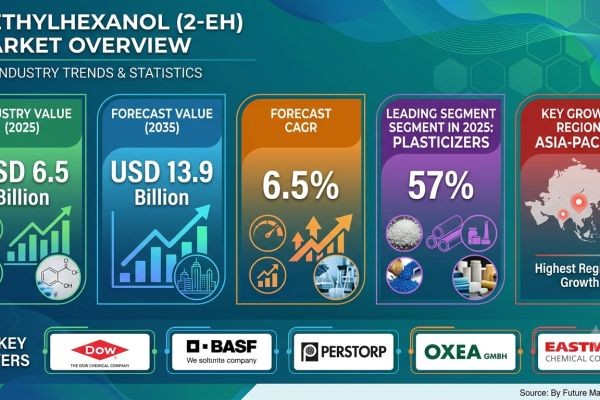
The global 2-ethylhexanol (2-EH) market is projected to witness strong expansion over the next decade, supported by growing industrial production and rising demand for flexible plastics across key sectors. The market is expected to grow steadily, reaching approximately USD 13.9 billion by 2036, registering a CAGR of 6.5%, according to the latest analysis by Future Market Insights (FMI).
Market growth is being shaped by increasing application in high-performance manufacturing, growing consumer demand for flexible polyvinyl chloride (PVC) products, and rapid adoption of advanced chemical formulations. 2-Ethylhexanol has evolved from a standard chemical intermediate into an essential regulatory-compliant component across various industrial and commercial products. While traditional phthalate-based plasticizers continue to dominate chemical consumption, manufacturers are increasingly integrating non-phthalate alternatives and specialty esters to comply with modern eco-friendly expectations and improve end-user application outcomes.
Global 2-Ethylhexanol (2-EH) Market Snapshot (2026–2036)
Market size outlook toward 2036: USD 13.9 billion
Forecast CAGR: 6.5%
Dominant application category: Plasticizers (~57% market share)
Fastest-growing segment: Plastics and polymers (~6.6% CAGR)
Key growth regions: Asia-Pacific, North America, European Union
Primary demand channel: Chemical intermediate and industrial manufacturing
Momentum in the Market
Beginning from steady regional adoption levels, the global 2-ethylhexanol market demonstrates accelerated growth throughout the forecast period as regulatory compliance and high-performance material standards become mandatory across multiple industries. Between 2026 and 2036, expanding construction activities and rising demand for flexible packaging are expected to significantly boost demand for integrated chemical systems. Increasing urbanization and higher infrastructure investment are encouraging governments and manufacturers to prioritize advanced manufacturing technologies.
From 2036 onward, innovation in non-phthalate plasticizers and integration with green chemistry platforms is expected to further strengthen market expansion. Smart manufacturing loops capable of optimizing chemical purity and reducing volatile organic compounds (VOCs) are emerging as key differentiators in new production models.
Request a Sample Report: https://www.futuremarketinsights.com/reports/sample/rep-gb-353
The Reasons Behind the Market’s Growth
Demand for 2-ethylhexanol globally is rising due to multiple structural and technological factors reshaping the regional industrial ecosystem.
Sustained Building and Construction Demand
Infrastructure construction and residential building projects drive significant demand for multi-purpose PVC products, such as cabling, flooring, and pipes, which rely heavily on 2-EH-based plasticizers.
Growing Plasticizer Production
Rapid expansion of chemical manufacturing hubs, particularly in the Asia-Pacific region, is driving large-scale industrial adoption of 2-EH for producing dioctyl phthalate (DOP) and dioctyl terephthalate (DOTP).
Rising Consumer Preference for Flexible Materials
Consumers and industrial buyers are prioritizing flexible, durable, and impact-resistant materials, accelerating adoption across various commercial plastics and polymer formulations.
Fuel Additives and Greener Energy Transitions
The rise of strict fuel standard initiatives, particularly in Europe, is creating demand for 2-ethylhexanol nitrates used as diesel fuel additives to improve combustion efficiency and lower vehicle emissions.
Top Segment Application Type
Plasticizers Lead Market Demand
Plasticizers account for the majority of 2-ethylhexanol consumption across global markets, supported by the ongoing necessity to impart flexibility, durability, and processing ease to polyvinyl chloride (PVC) materials.
Application and End-Use Analysis
Plasticizers segment: ~6.4% CAGR driven by universal flexible PVC adoption
Plastics and polymers: ~6.6% CAGR supported by high-performance engineering requirements
Synthetic lubricants: Steady growth driven by automotive and aerospace applications
Fuel additives: Rapidly expanding niche focused on environmental regulatory alignment
Regional Development: Manufacturing Ecosystem Drives Expansion
The global industrial supply chain is rapidly evolving, supported by cost-efficient production centers and expanding distribution networks.
Asia-Pacific: Regional production leader and the primary engine of chemical demand growth.
United States: Expanding chemical assembly, infrastructure development, and a steady 6.1% CAGR.
European Union: Rapid transformation toward low-VOC coatings, eco-friendly plasticizers, and an estimated 6.3% CAGR.
United Kingdom & Japan: Steady market expansion driven by compliance with strict chemical regulatory frameworks like REACH.
Localized manufacturing partnerships between chemical suppliers and regional industrial buyers are improving cost efficiency while accelerating product innovation and technology adoption.
Challenges, Trends, Opportunities, and Drivers
Drivers
- High demand for flexible PVC in construction and packaging
- Growing automotive coatings and synthetic lubricants sector
- Rising demand for performance-enhancing fuel additives
- Expansion of industrial chemical manufacturing infrastructure
Opportunities
- Transition toward bio-based and non-phthalate plasticizers
- Advanced low-VOC formulations for paints and coatings
- High-purity chemical grades for specialized medical or electronic parts
- Integration with sustainable manufacturing technologies
Trends
- Shift toward eco-friendly and safe plasticizing alternatives
- Innovation in high-efficiency diesel fuel additives
- Increased adoption of specialty acrylic esters
- Sustainability-focused supply chain transformations
Challenges
- Price volatility of raw materials like propylene and synthesis gas
- Complex integration and processing requirements for green alternatives
- Compliance with evolving and stricter global environmental safety standards
Country Growth Outlook
The market’s growth trajectory is closely tied to industrialization and infrastructure regulation implementation across key economies:
- USA: Manufacturing leadership and ongoing infrastructure modernization programs.
- Germany & France: Expanding automotive component production and strict eco-compliance adoption.
- China & India: Rapidly growing consumer demand and chemical processing capacity.
- United Kingdom: Rising demand for low-VOC products and strict chemical safety standards.
- Japan: Increasing urban mobility and high-tech manufacturing requirements.
The Competitive Environment
The global 2-ethylhexanol market is moderately consolidated, with leading safety and chemical technology providers competing through formulation innovation, localized manufacturing, and regulatory compliance. Leading companies include:
- The Dow Chemical Company
- BASF SE
- Perstorp
- OXEA GmbH (OQ Chemicals)
- Eastman Chemical Company
These players are investing heavily in advanced production technologies, high-efficiency purification lines, and sustainable material alternatives while forming partnerships with downstream manufacturers to strengthen supply chains and accelerate product development.
Future Outlook: Toward Intelligent and Safer Materials
The global 2-ethylhexanol market is entering a transformative decade shaped by sustainable engineering, process automation, and stricter safety expectations. Future chemical production systems are expected to function as highly integrated modules working alongside green chemistry standards to minimize lifecycle environmental impacts. As industrial markets mature and environmental safety awareness strengthens, 2-ethylhexanol will remain central to achieving durable, safe, and efficient material ecosystems throughout the world.
Explore More Related:
Industrial Ceramics Market https://www.openpr.com/news/4537911/industrial-ceramics-market-to-reach-usd-254-08-billion-by-2036
Aromatic Ketone Polymers Market https://www.futuremarketinsights.com/reports/global-aromatic-ketone-polymers-market
For a comprehensive strategic outlook and detailed analysis of technological developments shaping the industry, readers can explore the full report on the official Future Market Insights website: https://www.futuremarketinsights.com/reports/2-ethylhexanol-market






