
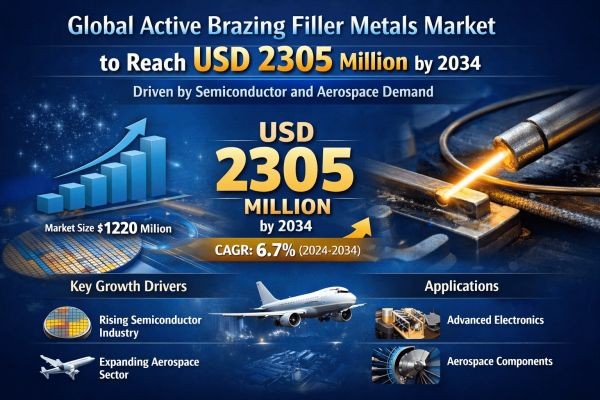
Active Brazing Filler Metals are advanced metallurgical alloys containing reactive elements like titanium, zirconium, or hafnium, engineered to create robust bonds between dissimilar materials—particularly ceramics and metals—without requiring prior metallization. This unique capability makes them indispensable for high-performance applications demanding hermetic seals, exceptional thermal stability, and mechanical integrity across industries including aerospace, electronics, medical devices, and energy systems. Unlike conventional brazing materials, ABFMs facilitate direct wetting of non-metallic surfaces, enabling innovative designs and enhancing component reliability in extreme environments.
Get Full Report Here: https://www.24chemicalresearch.com/reports/306936/active-brazing-filler-metals-market
Market Dynamics:
The market's trajectory is shaped by a complex interplay of powerful growth drivers, significant restraints that are being actively addressed, and vast, untapped opportunities.
Powerful Market Drivers Propelling Expansion
- Expansion in Electronics and Semiconductor Manufacturing: The relentless miniaturization and performance enhancement in semiconductor devices, power modules, and electronic packaging represent a primary growth vector. The global semiconductor industry, valued at over $600 billion, increasingly relies on ABFMs to create reliable thermal management solutions and hermetic seals in packages. These materials enable the direct bonding of silicon carbide (SiC) and gallium nitride (GaN) semiconductors to heat sinks and substrates, which is critical for next-generation power electronics and electric vehicle inverters. The shift towards wider bandgap semiconductors has driven a 25-30% increase in demand for specialized ABFMs capable of withstanding higher operating temperatures and providing superior thermal conductivity.
- Aerospace and Defense Applications: The aerospace sector's adoption of ceramic matrix composites (CMCs) and advanced thermal protection systems has created substantial demand for high-performance brazing solutions. ABFMs are essential for manufacturing components such as turbine blades, heat exchangers, and radar systems that must maintain structural integrity under extreme thermal and mechanical stress. The global commercial aircraft market's projected delivery of over 40,000 new aircraft in the next two decades, coupled with defense modernization programs, requires advanced joining technologies that can handle the thermal expansion mismatches between ceramics and superalloys, driving consistent market growth.
- Medical Device Manufacturing Innovations: The medical technology sector increasingly utilizes ABFMs for implantable devices, diagnostic equipment, and surgical instruments requiring biocompatible, corrosion-resistant joints. The ability to create reliable seals between ceramic insulators and metal components in devices like pacemakers, neurostimulators, and advanced imaging systems has become crucial. With the global medical device market exceeding $500 billion and growing at approximately 5% annually, the demand for precision joining solutions that meet stringent regulatory standards continues to expand, positioning ABFMs as critical enabling materials.
Download FREE Sample Report: https://www.24chemicalresearch.com/download-sample/306936/active-brazing-filler-metals-market
Significant Market Restraints Challenging Adoption
Despite their critical importance, the market faces hurdles that must be overcome to achieve broader adoption.
- High Material and Processing Costs: The sophisticated composition of ABFMs, often containing precious metals like silver, gold, and palladium, elevates material costs significantly—typically 40-60% higher than conventional brazing alloys. Furthermore, the specialized equipment required for controlled atmosphere or vacuum brazing represents substantial capital investment, with industrial-scale systems costing $500,000 to over $2 million. These economic barriers particularly challenge small and medium-sized enterprises and can limit adoption in price-sensitive applications, despite the technical advantages offered.
- Technical Complexity and Skill Requirements: Achieving consistent, high-quality brazed joints demands extensive metallurgical expertise and precise process control. Variations in heating rates, temperature uniformity, and atmosphere composition can lead to joint failures, requiring skilled technicians and comprehensive quality assurance systems. The scarcity of qualified brazing engineers and technicians creates operational challenges for manufacturers, potentially delaying production schedules and increasing training costs, which acts as a significant barrier to market expansion.
Critical Market Challenges Requiring Innovation
The transition from laboratory development to industrial-scale implementation presents its own set of technical and economic challenges. Maintaining consistent alloy composition and quality across production batches remains difficult, with leading manufacturers reporting rejection rates of 5-8% due to variations in reactive element content and oxide formation. The specialized nature of ABFM applications means that supply chains are often fragmented, with limited availability of certain alloy compositions and forms, potentially causing production delays for end-users.
Additionally, the market must address environmental and regulatory concerns regarding the use of certain metals, particularly in regions with strict substance restrictions. The development of alternative formulations that maintain performance while complying with evolving regulations represents an ongoing challenge that requires substantial research investment and testing validation.
Vast Market Opportunities on the Horizon
- Renewable Energy and Power Electronics: The global transition to renewable energy systems and electric vehicles creates tremendous opportunities for ABFMs. Solar thermal systems, solid oxide fuel cells, and advanced power converters all require reliable ceramic-to-metal joints that can withstand thermal cycling and corrosive environments. The electric vehicle power module market alone is projected to grow to $15 billion by 2030, representing a significant addressable market for brazing solutions that enhance thermal management and reliability in high-power applications.
- Emerging Applications in Quantum Computing and Photonics: The rapidly developing fields of quantum computing and integrated photonics require ultra-high vacuum systems and precise optical alignments that depend on hermetic ceramic-metal seals. ABFMs enable the creation of stable, reliable packages for quantum chips and photonic integrated circuits, which must maintain integrity under cryogenic temperatures and stringent environmental conditions. As these technologies transition from research to commercial deployment, they create new application vectors that could drive significant market growth in the coming decade.
- Advanced Manufacturing and Automation Integration: The integration of Industry 4.0 technologies and automated brazing systems presents opportunities for quality improvement and cost reduction. Smart brazing systems with real-time monitoring and adaptive control can optimize process parameters, reduce material waste, and improve joint consistency. These advancements could lower the total cost of ownership and make ABFM technology accessible to a broader range of applications, particularly in high-volume manufacturing where reproducibility is paramount.
In-Depth Segment Analysis: Where is the Growth Concentrated?
By Type:
The market is segmented into Silver-Based, Titanium-Based, Copper-Based, and Other specialty alloys. Silver-Based ABFMs currently dominate the market, prized for their excellent wettability, electrical conductivity, and proven performance across diverse applications. These alloys typically contain reactive elements like titanium or zirconium dispersed in a silver matrix, providing the dual benefits of precious metal conductivity with active element functionality. Titanium-based alloys serve more specialized high-temperature applications where superior strength and corrosion resistance are required, though at a higher cost point.
By Application:
Application segments primarily include Ceramics-to-Metal Joining and Metal-to-Metal Joining. The Ceramics-to-Metal segment represents the core application that distinguishes ABFMs from conventional brazing materials, driving innovation and commanding premium pricing. This application is critical in electronics, aerospace, and medical devices where electrical insulation, thermal management, and hermetic sealing are simultaneously required. While metal-to-metal brazing represents larger volume applications, the technical sophistication and value-added nature of ceramic bonding make it the primary growth driver and innovation focus within the market.
By End-User Industry:
The end-user landscape includes Electronics & Semiconductor, Aerospace & Defense, Automotive, Healthcare, and Energy & Power sectors. The Electronics & Semiconductor industry accounts for the largest market share, leveraging ABFMs for power device packaging, RF components, and sensor manufacturing. The Aerospace & Defense sector follows closely, utilizing these materials for turbine engines, radar systems, and satellite components where reliability under extreme conditions is non-negotiable. The Healthcare and Energy sectors are emerging as significant growth segments, driven by medical device innovation and renewable energy adoption.
Download FREE Sample Report: https://www.24chemicalresearch.com/download-sample/306936/active-brazing-filler-metals-market
Competitive Landscape:
The global Active Brazing Filler Metals market is moderately consolidated and characterized by technological specialization and application expertise. The leading companies—Morgan Advanced Materials (UK), TANAKA Precious Metals (Japan), and Aimtek (USA)—collectively command approximately 50-55% of the global market share as of 2025. Their dominance stems from comprehensive product portfolios, extensive research capabilities, and established relationships with major OEMs across multiple industries. These market leaders maintain their positions through continuous innovation in alloy development and application engineering, often working directly with customers to solve specific joining challenges.
List of Key Active Brazing Filler Metals Companies Profiled:
- Morgan Advanced Materials (UK)
- TANAKA Precious Metals (Japan)
- Aimtek Inc. (USA)
- Prince & Izant (USA)
- VBC Group (UK)
- Tokyo Braze Co., Ltd. (Japan)
- BrazeTec GmbH (Germany)
- Lucas-Milhaupt, Inc. (USA)
- Stella Welding Alloys (Italy)
- Wesgo Metals (USA)
- Precious Metals Processing (UK)
- Harris Products Group (USA)
The competitive strategy focuses heavily on research and development to enhance product performance and reduce costs, combined with forming strategic partnerships with end-users to co-develop application-specific solutions. Companies are increasingly investing in automation and quality control systems to improve consistency and reduce variability, recognizing that reliability is paramount for their customers' critical applications.
Regional Analysis: A Global Footprint with Distinct Leaders
- Asia-Pacific: The Asia-Pacific region, led by China, Japan, and South Korea, represents the largest and fastest-growing market, holding approximately 48% of global market share. This dominance is driven by the region's massive electronics manufacturing base, strong government support for advanced manufacturing, and rapidly expanding aerospace and medical device sectors. China's position as the world's largest semiconductor equipment market and Japan's leadership in materials science create a powerful ecosystem for ABFM adoption and innovation.
- North America and Europe: Together, these mature markets account for approximately 45% of global demand. North America's strength lies in its advanced aerospace, defense, and medical technology sectors, where performance requirements justify premium solutions. Europe maintains strong capabilities in automotive electronics, industrial equipment, and renewable energy systems, with Germany serving as a particular hub for high-quality manufacturing and materials innovation.
- Rest of World: Emerging markets in Southeast Asia, Latin America, and the Middle East represent the growing frontier of the ABFM market. While currently smaller in absolute terms, these regions present significant long-term growth opportunities driven by industrial development, infrastructure investment, and increasing technological sophistication across multiple sectors.
Get Full Report Here: https://www.24chemicalresearch.com/reports/306936/active-brazing-filler-metals-market
Download FREE Sample Report: https://www.24chemicalresearch.com/download-sample/306936/active-brazing-filler-metals-market
About 24chemicalresearch
Founded in 2015, 24chemicalresearch has rapidly established itself as a leader in chemical market intelligence, serving clients including over 30 Fortune 500 companies. We provide data-driven insights through rigorous research methodologies, addressing key industry factors such as government policy, emerging technologies, and competitive landscapes.
- Plant-level capacity tracking
- Real-time price monitoring
- Techno-economic feasibility studies
International: +1(332) 2424 294 | Asia: +91 9169162030
Website: https://www.24chemicalresearch.com/






