
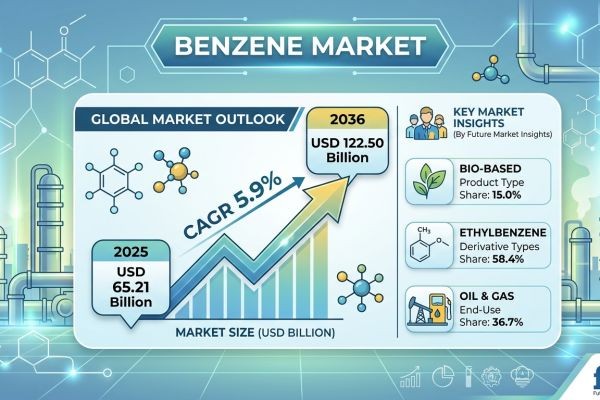
The global benzene market is projected to witness strong expansion over the next decade, supported by integrated refinery advancements, rising derivative chain access, and expanding chemical manufacturing across key regions. The market is expected to grow steadily, reaching approximately USD 122.50 billion by 2036, registering a CAGR of 5.90%, according to the latest analysis by Future Market Insights (FMI).
Market growth is being shaped by increasing demand for high-volume petrochemical feedstocks, growing consumer reliance on derivative chemical components, and rapid adoption of sustainable production alternatives. Benzene has evolved into an essential industrial building block used widely across the oil & gas, chemical, automotive, and paints & coatings sectors. While petroleum-based production continues to dominate pipelines, manufacturers are increasingly integrating advanced processes and bio-based alternatives to comply with modern environmental expectations and improve carbon footprint outcomes.
Global Benzene Market Snapshot (2026–2036)
Market size outlook toward 2036: USD 122.50 billion
Forecast CAGR: 5.90% (2026-2036)
Dominant end-use category: Oil & Gas (36.7% share)
Fastest-growing product segment: Bio-Based Benzene (~15.0% share by 2026)
Key growth countries: China, Japan, India
Primary demand channel: Chemical and derivative applications
Momentum in the Market
Beginning from steady industrial adoption levels, the global benzene market demonstrates accelerated growth throughout the forecast period as chemical processing capacity expands across multiple countries. Between 2026 and 2036, expanding commercial applications and rising automotive and industrial production are expected to significantly boost demand for integrated chemical systems. Increasing urbanization and higher industrial output are encouraging governments and manufacturers to prioritize advanced manufacturing feedstocks.
From 2036 onward, innovation in bio-based extraction technologies and integration with modern downstream operations is expected to further strengthen market expansion. Sustainable and bio-based benzene platforms capable of reducing carbon intensity while keeping downstream compatibility intact are emerging as key differentiators for major suppliers.
The Reasons Behind the Market’s Growth
Demand for benzene is rising due to multiple structural and technological factors reshaping the global chemical ecosystem.
Essential Role as Chemical Feedstock
Benzene acts as a critical feedstock required to produce key chemical compounds such as phenol and acetone, which are subsequently used in manufacturing plastics, resins, and adhesives.
Growing Downstream Derivative Demand
Rapid expansion of manufacturing hubs requiring major downstream derivatives like ethylbenzene and cumene is driving large-scale industrial adoption.
Rising Automotive and Industrial Capacity
The expansion of automotive assembly and heavy manufacturing sectors is accelerating the integration of benzene-derived plastics, coatings, and specialized synthetics.
Bio-Based Feedstock Shift
The rise of sustainable chemistry is creating demand for bio-based production pathways tailored to reduce environmental impacts while ensuring optimal material performance.
Top Segment Application Type
Oil & Gas Leads End-Use Market Demand
The oil & gas industry accounts for the majority of benzene consumption and integration across key markets, supported by vertical integration between refineries and petrochemical plants, capturing a dominant 36.7% end-use share.
Derivative Types and Segment Analysis
Ethylbenzene: Dominates the derivative types segment with a substantial 58.4% market share.
Bio-Based Benzene: Leads product type innovation, capturing a 15.0% share in 2026 as the industry shifts toward sustainable options.
Petroleum-Based Benzene: Remains a heavy baseline volume category supported by catalytic reforming and steam cracking processes.
Regional Development: Manufacturing Ecosystem Drives Expansion
The global benzene ecosystem is rapidly evolving into an efficient regional network supported by cost-effective production hubs and expanding merchant trade logistics.
China: Advances at a 4.9% growth rate, reflecting its dominant position as the largest single-country consumer with continuous downstream capacity construction.
Japan: Records 5.3% growth fueled by sustained domestic cumene and cyclohexane derivative consumption.
India: Posts an impressive 5.2% growth rate driven by expanding petrochemical refining capacity and industrialization.
Localized manufacturing partnerships between integrated refiners and chemical processors are improving supply chain resilience while accelerating modern technological adoption.
Challenges, Trends, Opportunities, and Drivers
Drivers
High demand for phenol, acetone, and ethylbenzene derivatives
Expanding global refining and petrochemical capacities
Rising automotive, construction, and electronic manufacturing
Increased volume demands for industrial coatings and plastics
Opportunities
Bio-based alternatives and sustainable processing technologies
Advancements in toluene disproportionation and steam cracking efficiency
Expanding applications within premium pharmaceutical synthesis
Development of zero-emission chemical processing plants
Trends
Transition toward sustainable bio-based product variants
Integration of refinery-to-chemical automation networks
Increased adoption of closed-loop chemical processing configurations
Evolving regional trade dynamics and merchant logistics optimization
Challenges
Volatile crude oil and petrochemical raw material pricing
Complex processing and environmental safety integration regulations
Compliance with evolving global carbon emissions standards
Country Growth Outlook
The market’s growth trajectory is closely tied to industrialization and refining infrastructure implementation across major global economies:
China: Processing expansion and heavy volume consumption leadership
Japan: Stable derivative production across specialized chemical applications
India: Rapid domestic manufacturing expansion and new refinery pipelines
The Competitive Environment
The global benzene market is moderately consolidated, with major chemical conglomerates competing through innovation, localized production advantages, and strict regulatory compliance. Leading operators focus on optimizing integrated refinery setups, expanding distribution logistics, and establishing long-term supply arrangements with derivative chemical producers. Companies are investing heavily in processing efficiency, lightweight and high-yield chemical extractions, and eco-friendly manufacturing platforms to build resilient pipelines and secure sustainable market footprints.
Future Outlook: Toward Sustainable and Efficient Chemistry
The global benzene market is entering a transformative decade shaped by sustainable alternatives, process automation, and stricter environmental expectations. Future production systems are expected to function as highly efficient modules working alongside bio-based extractions to yield optimal downstream derivatives. As industrial chemical markets mature and sustainability frameworks strengthen, benzene will remain central to achieving functional and robust material ecosystems throughout the global manufacturing landscape.
To access the complete strategic overview and comprehensive data insights on the industry, explore the full report on the official Future Market Insights website: https://www.futuremarketinsights.com/reports/benzene-market






