
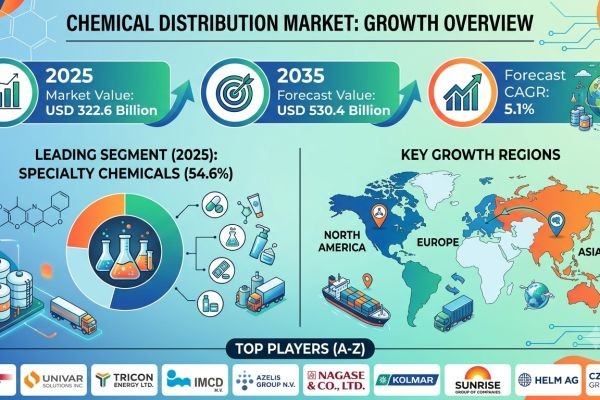
The global chemical distribution market is projected to witness strong expansion over the next decade, supported by strict global regulations and rising manufacturing production across major economies. The market is expected to grow steadily, reaching approximately USD 530.4 billion by 2035, registering a CAGR of 5.1%, according to the latest analysis by Future Market Insights (FMI).
Market growth is being shaped by increasing government mandates for chemical safety, growing complexity of downstream applications, and rapid adoption of specialized intermediaries for technical support. Chemical distributors have evolved from mere logistics providers into essential strategic partners across various manufacturing sectors. While traditional commodity chemicals continue to command significant volumes, distributors are increasingly focusing on specialty chemicals to comply with modern industrial expectations and improve localized value-added services.
Global Chemical Distribution Market Snapshot (2025–2035)
- Market size outlook toward 2035: USD 530.4 billion
- Forecast CAGR: 5.1%
- Dominant product category: Specialty Chemicals (54.6% market share)
- Fastest-growing end-use segment: Medical & Pharmaceutical (28.3% market share)
- Key growth countries: China, India, Germany, France, United Kingdom, USA, Brazil
- Primary demand channel: Localized and global distribution networks
Momentum in the Market
Beginning from steady regional adoption levels, the chemical distribution market demonstrates accelerated growth throughout the forecast period as safety compliance becomes mandatory across multiple countries. Between 2025 and 2030, expanding consumption of chemicals across construction, automotive, agriculture, and consumer goods is expected to significantly boost demand, pushing the market value to surpass USD 410 billion.
From 2030 to 2035, innovation in supply chain digitalization and integration with advanced automated logistics is expected to further strengthen market expansion. The incremental growth of USD 207.8 billion highlights a consistent, long-term demand curve across both bulk and specialty chemical sectors, especially as emerging economies build out their industrial infrastructure.
The Reasons Behind the Market’s Growth
Demand for chemical distribution is rising due to multiple structural and technological factors reshaping the global industrial ecosystem.
Regulatory Compliance and Safety Standards
Governments across various nations are enforcing strict global safety standards and hazardous material handling regulations. Distributors play a crucial role in ensuring full legal and environmental compliance during transit.
Growing Vehicle and Manufacturing Production
Rapid expansion of manufacturing hubs relies on a steady, reliable chemical supply chain. The growing reliance on outsourced logistics allows primary producers to focus on core operations.
Rising Demand from Key Industries
Downstream sectors like pharmaceuticals, agriculture, construction, and automotive manufacturing are accelerating their consumption of specialized formulations, increasing the need for efficient distribution networks.
Digital and Automation Expansion
The rise of digital commerce platforms and advanced tracking technologies is creating demand for transparent distribution channels, optimizing route efficiency and storage safety.
Top Segment Application Type
Specialty Chemicals Lead Market Demand
Specialty chemicals account for the majority of market value, commanding a dominant 54.6% share, supported by increasing downstream complexity and the requirement for specialized technical support.
End-Use Analysis
- Medical & Pharmaceutical: Accounts for a leading 28.3% share, driven by strict quality controls and health sector expansion.
- Construction: Expanding steadily with rising infrastructure developments globally.
- Automotive & Transportation: Supported by evolving manufacturing requirements and advanced materials.
- Agriculture: Driven by a continuous need for localized fertilizer and crop protection chemical supply loops.
Regional Development: Global Industrial Hubs Drive Expansion
The global market is rapidly evolving with regional manufacturing networks and localized partnerships improving cost efficiency while accelerating innovation.
- China: Holds a strong growth profile with a 6.9% CAGR, leading regional production and chemical logistics infrastructure.
- India: Expanding rapidly at a 6.4% CAGR, backed by government initiatives and infrastructure upgrades.
- Germany & France: Growing at 5.9% and 5.4% CAGRs respectively, driven by strict ecodesign requirements and safety frameworks.
- USA & UK: Demonstrating steady expansion at 4.3% and 4.8% CAGRs, backed by advanced pharmaceutical and aerospace supply sectors.
Challenges, Trends, Opportunities, and Drivers
Drivers
- Mandatory safety regulations and strict handling compliance
- Expanding demand from key industrial sectors like pharmaceuticals
- Increasing consumption of specialty chemicals globally
- Expansion of outsourced logistics models by chemical manufacturers
Opportunities
- Automation and digital tools to improve distribution efficiency
- Sustainability mandates pushing the adoption of eco-friendly chemicals
- Tailored localized distribution networks in emerging economies
- Value-added blending and technical laboratory assistance
Trends
- Transition toward fully digitalized supply chain tracking systems
- Increased consolidation among regional and global distributors
- Growth in smart storage facilities for hazardous materials
- Emphasis on secure packaging and carbon-reduced transport options
Challenges
- High capital costs for setting up compliant facilities
- Complex integration requirements across different regional legal landscapes
- Compliance with fast-changing environmental and chemical registration rules
The Competitive Environment
The global chemical distribution market is moderately consolidated, with international logistics companies and specialized technical distributors competing through innovation, localized infrastructure, and regulatory expertise. Leading market participants are investing heavily in automated logistics, sustainable chemical handling facilities, and value-added services. By forming strong partnerships with primary chemical producers and regional end-users, these players successfully optimize supply chains and minimize lead times.
Future Outlook: Toward Intelligent and Sustainable Supply Chains
The chemical distribution market is entering a transformative decade shaped by automation, digitalization, and stricter environmental expectations. Future distribution systems are expected to function as highly integrated service networks working alongside smart tracking databases to predict delivery timelines and handle inventory safely. As international chemical regulations tighten and sustainability goals solidify, distributors will remain a vital element in achieving a safer, smarter, and highly efficient manufacturing ecosystem globally.
For a comprehensive strategic outlook and detailed analysis of developments shaping the industry, readers can explore the full report on the official Future Market Insights website: https://www.futuremarketinsights.com/reports/chemical-distribution-market






