
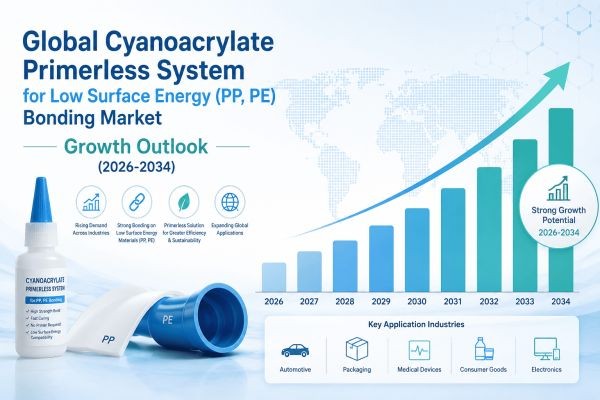
Cyanoacrylate primerless systems for low surface energy bonding are specially engineered instant adhesive formulations designed to bond inherently difficult-to-adhere substrates such as polypropylene (PP) and polyethylene (PE) without the need for surface pre-treatment or primer application. Traditionally, bonding polyolefin materials required activation steps such as flame treatment, plasma treatment, or chemical priming due to their non-polar molecular structure and low surface energy, typically ranging between 29–36 mN/m. These advanced cyanoacrylate formulations overcome this challenge through the incorporation of proprietary surface-active agents and modified monomer chemistries that promote molecular adhesion directly on untreated polyolefin surfaces. The result is a bonding solution that is not only technically effective but also operationally streamlined — eliminating pre-treatment steps that add cost, time, and chemical handling complexity to manufacturing workflows.
The market is gaining strong momentum driven by the growing adoption of lightweight thermoplastics in automotive, consumer electronics, and medical device manufacturing, where PP and PE components are increasingly prevalent. Furthermore, manufacturers across industries are under pressure to streamline assembly processes and reduce cycle times, making primerless bonding solutions an operationally and economically attractive alternative. Key players operating in this space include Henkel AG & Co. KGaA, 3M Company, Permabond LLC, Bostik SA, and H.B. Fuller Company, all of which have expanded their specialty cyanoacrylate portfolios to address polyolefin bonding requirements.
Get Full Report Here: https://www.24chemicalresearch.com/reports/309013/-market
Market Dynamics:
The market’s trajectory is shaped by a complex interplay of powerful growth drivers, significant restraints that are being actively addressed, and vast, untapped opportunities. Understanding this interplay is essential for any stakeholder seeking to navigate this specialized adhesive segment effectively.
Powerful Market Drivers Propelling Expansion
-
Automotive Lightweighting and the Polyolefin Substitution Wave: The automotive industry’s relentless push toward vehicle lightweighting has become one of the most significant forces propelling the cyanoacrylate primerless system market. Polypropylene and polyethylene are among the most widely used thermoplastics in modern vehicle interiors and exteriors — from bumpers and door panels to under-hood components — precisely because of their low density and chemical resistance. However, their inherently low surface energy has historically made reliable adhesive bonding exceptionally difficult without surface pre-treatment. The emergence of primerless cyanoacrylate formulations that can chemically overcome this barrier without plasma treatment, flame treatment, or adhesion promoters is fundamentally reshaping assembly workflows across OEM and Tier 1 supplier operations. As vehicle manufacturers continue replacing metal components with polyolefin-based alternatives to meet fuel efficiency and emissions targets, the need for high-performance primerless bonding solutions intensifies considerably.
-
Expansion of Consumer Electronics and Medical Device Manufacturing: Beyond automotive, consumer electronics manufacturers are increasingly incorporating PP and PE-based housings, cable management components, and structural elements into compact device architectures where space constraints make mechanical fastening impractical. Primerless cyanoacrylate systems offer near-instantaneous fixture times — often under 30 seconds — which aligns perfectly with the high-throughput, automated assembly lines typical of electronics manufacturing. In the medical device sector, the need for biocompatible, fast-curing adhesive solutions that can reliably bond low surface energy plastics without introducing potentially reactive primer chemicals is driving qualification of these advanced formulations. Regulatory compliance with ISO 10993 biocompatibility standards has become a key specification criterion, and several primerless cyanoacrylate products have achieved certification relevant to device housings and non-implantable components. The global polypropylene market exceeded 75 million metric tons in annual consumption, with adhesive bonding of PP components representing a growing share of downstream assembly operations across automotive, packaging, and consumer goods sectors — directly underpinning demand for primerless cyanoacrylate solutions.
-
Tightening Environmental and Safety Regulations Accelerating Primer-Free Adoption: The broader trend toward eliminating solvent-based primers and surface activation chemicals from production environments is accelerating adoption of primerless systems across geographies. Environmental, health, and safety regulations in North America, Europe, and increasingly across Asia-Pacific are tightening permissible exposure limits for volatile organic compounds associated with traditional adhesion promoters. Primerless cyanoacrylate systems directly address this compliance burden by consolidating the bonding process into a single-component, low-VOC step — reducing both cycle time and regulatory overhead simultaneously. This is not a marginal benefit; for large-scale manufacturers running multiple shifts across multiple facilities, the cumulative compliance savings can be substantial.
Download FREE Sample Report: https://www.24chemicalresearch.com/download-sample/309013/-market
Significant Market Restraints Challenging Adoption
Despite its promise, the market faces hurdles that must be overcome to achieve universal adoption.
-
Entrenched Surface Pre-Treatment Infrastructure in Established Facilities: A substantial restraint on market penetration is the widespread existing investment in surface pre-treatment infrastructure — flame treatment systems, corona discharge units, plasma equipment, and primer application stations — already installed in automotive, appliance, and packaging manufacturing facilities. These capital assets represent sunk costs that operations and procurement teams are often reluctant to write off, even when a primerless adhesive system could demonstrably reduce total process cost over time. The transition to primerless bonding requires not only qualification of the new adhesive but also re-validation of assembly processes, revision of quality control protocols, and retraining of production personnel. All of these represent real organizational inertia that slows adoption rates, particularly in industries where process change carries significant qualification risk.
-
Limited Awareness and Technical Knowledge Among Smaller Manufacturers: While large OEMs and Tier 1 suppliers typically have dedicated materials engineering teams capable of evaluating and qualifying advanced adhesive technologies, the small and medium-sized enterprise segment — which represents a large share of total PP and PE component assembly operations globally — often lacks the internal expertise to confidently assess primerless cyanoacrylate systems. This knowledge gap manifests as risk aversion: procurement decisions default to familiar, proven adhesive and surface treatment combinations rather than exploring newer formulations. Adhesive manufacturers targeting this segment face a substantial technical sales and education burden that extends qualification cycles and limits the pace of market expansion. However, companies that invest in application engineering support and field demonstration programs are finding that this barrier, while real, is progressively surmountable.
Critical Market Challenges Requiring Innovation
Achieving consistent bond strength across the full spectrum of PP and PE grades remains a genuine technical challenge. High-crystallinity homopolymer grades, heavily filled compounds, and certain impact-modified copolymers present surface characteristics that even advanced primerless formulations struggle to penetrate reliably. Bond strength on untreated PP in lap shear configurations with standard cyanoacrylates can vary meaningfully across resin lots and processing conditions, creating hesitation among design engineers who require predictable, validated adhesive performance in production environments. This performance variability is not a fundamental barrier — it is a formulation challenge — but it does require ongoing R&D investment and rigorous application-specific qualification protocols.
Furthermore, cyanoacrylate adhesives as a class exhibit sensitivity to elevated temperatures and high-humidity environments, and primerless systems for polyolefin bonding are not exempt from these limitations. Long-term bond integrity under thermal cycling — particularly relevant in automotive underhood and exterior applications — remains a concern that limits displacement of two-component epoxies and structural acrylics in the most demanding end-use segments. Additionally, the core monomers used in cyanoacrylate formulations are subject to price volatility linked to upstream petrochemical feedstock markets, and the additional functional additives required for primerless performance introduce further cost complexity. This can make primerless cyanoacrylate systems considerably more expensive on a per-unit-volume basis than commodity adhesives, creating adoption friction among cost-sensitive manufacturers who may not immediately recognize the process simplification value proposition.
Vast Market Opportunities on the Horizon
-
Electric Vehicle Platform Development Creating New Bonding Application Windows: The rapid global expansion of electric vehicle production is creating a distinctly favorable opportunity landscape for primerless cyanoacrylate systems. EV battery enclosures, thermal management components, and interior trim systems make extensive use of PP and PE-based materials precisely because of their electrical insulation properties, chemical resistance to battery electrolytes, and weight advantages. Unlike legacy internal combustion engine platforms where adhesive specifications are long-frozen, new EV architectures are still in active development — meaning adhesive technologies can be designed into assemblies from the ground up rather than retrofitted. This greenfield specification opportunity allows primerless cyanoacrylate suppliers to engage OEM and Tier 1 engineering teams early in platform development cycles, significantly improving the probability of securing long-term supply positions in a rapidly growing end-use segment. Global EV sales surpassed 14 million units in 2023, and the trajectory points clearly toward continued expansion through the forecast period.
-
Formulation Innovation Targeting Toughened and Flexible Primerless Systems: Ongoing research and development investment in cyanoacrylate polymer chemistry is yielding a new generation of toughened primerless formulations that address the brittleness historically associated with the adhesive class. By incorporating rubber-toughening agents, flexible oligomers, and hybrid cyanoacrylate-acrylate chemistries, formulators are progressively improving peel strength and impact resistance on polyolefin substrates. These advances are opening application segments that were previously inaccessible to cyanoacrylate adhesives, including soft-touch automotive interior components, flexible electronic device assemblies, and sporting goods manufactured from PP-based composites. Companies that successfully commercialize toughened primerless systems with validated performance on a broad range of PP and PE grades stand to capture meaningful share in what remains a largely underpenetrated addressable market.
-
Strategic Co-Development Partnerships Bridging Commercialization Gaps: The market is witnessing a growing appetite for collaborative development between adhesive manufacturers and end-user industries. Rather than relying on off-the-shelf formulations, forward-thinking OEMs are engaging adhesive suppliers in joint application development programs that produce primerless cyanoacrylate systems tailored to specific substrate grades, processing conditions, and performance requirements. These alliances effectively reduce time-to-qualification, pool technical resources, and create supply relationships with strong mutual commitment — a competitive dynamic that benefits both parties and accelerates the overall pace of market development. The combination of tailored chemistry and validated application data is proving to be far more persuasive to procurement and engineering teams than generic product data sheets.
In-Depth Segment Analysis: Where is the Growth Concentrated?
By Type:
The market is segmented into Ethyl Cyanoacrylate-Based Primerless Systems, Methyl Cyanoacrylate-Based Primerless Systems, Alkoxy Cyanoacrylate-Based Primerless Systems, and Modified/Hybrid Cyanoacrylate Primerless Systems. Modified/Hybrid Cyanoacrylate Primerless Systems represent the most technologically advanced and rapidly growing sub-segment, engineered with surface-active additives and adhesion promoters chemically integrated into the adhesive matrix itself. This eliminates the traditional need for a separate primer application step on polyolefin substrates. Ethyl cyanoacrylate-based primerless systems also maintain strong demand owing to their broad compatibility with diverse industrial processing environments and well-established performance track record across general-purpose bonding applications.
By Application:
Application segments include Automotive Interior & Exterior Assembly, Consumer Electronics & Appliances, Medical Device Assembly, Packaging & Labeling, and others. Automotive Interior & Exterior Assembly stands as the leading application segment, driven by the widespread use of polypropylene and polyethylene components throughout modern vehicle manufacturing. From dashboard panels and door trims to bumper fascias and under-hood plastic components, the automotive sector demands adhesive solutions that reliably bond low surface energy substrates without primer pre-treatment steps that interrupt production line efficiency. The medical device assembly segment is also gaining meaningful traction as regulatory compliance and cleanliness standards make single-component, primer-free adhesive systems particularly attractive for bonding plastic housings, tubing, and diagnostic equipment components.
By End-User Industry:
The end-user landscape includes Automotive OEMs & Tier Suppliers, Electronics Manufacturers, Medical Device Manufacturers, and Industrial Assembly & MRO. Automotive OEMs & Tier Suppliers represent the dominant end-user category, operating under relentless pressure to improve production throughput, reduce assembly cycle times, and minimize solvent or surface preparation chemical usage. Industrial assembly and MRO end users are increasingly adopting primerless formulations as maintenance and repair operations seek versatile adhesive solutions capable of bonding polyolefin plastics without specialized pre-treatment infrastructure.
Download FREE Sample Report: https://www.24chemicalresearch.com/download-sample/309013/-market
Competitive Landscape:
The global Cyanoacrylate – Primerless System for Low Surface Energy (PP, PE) Bonding market is characterized by a concentrated group of specialty adhesive manufacturers with deep R&D capabilities in surface chemistry, competing alongside regional players with growing investment in low surface energy compatible grades. Henkel AG & Co. KGaA dominates the competitive landscape through its Loctite brand, which offers dedicated primerless cyanoacrylate formulations engineered specifically for LSE plastics, leveraging decades of polymer bonding expertise and a global manufacturing and distribution footprint. Bostik SA (a subsidiary of Arkema Group) holds a significant position, producing industrial-grade cyanoacrylate systems with primerless capability across automotive, electronics, and consumer goods assembly sectors. H.B. Fuller Company continues to invest in next-generation cyanoacrylate systems for difficult-to-bond substrates, while Permabond LLC has developed a validated portfolio of primerless cyanoacrylates targeting PP and PE bonding that makes it a technically credible mid-market competitor. The competitive strategy across leading players is overwhelmingly focused on R&D to enhance bond performance on untreated polyolefin surfaces, alongside forming strategic partnerships with end-user companies to co-develop and validate application-specific solutions, thereby securing future demand.
List of Key Cyanoacrylate – Primerless System for Low Surface Energy (PP, PE) Bonding Companies Profiled:
-
Henkel AG & Co. KGaA (Germany)
-
Bostik SA (Arkema Group) (France)
-
H.B. Fuller Company (United States)
-
Permabond LLC (United States / United Kingdom)
-
Toagosei Co., Ltd. (Japan)
-
Taoka Chemical Co., Ltd. (Japan)
-
Cyberbond LLC (United States)
-
Illinois Tool Works Inc. – Devcon / Permatex (United States)
-
Pidilite Industries Ltd. (India)
-
Kafuter / Guangzhou Baiyun Chemical Industry Co., Ltd. (China)
-
Hernon Manufacturing Inc. (United States)
Regional Analysis: A Global Footprint with Distinct Leaders
-
Asia-Pacific: Stands as the leading region in the cyanoacrylate primerless system market, driven by its expansive manufacturing base across automotive, electronics, and consumer goods sectors. Countries such as China, Japan, South Korea, and India are at the forefront of adopting advanced adhesive technologies that eliminate the need for surface primers when bonding polypropylene and polyethylene substrates. The region’s dense concentration of automotive component manufacturers and electronics assembly plants generates substantial and sustained demand for reliable, fast-curing bonding solutions. Stringent production efficiency requirements and growing environmental regulations across key Asia-Pacific economies are pushing manufacturers to seek solvent-free and primer-free adhesive solutions, further solidifying the region’s dominant position in this specialized adhesive market.
-
North America: Represents a mature and technologically advanced market for primerless cyanoacrylate systems. The United States leads regional demand, supported by well-established automotive, medical device, and industrial manufacturing industries that routinely work with polypropylene and polyethylene components. North American manufacturers place significant emphasis on process efficiency and regulatory compliance, making primerless adhesive solutions particularly appealing as they reduce processing steps and minimize hazardous material handling. The medical device sector in particular favors primerless cyanoacrylate formulations due to strict cleanliness and biocompatibility requirements where primer residues could present contamination risks.
-
Europe: The market here is shaped by the region’s strong industrial heritage and progressively stringent environmental regulations. Germany, France, and the United Kingdom are key markets, driven by their significant automotive, industrial assembly, and packaging sectors. European regulatory frameworks governing VOC emissions and chemical safety are compelling manufacturers to adopt primer-free adhesive technologies. The automotive industry’s ongoing lightweighting initiatives across European OEMs have expanded the use of polypropylene and polyethylene structural components, creating consistent demand for advanced bonding solutions. Europe’s well-developed circular economy agenda is also encouraging adhesive suppliers to promote primerless formulations that support cleaner production processes.
-
South America and Middle East & Africa: These regions represent emerging frontiers for the primerless cyanoacrylate market. While currently smaller in scale, Brazil’s automotive assembly and consumer goods manufacturing sectors are gradually adopting more advanced adhesive technologies. In the Middle East and Africa, industrial diversification efforts across Gulf Cooperation Council economies and South Africa’s automotive assembly industry offer the most immediate opportunities. Both regions present significant long-term growth prospects tied to the pace of industrialization, foreign investment in manufacturing, and the gradual introduction of environmental regulations that incentivize the transition away from traditional primed bonding systems.
Get Full Report Here: https://www.24chemicalresearch.com/reports/309013/-market
Download FREE Sample Report: https://www.24chemicalresearch.com/download-sample/309013/-market
About 24chemicalresearch
Founded in 2015, 24chemicalresearch has rapidly established itself as a leader in chemical market intelligence, serving clients including over 30 Fortune 500 companies. We provide data-driven insights through rigorous research methodologies, addressing key industry factors such as government policy, emerging technologies, and competitive landscapes.
-
Plant-level capacity tracking
-
Real-time price monitoring
-
Techno-economic feasibility studies
International: +1(332) 2424 294 | Asia: +91 9169162030
Website: https://www.24chemicalresearch.com/






