
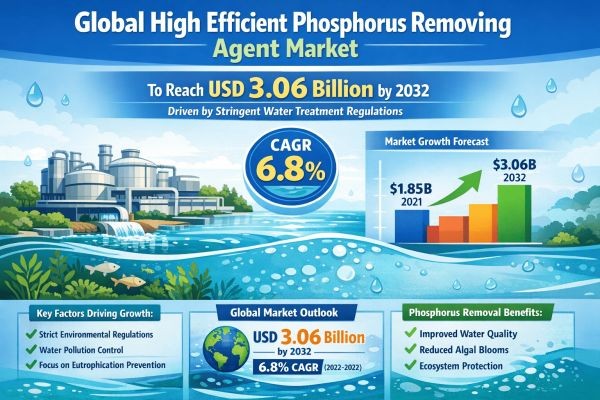
High Efficient Phosphorus Removing Agents represent a critical class of water treatment chemicals engineered to combat eutrophication in aquatic ecosystems by effectively reducing phosphorus concentrations in wastewater. These advanced formulations, primarily based on metal salts like aluminum and iron compounds, have transitioned from basic chemical applications to sophisticated environmental solutions. Their unique chemical properties—including high phosphorus binding capacity, rapid reaction kinetics, and compatibility with various wastewater matrices—make them indispensable for modern wastewater treatment infrastructure. Unlike traditional treatment methods, these agents offer precise control over phosphorus removal, facilitating compliance with increasingly stringent environmental regulations worldwide.
Get Full Report Here: https://www.24chemicalresearch.com/reports/261850/global-high-efficient-phosphorus-removing-agent-forecast-market-2024-2030-952
Market Dynamics:
The market's trajectory is shaped by a complex interplay of powerful growth drivers, significant restraints that are being actively addressed, and vast, untapped opportunities.
Powerful Market Drivers Propelling Expansion
- Stringent Environmental Regulations Driving Adoption: The global push for cleaner water resources has led to increasingly strict phosphorus discharge limits. Regulations such as the EU Water Framework Directive and US EPA effluent guidelines mandate total phosphorus levels below 0.1 mg/L in many jurisdictions. This regulatory pressure has created a compliance-driven market where municipal treatment plants face penalties exceeding $10,000 per violation, making high-efficiency phosphorus removal not just environmentally necessary but economically imperative for operators.
- Rapid Industrialization and Urbanization: The unprecedented growth in urban populations and industrial activities has intensified wastewater generation globally. With over 55% of the world's population now residing in urban areas, municipal wastewater treatment plants are operating at 120-140% of designed capacity in many developing regions. This capacity strain necessitates more efficient treatment chemicals that can handle higher pollutant loads while maintaining compliance, creating sustained demand for advanced phosphorus removal solutions.
- Agricultural Runoff Management Initiatives: Non-point source pollution from agricultural operations contributes approximately 40-50% of phosphorus loading in water bodies. Government-led initiatives and agricultural sustainability programs are driving adoption of phosphorus removal technologies in agricultural runoff treatment systems. These programs, often supported by subsidies covering 30-50% of implementation costs, represent a growing market segment as the agricultural sector faces increasing pressure to minimize environmental impact.
Download FREE Sample Report: https://www.24chemicalresearch.com/download-sample/261850/global-high-efficient-phosphorus-removing-agent-forecast-market-2024-2030-952
Significant Market Restraints Challenging Adoption
Despite their critical environmental role, the market faces hurdles that must be overcome to achieve universal adoption.
- High Operational Costs and Sludge Management Challenges: The sophisticated chemical formulations required for efficient phosphorus removal increase treatment costs by 25-40% compared to conventional methods. Furthermore, these agents generate 20-30% more chemical sludge, which requires specialized handling and disposal. With sludge management already consuming 30-50% of treatment plant operational budgets, this additional burden creates significant economic pressure, particularly for municipalities with limited funding.
- Technical Complexity and Operational Expertise Requirements: Optimal performance of high-efficiency phosphorus removal agents requires precise dosing control and pH management. Many treatment facilities lack the advanced instrumentation and trained personnel needed to maintain the narrow operational parameters (typically pH 5.5-7.0) for maximum efficiency. This technical barrier results in suboptimal performance in approximately 35% of installations, undermining confidence in the technology and slowing broader adoption.
Critical Market Challenges Requiring Innovation
The transition from laboratory formulations to real-world applications presents its own set of challenges. Maintaining treatment consistency with varying wastewater compositions is particularly difficult, with seasonal changes in industrial discharge affecting agent performance in 40-45% of cases. Furthermore, the presence of interfering substances like organic matter and certain anions can reduce removal efficiency by 15-25%, necessitating supplemental treatment steps.
Additionally, the market contends with supply chain vulnerabilities for raw materials. Fluctuations in aluminum and iron ore prices (typically 20-35% annual volatility) and the logistical challenges of transporting liquid chemical formulations add 8-12% to overall costs. These economic uncertainties make long-term budgeting difficult for wastewater treatment operators, particularly in developing regions where funding is already constrained.
Vast Market Opportunities on the Horizon
- Emerging Circular Economy Applications: Recent developments in phosphorus recovery technologies present revolutionary opportunities. Advanced removal agents now enable recovery of 80-90% of removed phosphorus as high-value fertilizer products like struvite. With the global phosphate fertilizer market valued at $65 billion, this nutrient recovery capability transforms wastewater treatment plants from cost centers into resource recovery facilities, potentially generating revenue streams that offset 30-40% of operational costs.
- Smart Water Treatment Integration: The integration of IoT sensors and AI-driven dosing systems represents the next frontier in phosphorus removal. Early adopters report 25-35% reductions in chemical usage through real-time monitoring and predictive dosing. The global smart water management market, projected to reach $45 billion by 2030, creates substantial opportunities for advanced phosphorus removal systems that can integrate with digital infrastructure for optimized performance.
- Industrial Wastewater Treatment Expansion: While municipal applications dominate currently, industrial wastewater represents the fastest-growing segment. Industries such as food processing, pharmaceuticals, and chemicals face increasingly strict discharge permits, with many requiring phosphorus levels below 0.05 mg/L. This stringent requirement drives adoption of specialized removal agents tailored to specific industrial effluents, creating premium market segments with higher margins and specialized application requirements.
In-Depth Segment Analysis: Where is the Growth Concentrated?
By Type:
The market is segmented into Aluminum Salt Type, Iron Salt Type, and others. Aluminum Salt-based agents currently lead the market, preferred for their high efficiency across a broad pH range and proven performance in municipal applications. Iron-based agents are gaining traction for their effectiveness in specific industrial applications and sometimes lower cost basis, though they face challenges with color development in treated water.
By Application:
Application segments include Municipal Sewage Treatment, Industrial Wastewater Treatment, and others. The Municipal Sewage Treatment segment currently dominates, driven by regulatory compliance requirements and large-scale infrastructure projects. However, the Industrial Wastewater Treatment segment is expected to exhibit the highest growth rates, particularly in regions with expanding manufacturing sectors and tightening industrial discharge regulations.
By End-User Industry:
The end-user landscape includes Municipal Water Treatment, Food and Beverage, Chemicals, Pharmaceuticals, and other industries. The Municipal Water Treatment sector accounts for the major share, leveraging these agents for compliance with environmental regulations. The Industrial sectors, particularly Food and Beverage, are rapidly emerging as key growth end-users as they face increasing scrutiny of their wastewater discharges.
Download FREE Sample Report: https://www.24chemicalresearch.com/download-sample/261850/global-high-efficient-phosphorus-removing-agent-forecast-market-2024-2030-952
Competitive Landscape:
The global High Efficient Phosphorus Removing Agent market is fragmented and characterized by robust competition and continuous product development. The leading companies—Pentair (U.S.), Kemira (Finland), and Ecolab (U.S.)—collectively command approximately 45% of the market share as of 2024. Their dominance is supported by extensive product portfolios, strong R&D capabilities, and established relationships with major municipal and industrial clients globally.
List of Key High Efficient Phosphorus Removing Agent Companies Profiled:
- Pentair (U.S.)
- WaterCo (Australia)
- Genesis Water Technologies (U.S.)
- Orenda Technologies (U.S.)
- EnviroChemie (Germany)
- Lenntech (Netherlands)
- Neo Water Treatment (India)
- Phoenix Products (U.S.)
- Fu Miao Technology (China)
- Sanfeng Environmental Group (China)
- WSHINE (China)
The competitive strategy focuses heavily on developing region-specific formulations that address local water chemistry challenges, alongside forming technical partnerships with engineering firms and treatment plant operators to demonstrate value and secure long-term supply agreements.
Regional Analysis: A Global Footprint with Distinct Leaders
- North America: Is the market leader, holding a 38% share of the global market. This dominance is driven by strict EPA regulations, advanced wastewater infrastructure, and high environmental awareness. The United States and Canada both show strong adoption rates, with particular growth in upgrading older treatment facilities to meet modern standards.
- Europe & Asia-Pacific: Together, they form a powerful growth bloc, accounting for 52% of the market. Europe's strength comes from the stringent EU Water Framework Directive implementation, while Asia-Pacific growth is fueled by rapid urbanization, industrial expansion, and new environmental regulations in China, India, and Southeast Asian countries.
- Latin America, Middle East, and Africa: These regions represent emerging opportunities in the phosphorus removal market. While currently smaller in market share, they present significant growth potential driven by increasing environmental awareness, infrastructure development projects, and gradually tightening regulatory frameworks for wastewater discharge.
Get Full Report Here: https://www.24chemicalresearch.com/reports/261850/global-high-efficient-phosphorus-removing-agent-forecast-market-2024-2030-952
Download FREE Sample Report: https://www.24chemicalresearch.com/download-sample/261850/global-high-efficient-phosphorus-removing-agent-forecast-market-2024-2030-952
About 24chemicalresearch
Founded in 2015, 24chemicalresearch has rapidly established itself as a leader in chemical market intelligence, serving clients including over 30 Fortune 500 companies. We provide data-driven insights through rigorous research methodologies, addressing key industry factors such as government policy, emerging technologies, and competitive landscapes.
- Plant-level capacity tracking
- Real-time price monitoring
- Techno-economic feasibility studies
International: +1(332) 2424 294 | Asia: +91 9169162030
Website: https://www.24chemicalresearch.com/






